
Born at the dawn of the late 1960s, the Peugeot 504 Cabriolet remains one of the most significant bridges between industrial pragmatism and automotive artistry. While the humble 504 sedan served as the backbone of French roads for decades, its open-top sibling, penned by the legendary design house Pininfarina, elevated the brand into the realms of high-fashion motoring. Even as the model remained in production into the early 1980s, its sophisticated design and mechanical refinement ensured it retained a devoted following. Today, we look back at a 1981 smoke-grey specimen—a model that perfectly encapsulates the "end-of-career" refinement that turned this classic into a collector’s icon.
The Intersection of Franche-Comté and Piedmont
The Peugeot 504 Cabriolet is a masterclass in cross-border synergy. To understand its DNA, one must look at the two distinct regions that birthed it: the French department of Franche-Comté and the Italian Piedmont.
Franche-Comté is a land of profound industrial heritage. It is a region where precision is a way of life, yielding everything from world-class horology and intricate machinery to artisanal gastronomy. For Peugeot, based in Sochaux, this environment fostered a culture of mechanical reliability and rigorous engineering.
Conversely, Piedmont—specifically the city of Turin—was the epicenter of the Italian automotive revolution. Home to Fiat and the world’s most prestigious design houses, Turin was a laboratory for the "applied arts." Here, metal was treated like sculpture, and the automobile was viewed as a canvas for aesthetic expression.

The collaboration between the Peugeot team, led by Paul Bouvot in La Garenne-Colombes, and the Italian maestros at Pininfarina in Grigliasco, was not merely a contract; it was a decades-long marriage of French reliability and Italian panache. This partnership, which began with the 403 and matured through the 404, reached its zenith with the 504.
Chronology: From Concept to Classic
The story of the 504 is a tale of evolution, marked by several critical milestones:
- September 1968: The Peugeot 504 sedan is unveiled to the world, setting a new benchmark for family comfort and road-holding.
- 1969: Recognizing the platform’s potential, Peugeot tasks Pininfarina with creating a bespoke coupe and cabriolet. Unlike previous generations, these were not merely "shortened" sedans but entirely new body designs.
- 1970s: The 504 Cabriolet establishes itself as a cult favorite, favored by the bourgeoisie and those who appreciated its subtle, understated elegance.
- 1981: The "end-of-career" models, such as our featured smoke-grey example, arrive. These units benefited from significant upgrades, including power steering and a five-speed manual transmission, transforming the car from a grand tourer into a more capable, modern-feeling machine.
- 1983: The curtain falls on the 504 Cabriolet, bringing an end to a production run that spanned 14 years.
Engineering and Aesthetic Distinctions
What makes the 504 Cabriolet so special? It is not just its beauty, but the extent to which Pininfarina deviated from the standard 504 platform.
A Geometry of Elegance
Sergio Pininfarina and his team did not simply lop the roof off the sedan. They shortened the wheelbase by 19 centimeters and reduced the total length to 4.36 meters (down from 4.49 meters). By dropping the height by 10 centimeters, they gave the car a lower, more athletic stance. The only shared visual DNA with the sedan was the sharp "median ridge" running along the side panels.

Lighting and Lineage
The front fascia was completely reimagined, featuring four distinct, rectangular-oval headlights that gave the car a "gaze" quite different from the family-oriented sedan. At the rear, the three-bar taillights suggested a sense of speed—a "claw" effect that would eventually become a signature for Peugeot.
Mechanical Refinements
By 1981, the car had matured significantly. The integration of a five-speed gearbox and power steering meant that the driving experience was no longer a workout. It was nimble, precise, and remarkably capable of keeping up with modern traffic. Furthermore, the engine hood was designed to hinge at the front, a departure from the sedan’s rear-hinged design, highlighting the bespoke nature of the cabriolet’s coachwork.
Supporting Data: Technical Specifications (1981 Model)
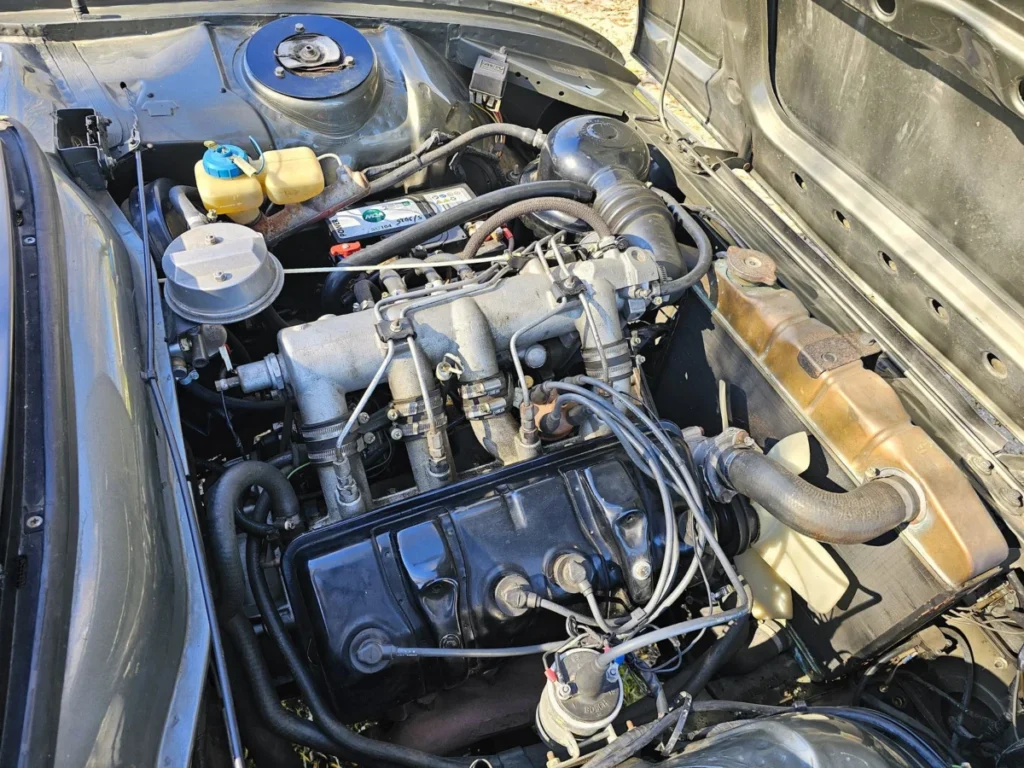
- Engine: 2.0L Inline-4 (Injection)
- Power Output: Approx. 106 hp
- Transmission: 5-speed manual
- Chassis: Modified 504 platform (shorter wheelbase)
- Steering: Power-assisted (standard on late-model variants)
- Body Style: 2-door, 4-seat convertible
- Designer: Pininfarina
Perspectives on the Design: A Hint of America?
Interestingly, historians and design critics often debate the influences behind the 504 Cabriolet’s profile. While it is quintessentially European, some observers note a subtle "American" influence in the way the rear wings are sculpted. Sergio Pininfarina, while creating a masterpiece of Italian glamour, was known to have admired the silhouette of the contemporary Chevrolet Camaro. The way the fenders flare and the hood flows toward the headlights carries a whisper of transatlantic sportiness, filtered through the refined lens of Italian design.
Implications for Collectors Today
The Peugeot 504 Cabriolet is no longer just a "used car"; it is an investment in automotive history. Its rarity, combined with the fact that it was the final true collaboration of the "Golden Age" of Peugeot-Pininfarina partnerships, keeps demand consistently high.

For the modern collector, the 1981-era models represent the "sweet spot." They possess the classic aesthetic of the late 60s but offer the mechanical ease of the early 80s. Finding a clean, well-maintained example—like the smoke-grey beauty showcased here—is akin to finding a piece of functional art.
Why it Matters
The 504 Cabriolet reminds us of a time when manufacturers were willing to take risks on niche, specialized body styles. It proves that a car does not need to be an extreme supercar to be desirable; sometimes, it just needs to be perfectly proportioned, mechanically sound, and blessed with the timeless touch of a master designer.
As we look at the evolution of the automotive industry today, the 504 stands as a testament to the fact that elegance never goes out of style. Whether you are driving through the winding roads of the Alps or the streets of a modern metropolis, the 504 Cabriolet continues to turn heads, proving that its designers achieved the ultimate goal: a car that is as beautiful to look at as it is rewarding to drive.
For those interested in the full technical analysis and archival photos of this stunning 1981 Peugeot 504, we encourage readers to consult the complete feature in Gazoline No. 346, available now via the official Gazoline online shop.
