

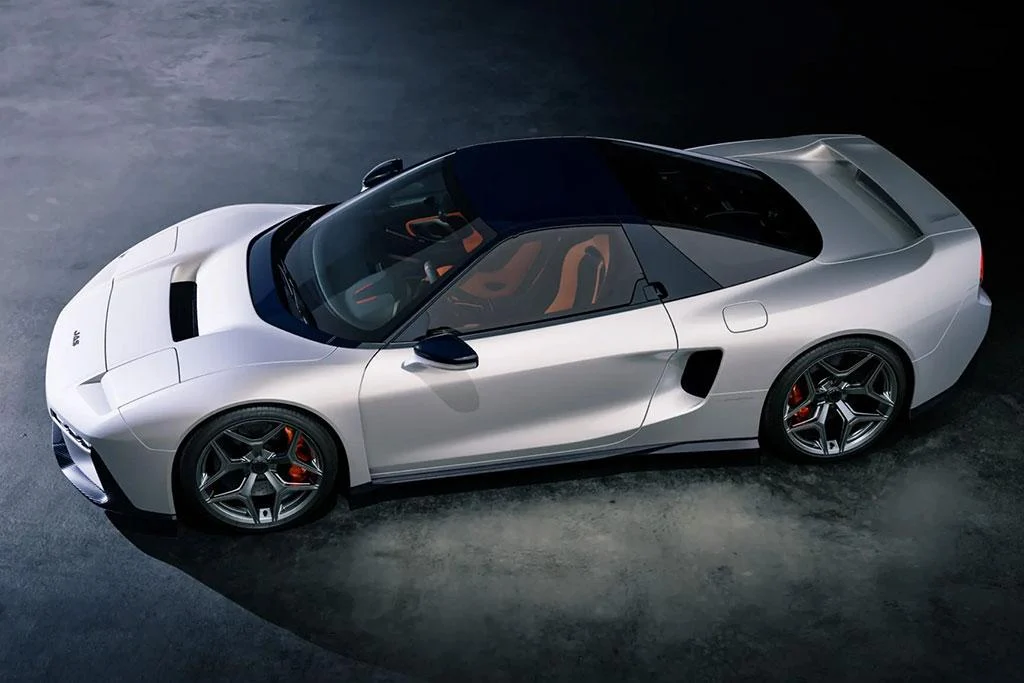
After teasing the automotive world with evocative sketches last year, JAS Motorsport finally pulled the veil off the "Tensei" at the 2026 Milano Design Week. The project, a collaborative masterstroke between the racing experts at JAS and the legendary design house Pininfarina, marks the unexpected and triumphant return of the first-generation Honda NSX. Yet, to label the Tensei as merely a "restomod" would be a disservice to the project’s complexity; it is a profound reimagining of a legend, bridging the gap between 1990s analog purity and 21st-century performance engineering.
Main Facts: The Anatomy of a Rebirth
The name "Tensei"—Japanese for "rebirth"—encapsulates the ethos of this venture. JAS Motorsport, historically known for its deep ties to Honda in touring car racing, has leveraged its technical prowess to breathe new life into the NA1/NA2 chassis.
At its core, the Tensei is a defiance of modern trends. While the automotive industry pivots toward hybridization, electrification, and forced induction, the Tensei stands as a bastion of the "old school." It features a naturally aspirated V6 engine mated to a crisp, 6-speed manual transmission. There is no complex hybrid assistance, no turbocharging, and no electronic intervention that might dilute the driver’s connection to the machine. By eschewing the complicated powertrain architecture of the second-generation NSX (NC1), JAS Motorsport has created a vehicle that prioritizes the visceral, tactile experience of driving above all else.
Chronology of the Project
The journey to the Tensei was not an overnight endeavor. It was a calculated, multi-year evolution of a vision that began in the garages of Arluno, Italy.
- 2024 (The Conceptual Phase): JAS Motorsport initiates a study on the viability of a high-performance restomod, focusing on the platform that changed the supercar landscape in 1990: the original Honda NSX.
- Early 2025 (The Pininfarina Partnership): Recognizing the need for a design language that could honor the original while pushing into the future, JAS engages Pininfarina. Initial sketches begin circulating, showcasing a widened, more aggressive stance.
- Late 2025 (Engineering Refinement): The team at JAS focuses on the chassis, moving from stock geometry to a heavily modified, carbon-fiber-intensive architecture. Testing of the naturally aspirated powertrain begins, focusing on throttle response and acoustic character.
- April 2026 (The Unveiling): During the Milano Design Week, the Tensei is officially presented to the public, marking the culmination of two years of intense development and artisanal craftsmanship.
Supporting Data: Engineering and Design Specs
The Tensei is not merely a cosmetic overhaul; it is a ground-up reconstruction. While the original NSX was a marvel of aluminum construction, the Tensei utilizes a full carbon-fiber body, significantly reducing weight while increasing structural rigidity.
Structural Adjustments
The design team has reworked the proportions to grant the car a modern "supercar" presence. The wheelbase has been stretched, the tracks widened, and the overall height lowered. The rear overhang has been shortened, lending the car a more compact, muscular aesthetic. Despite these radical changes, the iconic DNA of the original remains. The "pop-up" style lighting—reimagined with modern LED technology—and the distinct lateral air intakes are preserved, serving as a visual link to the 1990s.

Powertrain Philosophy
By focusing on a naturally aspirated V6, the Tensei engineers have prioritized the "soundtrack" and linear power delivery that defined the original NSX. This choice serves a specific audience: the purist driver. In an era where modern supercars often feel like "computers on wheels," the Tensei is designed to be a mechanical instrument. The gear shift action is tuned for maximum precision, providing the heavy, mechanical engagement that current dual-clutch systems have largely replaced.
Official Responses and Industry Reception
During the unveiling in Milan, the atmosphere was electric. "We didn’t want to build a replica," stated a lead spokesperson for JAS Motorsport. "We wanted to build the NSX that Honda might have developed had they continued the NA1 lineage into the 2020s, using modern materials and the best of Italian design flair."
Pininfarina, synonymous with elegance, noted that their goal was to ensure the Tensei looked as if it were carved by the wind. "The challenge was to modernize without erasing the soul," a lead designer commented. "We kept the soul of the original NSX—its balance, its visibility, its lightness—but we gave it the aggressive silhouette required for a modern performance icon."
Industry analysts have praised the project for its audacity. In a market saturated with EVs, a dedicated internal-combustion, manual-transmission vehicle is viewed as a "collector’s dream" that will likely appreciate in value the moment it leaves the factory floor.
Implications: A Statement Against the Status Quo
The Tensei project carries significant weight for the future of the automotive enthusiast market. It represents a "philosophical pivot" for high-end automotive restoration and modification.
The "Analog" Resurgence
As the world moves toward automated driving and silent, high-torque electric motors, the Tensei creates a counter-culture movement. It validates the idea that there is still a massive, wealthy, and passionate market for cars that require "work" to drive. It suggests that the future of the supercar might not be about who has the most horsepower, but who can offer the most intense emotional experience.

Exclusive Craftsmanship
The production model is as exclusive as it is ambitious. Each Tensei will be built at the JAS Motorsport facility in Arluno, using donor NSX chassis that are stripped down to the bare metal and rebuilt to modern standards. This level of bespoke manufacturing ensures that no two cars are identical. It positions the Tensei not as a car, but as an investment-grade artifact.
The Legacy of the NSX
The original NSX was developed with the input of Ayrton Senna, intended to humble the best of Europe, specifically Ferrari. By bringing Pininfarina—the house that designed so many iconic Ferraris—into the fold, the Tensei completes a strange, beautiful circle of history. It is a Japanese heart, an Italian suit, and a global obsession.
Final Thoughts: The Last of the Mohicans?
Is the Tensei the future of motoring? Perhaps not. But it is certainly a guardian of the past. By blending the raw, unadulterated performance of the 1990s with the sophisticated carbon-fiber technology of 2026, JAS Motorsport has created a machine that demands respect.
For the collector, the Tensei represents the pinnacle of the "restomod" movement. It is a car for those who miss the smell of gasoline, the vibration of the engine through the seat, and the satisfaction of a perfectly timed gear change. In an era of digital perfection, the Tensei is a reminder that the most exciting thing a car can do is feel "human." Whether it is a fleeting spark in the face of an electric future or the start of a new, boutique movement of high-performance analog cars, one thing is certain: the NSX is back, and it is more ferocious than ever.
