
Introduction: The Main Facts of the Alpine Pivot
The landscape of Formula 1 is undergoing a seismic shift, and at the center of this tectonic movement sits Alpine. After years of organizational instability, management "revolving doors," and underwhelming track performance, the French outfit—once the proud works team of Renault—is reinventing itself with a ruthlessness rarely seen in the paddock.
The most striking headline is Alpine’s resurgence in the 2026 season. Now powered by Mercedes-AMG High Performance Powertrains, the team has shed its "mid-field laggard" reputation to become the undisputed "best of the rest," nipping at the heels of the established "Big Four": Mercedes, Ferrari, McLaren, and Red Bull. In a staggering statistical turnaround, Alpine has secured more points in the opening four races of 2026 than it managed during the entirety of its final year as a Renault-powered entity in 2025.
However, the story extends far beyond the stopwatch. Alpine is currently the subject of intense financial speculation and a geopolitical power struggle within the sport. With the investment group Otro Capital looking to divest its 24% stake—valued at approximately €700 million—the team’s ownership structure is in flux. While high-profile figures like former Red Bull chief Christian Horner have been linked to the acquisition, Mercedes has emerged as the frontrunner. This potential "German-French" alliance has sent shockwaves through the FIA and rival boardrooms, raising concerns about "B-team" dynamics and the erosion of sporting equity.
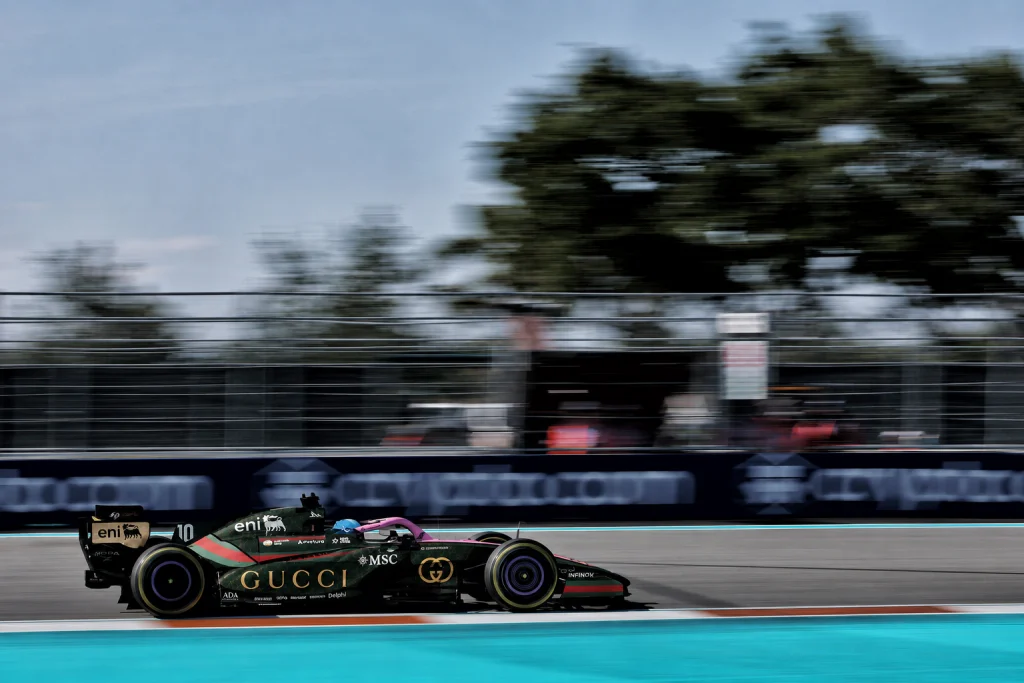
Furthermore, the brand is pivoting toward a luxury lifestyle identity. Rumors of a 2027 title sponsorship with the Italian fashion house Gucci suggest that Alpine’s future is as much about the "Golden Triangle" of Paris fashion as it is about the "Motorsport Valley" in England.
Chronology: From Turmoil to Transformation (2023–2027)
To understand Alpine’s current trajectory, one must examine the chaotic timeline that led to this radical restructuring.
2023–2024: The Era of Instability
The roots of the current shift lie in the "management valse" of 2023. The abrupt departures of Team Principal Otmar Szafnauer and Sporting Director Alan Permane signaled a lack of patience from the Renault Group’s top brass. This period was marked by the entry of Otro Capital, which brought in celebrity investors like Ryan Reynolds and Patrick Mahomes, driving the team’s valuation upward despite stagnating results. The return of the controversial Flavio Briatore as a "Special Advisor" in 2024 served as the catalyst for the team’s current "win-at-all-costs" pragmatism.
2025: The Death of the Works Program
The most painful chapter in the team’s history occurred in 2025: the decision to terminate the Renault engine program at Viry-Châtillon. This move ended decades of French motorsport heritage, sparking protests from employees and criticism from the French political establishment. By deciding to become a customer team, Alpine admitted that it could no longer compete as a full constructor against the likes of Ferrari or Mercedes.
2026: The Mercedes Era and Performance Surge
The transition to Mercedes power in 2026 proved to be a masterstroke for immediate results. By integrating the championship-winning German hybrid units, Alpine eliminated its primary weakness—power unit reliability and deployment. This technical alliance propelled the team to the front of the midfield, effectively creating a "Mercedes 2.0" on the grid.
2027 and Beyond: The Luxury Horizon
Looking toward 2027, the team is expected to conclude its partnership with BWT, the water technology firm known for its iconic pink livery. In its place, the "Gucci-Alpine" era is rumored to begin, marking a total rebranding of the team into a high-fashion, high-performance icon under the influence of Kering and Luca de Meo.
Supporting Data: The Financial and Technical Calculus
The shift in Alpine’s strategy is backed by hard numbers that reflect the current "gold rush" in Formula 1.
The Valuation Explosion
Despite the team’s struggles on track between 2023 and 2025, its market value has skyrocketed. Formula 1’s global expansion, fueled by the "Drive to Survive" effect and the budget cap, has made team ownership a blue-chip investment.
- Otro Capital’s Stake: The 24% share purchased in 2023 is now being shopped for nearly €700 million.
- Total Valuation: This implies a total team valuation exceeding $2.8 billion, a figure that would have been unthinkable five years ago for a midfield team.
Competitive Metrics
The technical decision to abandon the Renault engine was driven by a deficit estimated at 15 to 30 horsepower compared to the field leaders in 2024. The move to Mercedes in 2026 not only closed this gap but provided Alpine with superior energy recovery systems (ERS) and packaging efficiency. The result: Alpine scored more points in four races of 2026 than in the entire 23-race calendar of 2025.
The Kering Connection
The rumored Gucci deal is not merely a random sponsorship. It is a strategic move facilitated by Luca de Meo, the CEO of Renault Group. De Meo’s connections within the luxury conglomerate Kering (which owns Gucci) provide a unique synergy. With the luxury market rival LVMH (Louis Vuitton Moët Hennessy) already heavily invested in F1 through brands like TAG Heuer, the entry of Gucci represents a corporate "arms race" for the luxury demographic.
Official Responses and Political Friction
The prospect of Mercedes taking a significant equity stake in Alpine has not been met with universal acclaim. In the paddock, "political warfare" is the standard operating procedure, and this move has drawn significant fire.
The "B-Team" Accusation
Zak Brown, CEO of McLaren Racing, has been the most vocal critic. Brown argues that if Mercedes becomes both a power unit supplier and a part-owner of Alpine, it creates a "dangerous precedent" similar to the relationship between Red Bull Racing and Racing Bulls (VCARB).
"We need to ensure that Formula 1 remains a competition between ten independent constructors," Brown stated in a recent briefing. "A situation where a major manufacturer has significant influence—technical, financial, and political—over a rival team is a conflict of interest that threatens the integrity of the sport."
The FIA’s Watchful Eye
The FIA (Fédération Internationale de l’Automobile) has remained more reserved but is reportedly monitoring the negotiations closely. The governing body is wary of "collusion" regarding technical confidentiality and voting blocks within the F1 Commission. If Mercedes and Alpine operate in lockstep, they could effectively control the direction of future regulations, a prospect that worries independent teams like Williams or Haas.
The Wolff-Horner Shadow Play
In the background, the personal rivalry between Toto Wolff (Mercedes) and Christian Horner (Red Bull) continues. Horner, who was linked to a potential takeover of Alpine after his rumored departure from Red Bull in 2025, appears to have been outmaneuvered by Wolff. By securing a technical and potentially financial foothold in Enstone, Wolff is extending his "sphere of influence" across the grid, ensuring that Mercedes remains the dominant political force in the sport.
Historical Context: The Briatore Precedent
To understand the current maneuvering, one must look back to 1994 and the actions of the man now advising Alpine: Flavio Briatore.
The current situation bears a striking resemblance to Briatore’s acquisition of the Ligier team in the mid-90s. At the time, Briatore was the boss of Benetton. He purchased Ligier—a French team—primarily to gain access to their Renault V10 engine contracts. He then redirected those engines to his Benetton team, helping Michael Schumacher win the 1995 World Championship.
During that era, the Ligier JS41 was widely criticized for being a "carbon copy" of the Benetton B195. Briatore’s ability to juggle interests across multiple teams (including Minardi) created a web of influence that the sport is still trying to regulate today. His return to Alpine suggests that the "Enstone-Viry" saga is following a familiar playbook: using a French team as a strategic pawn in a much larger global game of chess.
Implications: The Future of the Alpine Brand
The transformation of Alpine from a "French National Team" to a "Mercedes-powered Luxury Icon" has profound implications for the sport and the automotive industry.
1. The End of the "Pure Constructor" Ideal
Alpine’s pivot signals the end of the era where every major manufacturer feels the need to build their own engine. If a brand as historic as Renault/Alpine decides that buying a Mercedes engine is more efficient than building their own, it suggests that the "marketing value" of F1 is shifting from technical prowess to lifestyle branding.
2. The Luxury Branding War
If the Gucci partnership comes to fruition in 2027, Alpine will no longer be competing just with McLaren or Ferrari on track; they will be competing with them for "share of mind" in the luxury sector. This aligns with Luca de Meo’s vision of Alpine as a "mini-Ferrari"—a high-margin, exclusive brand that uses F1 as a global catwalk.
3. Potential for Conflict
The closer Alpine moves to Mercedes, the more it risks losing its identity. While performance has improved, the "soul" of the team—the French engineering heritage of Viry-Châtillon—has been sacrificed. If the FIA introduces stricter rules against "A/B-team" collaborations, Alpine could find itself in a precarious position, caught between a supplier that owns them and a regulator that wants them to be independent.
Conclusion
Alpine is currently a team in "hyper-transition." By embracing Mercedes power and the ruthless strategic guidance of Briatore and De Meo, they have fixed their performance issues at the cost of their independence. As the 2026 season unfolds and the 2027 "Gucci era" approaches, the F1 world will be watching to see if this "stylish" new Alpine can truly challenge the elite, or if it will remain a high-priced satellite in the orbit of the Silver Arrows. For now, the "Renaissance" is in full swing, but in the shark-infested waters of Formula 1, every alliance comes with a price.
