

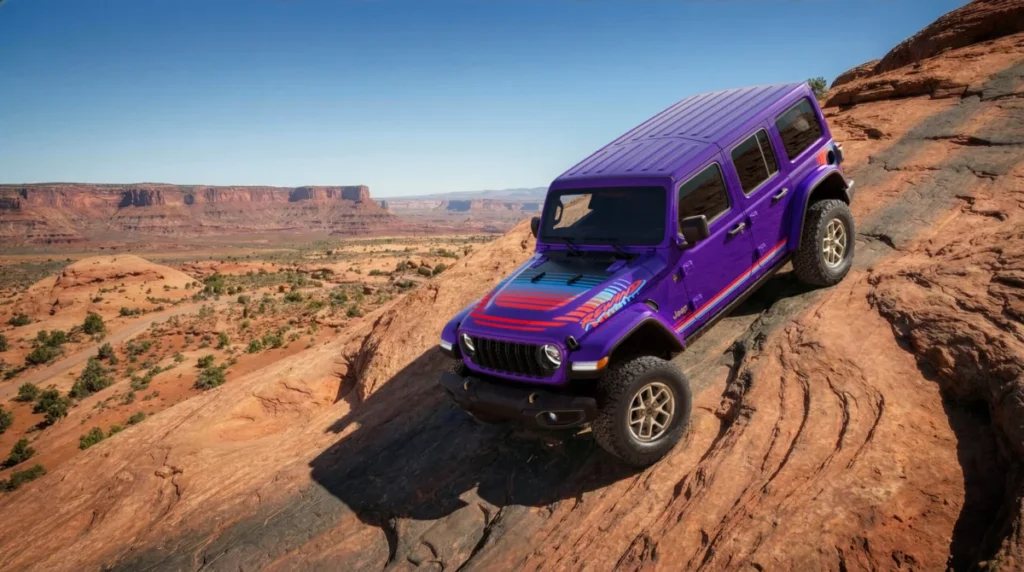
It is the automotive equivalent of a chart-topping comeback tour: a design study that captured the public imagination so viscerally that the manufacturer had no choice but to fast-track it for production. When Jeep unveiled the "Rewind" concept at the 2025 Easter Jeep Safari in Moab, Utah, it was intended as a tribute to the brand’s heritage—a playful, neon-drenched nod to the aesthetics of the 1980s and 1990s.
Today, that vision has shifted from the dusty trails of Moab to the showroom floor. As the sixth installment of the ambitious "Twelve 4 Twelve" initiative, the Wrangler "Rewind" and its sibling, the Gladiator "Rewind," are set to redefine how a legacy brand engages with its own history. This is more than a paint job; it is a meticulously crafted time capsule on wheels, designed to evoke the spirit of a pre-digital era while retaining the sophisticated off-road architecture of a modern-day trail conqueror.
The Chronology of a Concept: From Moab to Mainstream
The journey of the Rewind project is a masterclass in modern consumer-led product development.
Phase 1: The Moab Spark (April 2025)
The annual Easter Jeep Safari serves as the ultimate proving ground for Jeep’s design team. It is a place where engineering limitations are suspended, and creativity is the only currency. When the Rewind concept debuted, it stood out against the sea of matte-black tactical builds. Its vibrant decals and "8-bit" aesthetic provided a sharp, nostalgic contrast to the rugged topography of Utah.
Phase 2: The Data-Driven Decision (May–June 2025)
Following the event, Jeep’s marketing and research departments analyzed social media sentiment, consumer feedback forms, and traffic metrics from the event’s digital footprint. The reception was overwhelming. Unlike typical concepts that remain static prototypes, the Rewind generated an unprecedented volume of inquiries regarding availability.
Phase 3: The "Twelve 4 Twelve" Integration (July 2025–Present)
Jeep’s corporate strategy for 2026—the "Twelve 4 Twelve" campaign—offered the perfect vehicle for the Rewind. By pledging to release 12 distinct limited-edition models over 12 months, Jeep created a framework that allows for niche, high-personality builds that might otherwise be stifled by the rigid requirements of mass-production vehicles. The Rewind was fast-tracked as the sixth entry in this series, securing its place in the lineup alongside both the Wrangler and the Gladiator.
Design Philosophy: The 8-Bit Aesthetic
The aesthetic of the Rewind project is rooted in the "Golden Age" of late-20th-century pop culture. The design team, comprised largely of engineers and artists who grew up during the advent of home gaming consoles and neon-drenched malls, sought to capture a specific "vibe" rather than a specific car.
The Visual Language
The exterior of the Rewind is characterized by high-contrast geometric patterns that mimic early pixel art. The color palette draws from the iconic, albeit chaotic, designs found on consumer goods of the early 1990s—think vibrant teals, magenta accents, and deep, saturated purples set against a base of classic Jeep heritage colors.
"We wanted to capture the feeling of the first time you picked up a controller," says a lead designer from the Jeep studio. "It’s about that specific mix of optimism and innovation that defined the turn of the decade." The result is a vehicle that feels familiar yet entirely out of place in a modern, muted automotive landscape, effectively "breaking the mold" of current design trends.
Technical Specifications: A Willys Foundation
While the Rewind is defined by its nostalgia, the engineering underneath is strictly contemporary. Jeep has chosen the Willys trim as the foundation for these editions, ensuring that the vehicles are not merely "parade queens," but highly capable off-road machines.
Performance Under the Hood
- Powertrain: The Rewind models feature the tried-and-true 3.6L Pentastar V6, paired with an optional 8-speed automatic or a 6-speed manual transmission, catering to the purists.
- Off-Road Hardware: As a Willys-based model, the Rewind comes standard with heavy-duty Dana 44 axles, a Trac-Lok limited-slip rear differential, and the Command-Trac 4×4 system, which provides a 2.72:1 low-range gear ratio.
- Tires and Suspension: The vehicle is equipped with 32-inch Mud-Terrain tires, specifically selected to provide a "period-correct" look while offering superior grip on loose surfaces. The suspension has been tuned to provide a slightly more compliant ride, balancing the needs of the daily commuter with the demands of the weekend trail enthusiast.
Official Perspectives
The launch of the Rewind is being viewed internally as a litmus test for how much personality a modern vehicle can carry. Bob Broderdorf, the CEO of the Jeep brand, emphasized the necessity of the project during the press conference:
"When we saw the reaction to the Rewind concept at the Easter Safari, it wasn’t just ‘like’ or ‘interest.’ It was an emotional response. People weren’t just looking at a car; they were looking at their childhood. In the automotive industry, we often get caught up in the race toward total electrification and autonomous driving. The Rewind is a reminder that people still want to feel something when they get behind the wheel. It’s a celebration of the joy of driving."
Jeep’s strategy shift towards limited-run production—as evidenced by the "Twelve 4 Twelve" program—marks a departure from the "one-size-fits-all" manufacturing approach. By focusing on smaller, more frequent drops, the brand can maintain high levels of engagement without the risks associated with long-term production of polarizing designs.
The Broader Implications: A New Era for Customization
The Rewind project is not an isolated incident; it is a signal of a broader shift in the automotive industry. As vehicle platforms become increasingly standardized due to electrification and shared chassis architectures, the "personality" of a vehicle is being pushed to the surface-level design and interior appointments.
1. The Death of the "Boring" Car?
Manufacturers are realizing that in a world of increasingly efficient, aerodynamic, and similar-looking electric vehicles, the "cool factor" is the most valuable differentiator. By leaning into retro aesthetics, Jeep is tapping into the "Y2K" nostalgia trend that has already revitalized fashion and music.
2. The "Twelve 4 Twelve" Legacy
This campaign could fundamentally change how dealerships operate. Instead of static inventory, dealers are now dealing with "collector’s items" from the factory floor. This drives foot traffic, creates urgency, and fosters a sense of community around the brand. If the Rewind is successful, we can expect other legacy manufacturers to follow suit, launching "limited edition" cycles that mimic the "drop culture" currently dominating the retail and streetwear industries.
3. The Future of Off-Roading
Jeep’s decision to pair high-fashion aesthetics with authentic, high-capability mechanicals is a strategic pivot. It acknowledges that the vast majority of Jeep owners use their vehicles for daily driving, yet they want the capability of a rock-crawler. The Rewind serves as a badge of honor for the weekend adventurer, providing the necessary specs for the trail while standing out in the suburban parking lot.
Conclusion: The Road Ahead
The Wrangler and Gladiator "Rewind" are more than just nods to the past; they are sophisticated marketing tools that bridge the gap between the brand’s storied history and its future. By embracing the aesthetics of the 8-bit era, Jeep has managed to inject a sense of playfulness and humanity back into a market that often feels overly sterile.
Whether you are a traditionalist who prefers the understated, utilitarian look of a classic CJ-7, or a modern enthusiast looking for a vehicle that makes a bold statement, the Rewind represents an important milestone. It proves that a brand does not need to abandon its heritage to innovate—it simply needs to know how to press "rewind" at the right moment.
As we look toward the remaining editions in the "Twelve 4 Twelve" series, one thing is clear: the future of the automotive industry is looking a lot like the past, and for the fans of the Jeep brand, that is a ride worth taking.
What about you? Are you drawn to this neon-infused, nostalgic throwback, or does the raw, functional simplicity of a traditional off-roader still hold the keys to your heart? In an age of infinite choices, Jeep is betting that there is still plenty of room for those who like to look back while moving forward.
