

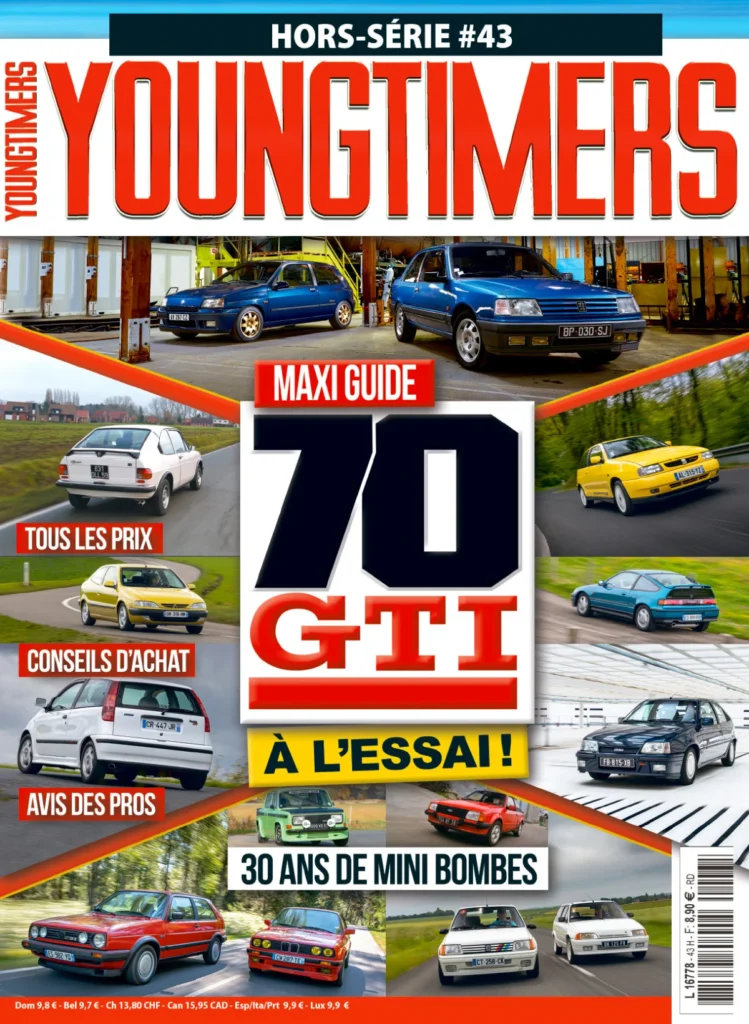
In the world of automotive journalism, few segments evoke as much passion, nostalgia, and raw driving emotion as the "GTI" era. It was a golden age of engineering—a time when weight was kept to a minimum, mechanical feedback was unfiltered, and the "hot hatch" was not just a vehicle, but a cultural phenomenon. Recognizing the enduring significance of these machines, Youngtimers magazine has officially unveiled its latest special edition, Hors-série n°43, titled "Maxi guide, 70 GTI à l’essai!" (Maxi Guide, 70 GTIs Tested!).
This monumental publication serves as a comprehensive archive of four decades of automotive history, spanning from 1975 to 2005. It is a definitive resource for enthusiasts, collectors, and historians alike, offering a deep dive into the models that defined the hot hatch landscape.
The Genesis of the Hot Hatch: A Four-Decade Retrospective
The "GTI" label—originally popularized by Volkswagen—became a shorthand for accessible, high-performance motoring. Youngtimers magazine’s latest issue takes readers on a chronological journey, starting from the mid-1970s, when manufacturers began stuffing larger engines into small, nimble chassis, and concluding in the mid-2000s, just before the era of heavy, electronically-nanny-governed performance cars fully took hold.
The editorial team has curated a list of 70 iconic vehicles, meticulously testing and analyzing each to understand why they remain the benchmark for driver engagement. From the raw, carbureted thrills of the Renault 5 Alpine to the precision-engineered prowess of the Clio II RS 182, the issue captures the evolution of the "GTI spirit."
Chronology: The Evolution of the Performance Compact
The Hors-série n°43 categorizes these machines not just by speed, but by their impact on the automotive zeitgeist. The chronology is segmented into the pioneers (late 70s), the turbo-charged boom (the 80s), the high-revving naturally aspirated era (the 90s), and the refined powerhouses (the early 2000s).
The Pioneers (1975–1982)
This era set the blueprint. Vehicles like the Volkswagen Golf GTI 1600 and the Renault 5 Alpine proved that small cars could dominate both the commute and the twisty B-roads. The Youngtimers guide provides extensive data on the Simca 1000 Rallye 2 and the Peugeot 104 ZS2, highlighting the rudimentary yet brilliant mechanical setups that defined the early days of the segment.
The Turbo Revolution (1983–1990)
The mid-80s saw the rise of forced induction. The guide pays homage to the legendary Renault Supercinq GT Turbo, the Fiat Uno Turbo i.e., and the MG Metro Turbo. These cars brought affordable, high-boost thrills to the masses, often characterized by "laggy" but exhilarating power delivery that is rarely replicated in modern vehicles.
The Peak of Handling (1991–1998)
As safety standards and emissions regulations tightened, manufacturers responded with high-revving, multi-valve engines and sophisticated suspension tuning. Featured models include the Peugeot 306 S16 BV6, the iconic Renault Clio Williams, and the Honda CRX 1.6i-VT, a car that famously introduced the world to the visceral joy of VTEC.
The Final Refinement (1999–2005)
Before the segment evolved into the modern "Super-Hatch," the early 2000s produced some of the most well-rounded performance cars ever made. The guide highlights the Peugeot 206 RC, the VW Golf IV GTI 25th Anniversary, and the Mini Cooper S JCW GP, noting how these cars managed to balance comfort with track-ready performance.
Supporting Data: The Full Roster
The strength of Hors-série n°43 lies in its breadth. The magazine has compiled a exhaustive list that serves as a "Who’s Who" of performance history. The catalog includes:
- Italian Legends: Alfa Romeo 145 2.0 QV, Alfa 33 1.7 QV, Alfasud Ti, Autobianchi A112 Abarth, Fiat Abarth Ritmo 130 TC, Fiat Punto GT, Lancia Delta HF Turbo, and the HPE HF.
- French Icons: Citroën AX Sport, Saxo VTS 16v, Visa II Chrono, Xsara VTS, ZX 16v; Peugeot 106 XSi, 205 GTI (1.6 & 1.9), 205 Rallye, 206 RC/S16, 309 GTI 16; Renault 11 Turbo, 19 16S, Clio 16V, Clio Williams, Megane Coupe 16V, Supercinq GT Turbo, and the Talbot Samba/Sunbeam.
- German Engineering: BMW 318is (E30), 323ti (E36), Opel Corsa GSi, Kadett D GTE, Kadett E GSi 16V, VW Golf I/II/III/IV GTI iterations, Lupo GTI, and the Polo G40.
- The Global Wave: Ford Escort (RS 1600i, RS Turbo, XR3, XR2, Fiesta Turbo), Honda Civic 6G VTi, CRX, Mazda 323 GTS Turbo, MG ZR 160, Mitsubishi Colt GT-i 16V, Nissan Sunny GTI, and the legendary Toyota Corolla AE86/AE92.
Editorial Perspective: Why These Cars Still Matter
In the accompanying editorials, the Youngtimers team discusses the "Why" behind this massive project. The core argument is simple: the modern automotive experience is increasingly digitized, sanitized, and isolated.
"The GTI era represents a direct line of communication between the driver, the road, and the machine," the editorial notes. "There are no drive modes, no traction control systems that can be fully turned off, and no dual-clutch gearboxes to do the work for you. In these 70 cars, the driver is the final arbiter of performance. That is a feeling that is being lost, and our goal with this special issue is to preserve the documentation of that feeling for the next generation of enthusiasts."
Implications: The Rising Value of the "Youngtimer" Market
The release of this guide comes at a pivotal moment for the collector car market. As Gen X and Millennial collectors reach their prime earning years, the cars of their youth—the 1990s hot hatches in particular—have seen a dramatic surge in valuation.
- Market Stability: The publication of this "Maxi Guide" is likely to influence market interest in the lesser-known models listed, such as the Rover 114 GTi or the Mitsubishi Colt GT-i, which have historically been overshadowed by the "big names" like the Peugeot 205 GTI.
- Cultural Preservation: By documenting the technical specifications, performance nuances, and historical context of these 70 vehicles, Youngtimers is effectively creating a "Red List" of endangered automotive species. This archival effort is essential as parts become scarcer and original, unmodified examples of these cars disappear.
- Community Engagement: The magazine has already seen a surge in interest from car clubs across Europe, eager to see if their specific model variant made the cut. This serves as a testament to the fact that these cars are not just static museum pieces; they are the centerpieces of active, vibrant driving communities.
Conclusion: A Must-Have for the Enthusiast’s Library
The Youngtimers Hors-série n°43 is not merely a magazine; it is a reference work. Whether you are an owner looking to restore your vehicle to factory specifications, a collector evaluating a potential purchase, or simply a fan of the golden era of the hot hatch, this issue provides the data and the storytelling required to appreciate these machines fully.
For those interested in securing a copy, Youngtimers is offering the publication at standard kiosk pricing, with the added benefit of free shipping for direct orders. It is a rare opportunity to own a comprehensive history of the cars that taught a generation how to drive.
About Youngtimers Magazine:
Youngtimers is the leading French automotive publication dedicated to the cars of the 1970s, 80s, and 90s. With a focus on the "modern classic" market, the magazine combines technical deep dives with high-quality photography and in-depth historical analysis. For more information, visit the official Youngtimers website.
