

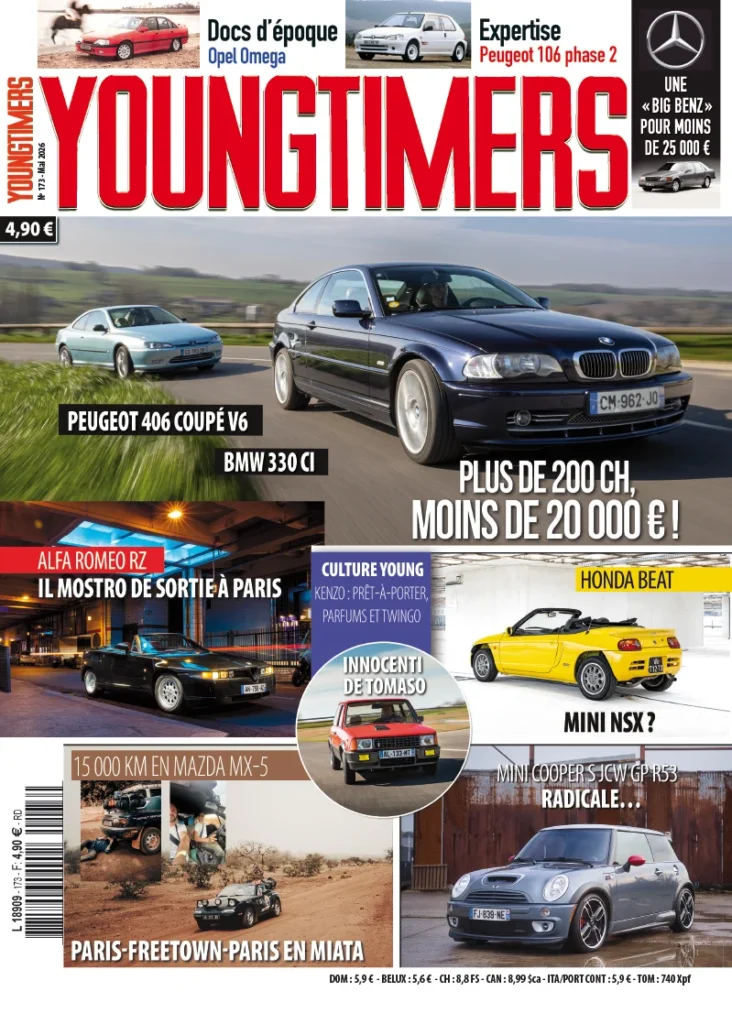
Paris, France – April 30, 2026 – Youngtimers Magazine, the preeminent authority on modern classics, today announced the highly anticipated release of its May 2026 issue, N°173. Landing on newsstands and available for immediate order online, this latest edition promises an exhilarating journey through the golden era of automotive engineering, featuring a meticulously curated selection of vehicles that define the "youngtimer" movement. From iconic German performance to rare Italian roadsters and charming Japanese Kei cars, Issue N°173 encapsulates the diverse appeal and enduring legacy of cars from the 1980s, 1990s, and early 2000s.
The cover story highlights a captivating duo: the refined power of the BMW 330 Ci E46 and the timeless elegance of the Peugeot 406 Coupé V6, two machines that, despite their different origins, embody the spirit of accessible performance and sophisticated design. Beyond these headliners, readers will discover an eclectic mix including the audacious Alfa Romeo RZ, the miniature marvel Honda Beat, the track-focused Mini Cooper S JCW GP R53, the understated luxury of the Opel Omega, the spirited Peugeot 106 Phase 2, and the quirky Innocenti De Tomaso. Adding a practical dimension, the issue also features an insightful long-term test covering 15,000 kilometres in the beloved Mazda MX-5, reinforcing the message that these machines are not just for admiring, but for driving.
This issue arrives at a time when the appreciation for youngtimers is experiencing an unprecedented surge. Enthusiasts worldwide are increasingly recognizing the blend of modern usability, analogue driving feel, and emerging collectibility that these vehicles offer. Youngtimers Magazine continues to serve as a vital guide, celebrating the cars that shaped a generation and providing invaluable insights for collectors, restorers, and everyday drivers alike.
Main Facts: A Diverse Tapestry of Modern Classics
Youngtimers N°173, released on April 30, 2026, presents an unparalleled cross-section of automotive history, focusing on vehicles that have transitioned from used cars to coveted modern classics. The editorial team has meticulously assembled a roster of cars that not only represent significant engineering achievements but also evoke a strong sense of nostalgia and passion.
The issue’s central theme appears to be the exploration of vehicles that offer distinct driving experiences and unique places in automotive lore. The BMW 330 Ci E46, with its inline-six engine and balanced chassis, represents the pinnacle of executive sportiness from the turn of the millennium. In contrast, the Peugeot 406 Coupé V6, a Pininfarina masterpiece, showcases French design flair combined with a potent, smooth V6 engine, offering a grand touring experience often overlooked.
The magazine delves into rarer finds like the Alfa Romeo RZ, a limited-production roadster known for its polarizing yet captivating design, and the Innocenti De Tomaso, a charming Italian hot hatch with a rich, albeit complex, heritage. It also crosses geographical boundaries to feature the Honda Beat, a Japanese Kei car that defies its small stature with a mid-engine, high-revving character, and the Mini Cooper S JCW GP R53, a British icon reimagined for track prowess.
For those seeking more accessible thrills, the Peugeot 106 Phase 2 is celebrated for its lightweight agility and spirited performance, making it an ideal entry point into youngtimer ownership. The Opel Omega, often overshadowed by its German rivals, receives its due recognition, highlighting its comfort, build quality, and potential as an appreciating classic. Finally, the long-distance test of the Mazda MX-5 underscores the enduring appeal of the quintessential roadster, proving its mettle over thousands of kilometres, cementing its status as a reliable and joyful companion for enthusiasts.
This comprehensive approach ensures that Youngtimers N°173 offers something for every type of enthusiast, from those seeking high-performance machines to those appreciating quirky design or reliable daily drivers with character.
Chronology: The Enduring Legacy of Youngtimers Magazine
Since its inception, Youngtimers Magazine has carved a unique niche in automotive journalism, championing a category of vehicles often overlooked by traditional classic car publications. The magazine launched with a clear mission: to shine a light on cars from the 1980s, 1990s, and early 2000s that possessed the potential to become future classics. These were cars that, at the time, were simply "used cars" but harboured the design, engineering, and emotional appeal to transcend their depreciated status.
Over the years, Youngtimers has become more than just a magazine; it’s a cultural touchstone for a generation of enthusiasts. It documented the rise of the hot hatch, the evolution of performance saloons, the allure of Japanese sports cars, and the resurgence of analogue driving experiences in an increasingly digital world. Issue N°173, published in May 2026, marks another significant milestone in this journey, demonstrating the magazine’s sustained commitment to its core philosophy.
The trajectory of Youngtimers Magazine has mirrored the growth of the youngtimer phenomenon itself. What began as a niche interest has blossomed into a global movement, with dedicated clubs, events, and a robust market for these modern classics. The magazine has played a crucial role in legitimizing this segment, providing expert analysis, buying guides, restoration tips, and captivating features that highlight the unique stories behind each car. Each issue, including N°173, contributes to building a comprehensive archive of these vehicles, ensuring their history and appeal are preserved for future generations. The consistent quality and depth of content have fostered a loyal readership, eagerly anticipating each new release as a definitive guide to the evolving landscape of modern classic motoring.
Supporting Data: A Deep Dive into Featured Vehicles
Issue N°173 provides an in-depth look at a diverse collection of youngtimers, each with its own compelling narrative.
BMW 330 Ci E46: The Epitome of Executive Sportiness
The BMW E46 generation (1998-2006) is widely regarded as one of BMW’s finest, perfectly blending dynamic driving characteristics with premium comfort and timeless design. The 330 Ci coupé, particularly the post-facelift models, represents the zenith of the non-M E46 range. Powered by the M54B30 3.0-litre inline-six engine, producing 231 horsepower, it offered a sublime balance of power, smoothness, and responsiveness. Youngtimers Magazine likely explores its near-perfect 50:50 weight distribution, engaging steering, and the enduring appeal of its pillarless coupé silhouette. For many, the 330 Ci E46 encapsulates the essence of the ultimate driving machine before the advent of overly complex electronics, making it a highly desirable youngtimer for purists.
Peugeot 406 Coupé V6: French Elegance Meets Grand Touring
Designed by Pininfarina, the Peugeot 406 Coupé (1996-2004) stands as a testament to elegant, understated design, a stark contrast to many of its more flamboyant contemporaries. The V6 variant, typically featuring the 3.0-litre ES9J4S engine, delivered around 210 horsepower, endowing the coupé with effortless cruising capability and a refined driving experience. Youngtimers likely highlights its luxurious interior, comfortable ride, and its unique position as a sophisticated grand tourer from a mainstream French manufacturer. Its rarity and beautiful lines are increasingly appreciated, positioning it as a future classic for those who value style and comfort over outright aggression.
Alfa Romeo RZ: The Radical Roadster
The Alfa Romeo RZ (Roadster Zagato), produced in limited numbers between 1992 and 1994, is a car of extreme character. Following the controversial but iconic SZ (Sprint Zagato) coupé, the RZ shared its mechanicals, including the glorious "Busso" 3.0-litre V6 engine, but wrapped it in an even more audacious open-top body. Its distinctive styling, often described as "Manga-esque" or "Il Mostro" (The Monster), makes it instantly recognizable and undeniably unique. The magazine’s feature likely delves into its hand-built exclusivity, the raw driving experience of its powerful V6, and its status as a highly collectible and conversation-starting youngtimer.
Honda Beat: Kei Car Charm and Engineering Brilliance
The Honda Beat (1991-1996) is a testament to Honda’s engineering prowess within the confines of Japan’s strict Kei car regulations. This tiny, mid-engined, rear-wheel-drive roadster was powered by a mere 660cc three-cylinder engine, but it revved to an astonishing 8,500 rpm, producing its maximum permitted 63 horsepower with a delightful mechanical symphony. Youngtimers will undoubtedly explore its agile handling, spirited character, and the sheer joy it offers behind the wheel, defying its diminutive size. As imports become more common, the Beat’s unique blend of charm, rarity, and pure driving fun makes it a fascinating and increasingly popular youngtimer.
Mini Cooper S JCW GP R53: A Track-Focused Legend
The first-generation Mini Cooper S JCW GP (2006) was a limited-edition, hardcore variant of the R53 Cooper S, developed by John Cooper Works. Stripped of its rear seats, fitted with a stiffer suspension, improved brakes, and a supercharged 1.6-litre engine tuned to 218 horsepower, it was designed for maximum performance. Its distinctive aero kit and unique Thunder Blue paint with a silver roof further set it apart. The feature in Youngtimers N°173 will likely emphasize its raw, analogue driving experience, its agility on twisty roads, and its status as a highly sought-after collector’s item due to its rarity and uncompromising performance focus.
Opel Omega: The Unsung Executive Hero
The Opel Omega (particularly the B generation, 1993-2003) represented Opel’s earnest attempt at the executive saloon market. While perhaps lacking the immediate prestige of its German rivals, the Omega offered impressive comfort, robust engineering, and excellent value. Available with a range of engines, including smooth V6s, it provided a refined and spacious driving experience. Youngtimers Magazine might highlight its often-overlooked qualities, its potential for affordable classic ownership, and its surprising resilience, making it a practical and increasingly appealing youngtimer for those seeking comfort and space without the premium price tag.
Peugeot 106 Phase 2: The Accessible Pocket Rocket
The Peugeot 106 Phase 2 (1996-2003) built upon the success of its predecessor, refining its styling and improving its interior. While the entire 106 range offered nimble handling, the sporting variants like the Rallye and S16 (GTI in some markets) are the true youngtimer darlings. Lightweight, agile, and powered by high-revving engines (1.3-litre for Rallye, 1.6-litre for S16), they delivered an intoxicating driving experience. The magazine will likely celebrate its "go-kart" like handling, its affordability, and its enduring appeal as an accessible, fun-to-drive hot hatch, perfect for both daily use and spirited weekend drives.
Innocenti De Tomaso: Italian Flair in a Small Package
The Innocenti De Tomaso (1976-1993) is a fascinating blend of British underpinnings and Italian design and performance aspirations. Based on the Mini, but restyled by Bertone and later benefiting from De Tomaso’s ownership, these cars featured more modern engines (initially British Leyland, later Daihatsu) and a more aggressive, sporty aesthetic. Youngtimers N°173 will likely explore its quirky history, its rarity outside of Italy, and its unique position as a hot hatch that combines practicality with distinctive Italian flair and a touch of motorsport heritage.
15,000 km in a Mazda MX-5: The Ultimate Road Trip Companion
The Mazda MX-5 (Miata) has long been celebrated as the world’s best-selling two-seater sports car, revered for its simplicity, reliability, and engaging driving dynamics. A 15,000 km long-term test featured in Youngtimers is a testament to its enduring quality and suitability for genuine driving adventures. This feature will undoubtedly highlight the MX-5’s ability to cover long distances with ease, its fuel efficiency, its robust mechanicals, and, most importantly, the sheer joy it delivers on every journey, proving that a youngtimer doesn’t have to be a garage queen but can be a true companion for the open road.
Official Responses and Editorial Insight
In an exclusive statement, Jean-Luc Dubois, Editor-in-Chief of Youngtimers Magazine, expressed his enthusiasm for the new issue: "N°173 is a true reflection of the passion and diversity that defines the youngtimer movement. Our team has worked tirelessly to bring our readers stories that not only inform but also inspire. We believe that these cars represent a sweet spot in automotive history – a period where technology advanced significantly, yet the raw, mechanical connection between driver and machine remained paramount."
He continued, "The selection for May 2026 was driven by a desire to showcase both the widely recognized icons like the BMW E46 and the Peugeot 406 Coupé, as well as the more esoteric delights such as the Alfa Romeo RZ and the Honda Beat. Each car has a story, a soul, and a unique place in the hearts of enthusiasts. Our long-term test of the Mazda MX-5, for instance, isn’t just about covering miles; it’s about celebrating the accessible joy of driving and demonstrating the enduring reliability of these modern classics. We aim to provide content that resonates with both seasoned collectors and those just beginning their journey into the world of youngtimers."
The editorial team emphasized that the process of curating each issue involves extensive research, hands-on driving experiences, and deep engagement with the youngtimer community. This dedication ensures that every feature is authentic, insightful, and captures the true essence of the vehicles discussed.
Implications for the Youngtimer Market and Enthusiasts
The release of Youngtimers N°173 carries significant implications for the broader youngtimer market and the enthusiast community. Features in respected publications like Youngtimers often play a crucial role in shaping perceptions, influencing market values, and sparking renewed interest in specific models. By highlighting cars like the Opel Omega or the Innocenti De Tomaso, the magazine can bring lesser-known models into the spotlight, potentially driving up demand and appreciation for previously overlooked gems.
The emphasis on driving and practicality, exemplified by the 15,000 km MX-5 test, reinforces the idea that youngtimers are not merely static investments but vehicles meant to be enjoyed on the road. This perspective encourages owners to maintain, restore, and actively use their cars, fostering a vibrant and engaged community. Furthermore, the detailed articles serve as valuable resources for potential buyers, offering insights into ownership costs, common pitfalls, and the unique characteristics of each model.
As the automotive industry rapidly shifts towards electrification and autonomous driving, the analogue appeal of youngtimers becomes even more pronounced. They offer a tangible connection to a past era of motoring, a time when driving was a more visceral and less mediated experience. Youngtimers Magazine, through issues like N°173, acts as a guardian of this heritage, ensuring that these remarkable machines continue to be celebrated and enjoyed for generations to come.
Enthusiasts are encouraged to secure their copy of Youngtimers N°173 immediately. The issue is available at all major newsstands, or can be conveniently ordered online directly from the Youngtimers website. For a limited time, online orders benefit from complimentary shipping, making it easier than ever to dive into the world of modern classics.
Rendez-vous in kiosks, or order your number on our online shop at the same price, shipping costs offered:
Youngtimers n°173 – May 2026
