

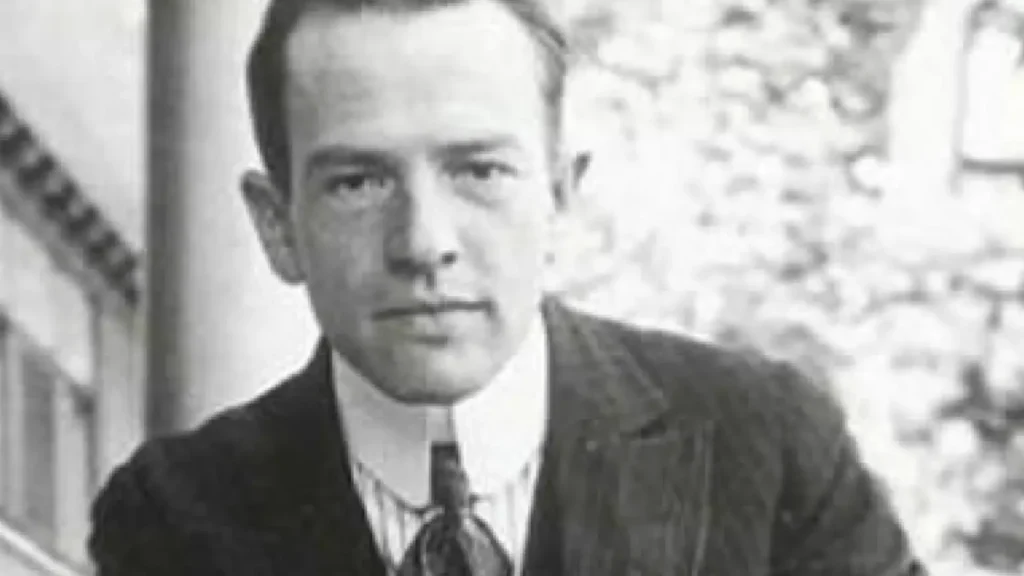
In the history of industrial capitalism, few figures evoke as much chilling efficiency—or as much moral controversy—as Charles Bedaux. A self-made magnate who rose from the poverty of Charenton, France, to the pinnacle of American corporate power, Bedaux transformed the way the world worked. By quantifying human exertion into a mathematical abstraction, he became the architect of a new industrial discipline. Yet, his legacy is not merely one of labor management; it is a dark tapestry of failed expeditions, geopolitical intrigue, and an ignominious end that saw a man of immense influence die a traitor in a Miami jail cell.
The Architect of the "B" Unit: Industrial Alchemy
At the height of the 1920s, in the hallowed halls of the Lingotto factory in Turin and the vulcanization workshops of Michelin in Clermont-Ferrand, the appearance of a man in a sharp suit wielding a dual-dial stopwatch was a harbinger of dread. He was not a plant manager or an engineer; he was an agent of the Charles E. Bedaux Company.
Bedaux’s revolutionary, albeit ruthless, contribution was the "B" unit—a system of "scientific management" that went beyond mere Taylorism. While Frederick Winslow Taylor focused on the mechanical repetition of tasks, Bedaux attempted to factor in human physiology. He divided the minute into sixty "B" units, a composite of effort and mandatory recovery time calculated based on the perceived difficulty of the task.
On paper, the system promised to prevent exhaustion and optimize output. In the reality of the factory floor, it functioned as a mechanism of methodical extraction. Consultants armed with stopwatches measured every motion to the hundredth of a second. A baseline of 60 B-units per hour was expected; those who surpassed it earned bonuses, while those who failed faced disciplinary scrutiny. By incentivizing speed, Bedaux’s system effectively pitted worker against worker, systematically dismantling the solidarity of the labor force. At Michelin in 1927, this friction culminated in explosive strikes, as workers decried the system as a form of "capitalist sweat-mining."
Chronology: A Life of Unchecked Ambition
- 1886: Born in Charenton-le-Pont, France.
- 1906: Emigrates to the United States with virtually no resources, taking menial jobs in the mines and factories of the American West.
- 1916: Establishes the Bedaux Company in Cleveland, beginning his ascent as an efficiency consultant.
- 1920s: Expands globally, with offices in London, Paris, and New York. The Bedaux system becomes the standard for major industrial conglomerates.
- 1934: The Bedaux Sub-Arctic Expedition occurs, a disastrous attempt to traverse the Canadian Rockies with Citroën-Kégresse vehicles.
- 1937: Hosts the wedding of the Duke of Windsor and Wallis Simpson at his Château de Candé in France.
- 1940: Deepens ties with Nazi officials in occupied Paris, including Ambassador Otto Abetz.
- 1942: Moves to Algiers to lead a project for the Vichy regime, aiming to exploit North African resources for the Axis war effort.
- 1943: Arrested by U.S. military intelligence in North Africa on charges of treason.
- 1944: Commits suicide on February 14 in a Miami detention center.
The Bedaux Sub-Arctic Expedition: A Masterclass in Hubris
If Bedaux’s industrial methods were an exercise in cold calculation, his 1934 Bedaux Sub-Arctic Expedition was a descent into surreal megalomania. Fascinated by the media success of the "Yellow Cruise" (Croisière Jaune) in Central Asia, Bedaux sought to replicate the glory of a trans-continental adventure. He invested his own fortune to purchase five Citroën-Kégresse Type P17 half-track vehicles, aiming to carve a path through the wilderness from Edmonton to the Yukon.
The expedition was a logistical nightmare. Bedaux, accompanied by his wife, his mistress, Italian servants, a geologist, and a film crew from Fox, traveled with cases of vintage champagne, fine china, and 130 pack horses. The wilderness, however, proved indifferent to his status. The soft, specialized tracks of the Citroëns were no match for the treacherous peat bogs and steep slopes of the British Columbia mountains.
As the vehicles became hopelessly mired in mud and trapped by rising rivers, Bedaux’s refusal to turn back manifested in a display of wanton destruction. He ordered two of the state-of-the-art vehicles to be dynamited into a ravine to avoid further delays, and eventually abandoned the remaining three to the mountain snow, finishing the journey on horseback. The expedition stands as a defining symbol of Bedaux’s character: a man who believed that sheer capital could override the laws of physics and geography.
Supporting Data: The Efficiency Paradox
The adoption of the Bedaux system was driven by a desperate need to manage skyrocketing labor costs during the Great Depression. By 1930, the Bedaux Company held contracts with over 500 major firms globally.
- Productivity Gains: Companies reported increases in production efficiency of 20% to 40% within the first two years of implementation.
- Wage Polarization: While total wages often increased for the most productive workers, the "B" system created a permanent anxiety, as the baseline requirement (60 Bs) was often adjusted upward as technological improvements made tasks easier.
- The Human Cost: Studies conducted in the 1930s regarding labor unrest in the automobile sector consistently cited "speed-up" and "stretch-out" tactics—terms synonymous with the Bedaux method—as the primary drivers for the formation of industrial unions, including the UAW in the United States.
Official Responses and Geopolitical Implications
Bedaux’s influence extended into the highest levels of government, where his belief in "authoritarian planning" found receptive ears among the European elite. His ownership of the Château de Candé made him a central figure in the social and political maneuvers of the late 1930s.
When he hosted the Duke of Windsor’s wedding in 1937, he was not merely acting as a socialite; he was brokering influence. Bedaux, convinced that industrial efficiency could solve the social ills of the Depression, aligned himself with figures like Hjalmar Schacht, the German Minister of Economics. His attempts to organize a tour of German factories for the Duke of Windsor were clearly designed to showcase the Nazi model of industrial stability to the British establishment.
Following the fall of France, Bedaux’s collaboration turned into high treason. His project in North Africa—a proposed pipeline to channel supplies to the Mediterranean—was a direct contribution to the Axis war machine. The U.S. government, having long monitored his activities, viewed his project as a critical threat to Allied supply lines. When the Allied forces landed in North Africa during Operation Torch, they found Bedaux at the center of this web of collaboration.
The Final Reckoning
The tragedy of Charles Bedaux is the story of a man who treated human life as a series of variables to be optimized. Having spent his life measuring the energy of others, he was eventually caught in a system he could not manipulate: the machinery of international justice.
Following his arrest, the FBI and military intelligence prepared an airtight case of treason. They alleged that Bedaux had used his corporate network as a front for espionage and economic sabotage. However, the trial never took place. On February 14, 1944, within the sterile, gray walls of a Miami immigration detention center, Bedaux managed to conceal a lethal dose of barbiturates.
In his final act, the man who had turned the working class into an "invisible commodity" reclaimed control over his own time. He died, effectively, by his own clock. The death of Charles Bedaux marked the end of a particularly brutal chapter in the history of management. His legacy remains a warning: the belief that society can be governed by the same cold, mathematical precision as a factory floor is not only a failure of ethics—it is a path to the abyss.
