

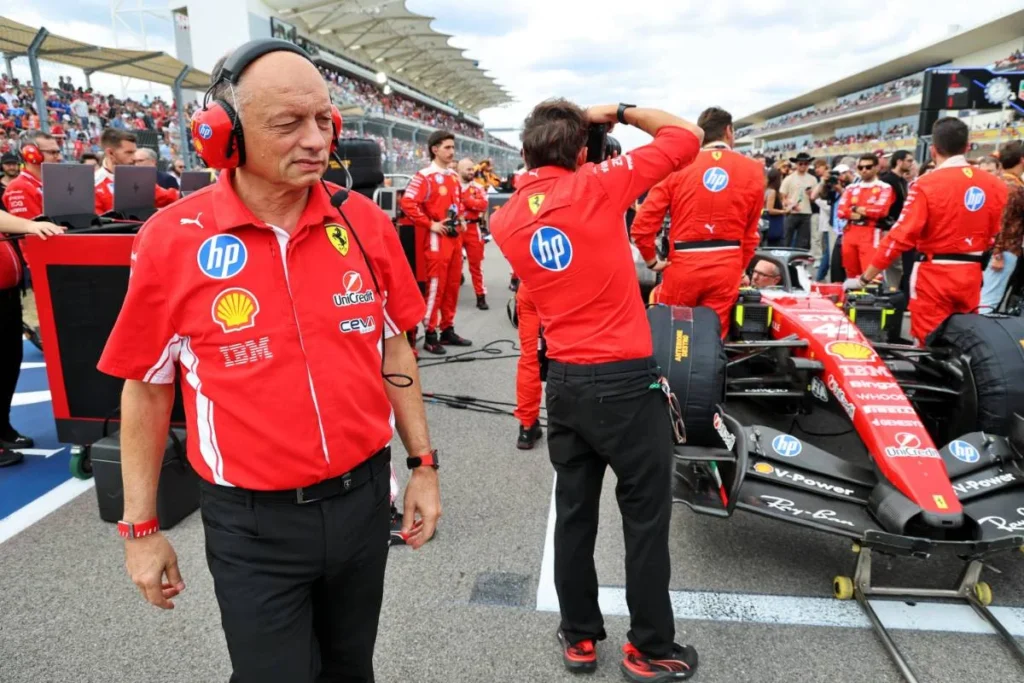
Introduction: A Podium with a Bitter Aftertaste
The Formula 1 paddock left the Circuit of the Americas (COTA) in Austin with a lingering sense of "what if" regarding the Scuderia Ferrari’s performance. While Charles Leclerc’s second-place finish and Lewis Hamilton’s strong fourth-place showing represent a robust points haul for the Italian outfit, the prevailing mood within the Maranello garage was one of tempered frustration.
Coming into the weekend as favorites based on their blistering pace during Friday’s free practice sessions, Ferrari arrived in Texas with clear designs on the top step of the podium. However, the reality of the Grand Prix weekend proved once again that in the modern era of Formula 1, raw pace is only half the battle. As Ferrari continues to refine the SF-26, the team finds itself caught in a high-stakes tug-of-war between their undeniable race-day superiority and the increasingly elusive art of the perfect qualifying lap.
Chronology of the Weekend: From Dominance to Recovery
Friday and Saturday Morning: The Illusion of Control
The weekend began under auspicious skies for the Scuderia. From the moment the pit lane opened for Free Practice 1, the Ferrari SF-26 appeared to be the class of the field. Charles Leclerc set the tone early, topping the time sheets with a level of confidence that suggested the car was perfectly dialed into the undulating Austin tarmac.
By Saturday morning, the momentum remained, with Lewis Hamilton finding a rhythm that hinted at a potential front-row lockout. The telemetry data suggested that Ferrari had finally unlocked a consistent operating window for their tires—a recurring issue throughout the season. However, as the sun began to dip and the track temperatures shifted, the team’s clinical advantage began to evaporate.
The Qualifying Conundrum
When the lights turned green for the crucial Q3 session, the picture changed drastically. Both Leclerc and Hamilton struggled to replicate the magic of the practice sessions. While the pace was there, the "flick of a switch" required to turn on the tires for a single flying lap proved impossible to find.
The result was a sobering fourth and fifth on the grid. In a field where the margins are measured in milliseconds, the duo found themselves trapped behind the Mercedes and Red Bull machines. The qualifying session was not a disaster, but it was a tactical setback, forcing the drivers to play catch-up on a track where passing, while possible, is never a guarantee.
The Grand Prix: A Strategic Offensive
Starting from the second and third rows, Ferrari opted for an aggressive two-stop strategy, utilizing the soft-compound tires to gain an early advantage. The goal was clear: utilize the superior long-run pace of the SF-26 to undercut the leaders and pressure the front-runners into mistakes.
The strategy paid dividends. Leclerc, driving with clinical precision, scythed through the field, eventually hunting down Max Verstappen in the closing stages to secure a hard-fought second place. Hamilton, meanwhile, showcased his veteran race craft, managing his rubber and pushing hard to challenge for the final spot on the podium. Only a late-race Virtual Safety Car (VSC) prevented him from mounting a serious assault on the top three, ultimately leaving him in fourth.
Supporting Data: The Margin of Error
The technical reality facing Frédéric Vasseur and his engineering team is a testament to the hyper-competitive nature of current F1 regulations. The "window of operation" for the tires—the temperature range where the rubber provides maximum grip—has become agonizingly narrow.
The "Dime-Sized" Gap
Vasseur’s analysis is backed by the data: a deviation of just a few degrees in tire temperature, or a single gust of wind across the back straight, can cause a performance drop-off of two to three-tenths of a second. In the current grid hierarchy, that margin is the difference between starting on the front row and being buried in the midfield.
- Q2 vs. Q3: Leclerc’s best effort during the session was logged in Q2, a clear indicator that the car had the potential for pole, but the team failed to optimize the track-evolution-to-tire-prep ratio in the final shootout.
- The Points Trajectory: Despite the frustration, Ferrari has statistically been the most consistent team over the last four races, consistently outscoring their rivals. The data suggests that while the "win" is escaping them, the "consistency" is finally arriving.
Official Responses: The Vasseur Philosophy
"A Feeling I Like"
Frédéric Vasseur, ever the pragmatist, offered a refreshing take on the team’s dissatisfaction. "Very early in the race, Charles was looking at the lead. And when you finish second when you aimed for first, you aren’t happy," Vasseur remarked. "But it is a feeling I like. It shows we have raised our standards. We are no longer satisfied with just being in the mix; we want to dominate."
Addressing the Qualifying Gap
Regarding the recurring struggle on Saturdays, Vasseur was defensive but analytical. He pointed out that the entire grid is struggling with the same volatility. "Look at the field," he noted. "We aren’t the only ones who lost rhythm in Q3. It’s a game of millimeters. We are seeing that you can have the fastest car on Friday and Saturday morning, but if you don’t nail that one specific, 90-second window in Q3, the entire weekend strategy is compromised."
Vasseur emphasized that the technical upgrades are working, but the team’s focus must now shift to the "human-machine interface"—ensuring that drivers and engineers can communicate and react to track conditions in real-time to adjust tire preparation cycles.
Implications: The Road to the Championship
What does the Austin weekend mean for the remainder of the season?
1. The Validation of the SF-26
The most positive takeaway for Ferrari is that the SF-26 is a legitimate contender. It is kind on its tires during long stints and possesses enough straight-line speed to overtake, which is a significant improvement over last year’s iterations. The car is no longer a "one-trick pony" that fades in the second half of a race.
2. The Mental Shift
Ferrari’s leadership is clearly undergoing a cultural transformation. Under Vasseur’s tenure, the focus has shifted from "blaming the strategy" to "optimizing the process." The fact that they are consistently the highest point-scoring team over the last month is a sign of a team that is maturing.
3. The Need for "Saturday Perfection"
The implication for the upcoming races is clear: Ferrari must master the Q3 warm-up cycle. If they can start on the front row, the race-day pace they showed in Austin suggests they would be almost impossible to beat. The technical team in Maranello is likely to spend the coming weeks simulating qualifying runs under various thermal loads to ensure they can hit that "narrow window" regardless of environmental factors.
4. A Championship Threat?
If Ferrari can bridge the gap between their Friday pace and their Saturday qualifying performance, the championship battle will become a three-way, or perhaps four-way, fight. The gap to the leaders is closing, not just in terms of raw speed, but in terms of operational efficiency.
Conclusion: A Turning Point
The Austin Grand Prix serves as a microcosm of the 2024 season. Ferrari has the talent, the machinery, and the momentum, but they are still refining the surgical precision required to win in the modern F1 era.
While the team leaves Texas with a sense of unfinished business, the progress is undeniable. The frustration felt by Vasseur and his drivers is not a sign of failure, but a sign of ambition. They are no longer fighting for the scraps of the podium; they are fighting for the top spot. As the championship heads into its final stretch, the question for Ferrari is no longer whether they can build a car capable of winning, but whether they can execute a perfect weekend from start to finish. If they can translate their race-day pace into Saturday pole positions, the rest of the field should be very worried indeed.
