

In the pantheon of classic front-engined V12 Ferraris, certain models achieve mythical status immediately, while others spend decades lingering in the shadows of their more famous stablemates. The Ferrari 365 GTB/4 "Daytona" is universally celebrated as an aggressive, wedge-shaped icon of 1970s automotive design. Yet, its sophisticated sibling—the 365 GTC/4—has historically been viewed as the thinking collector’s alternative.
With a production run spanning barely two years from late 1971 to early 1973, just 500 examples of the GTC/4 were ever manufactured. Far from being a mere footnote in Maranello’s storied history, the 365 GTC/4 offered a unique blend of supercar performance, grand touring comfort, and everyday usability.
Now, automotive enthusiasts and high-end collectors are turning their attention to a particularly well-documented specimen: chassis 15647. Acquired by selling dealer 1600Veloce—a recognized Bring a Trailer Local Partner—this striking 1972 Ferrari 365 GTC/4 is currently offered in North Salem, New York. Finished in an elegant Marrone Colorado over beige and brown leather, this numbers-matching Italian thoroughbred presents a compelling opportunity to acquire a pristine piece of Prancing Horse history, complete with a clean Florida title, extensive documentation, and a meticulous multi-thousand-dollar restoration.

Main Facts: Engineering Excellence and Specification
To understand the appeal of the 365 GTC/4, one must look beneath its sweeping Pininfarina-designed bonnet. At the heart of chassis 15647 lies a legendary 4.4-liter Tipo F101 AC 000 quad-cam V12 engine. This powerhouse features an aluminum block with cast-iron cylinder sleeves, paired with aluminum cylinder heads housing dual overhead camshafts and two valves per cylinder.
Unlike its Daytona sibling, which utilized side-draft carburetors, the GTC/4 was engineered with six twin-choke Weber carburetors positioned strategically on the outer sides of the cylinder banks. This clever packaging adjustment allowed engineers to lower the hood line dramatically, giving the car a sleeker, more organic profile without sacrificing breathability. The engine was factory-rated at a formidable 320 horsepower and 318 lb-ft of torque.
Power is delivered to the rear wheels via a rear-mounted five-speed manual transaxle, a robust torque tube, and a limited-slip differential. This layout ensured near-perfect weight distribution, enhancing the grand tourer’s composure through sweeping high-speed corners.

Key Technical Specifications:
- Engine Type: 4.4-liter (4,390cc) Tipo F101 Quad-Cam V12
- Induction: 6 x Weber twin-choke side-draft carburetors
- Transmission: 5-speed manual transaxle with rear-mounted limited-slip differential
- Horsepower: 320 hp
- Torque: 318 lb-ft
- Suspension: Four-wheel independent suspension with hydraulic rear self-leveling struts and Koni shocks
- Brakes: Power-assisted four-wheel disc brakes
- Wheels & Tires: 15-inch Borrani wire wheels with three-eared knockoffs, wrapped in 215/70 Michelin XWX tires
Chronology: A Well-Documented Provenance
The history of chassis 15647 reads like a roadmap of classic car preservation, tracing a path from its Italian assembly line to the hands of prominent American collectors and specialists.
1972–1974: Importation and Early American Ownership
As one of roughly 500 units built, chassis 15647 was originally exported to the United States through Chinetti-Garthwaite Imports of Paoli, Pennsylvania—the legendary North American distribution hub established by Luigi Chinetti, Ferrari’s primary U.S. importer. By September 1974, the car found its way to Wide World of Cars in Nanuet, New York, where it was officially sold to noted collector Paul Pappalardo. Historical dealer records from October 1974 still accompany the vehicle, cementing its early American provenance.
2009: The Comprehensive Restoration
After decades of careful preservation and limited use, the Ferrari underwent a comprehensive, high-dollar cosmetic and mechanical refurbishment in 2009. Entrusted to the renowned specialists at Automotive Restorations of Stratford, Connecticut, the car received a total expenditure exceeding $45,000.

During this restoration, the car was treated to a high-quality repaint in its current, deeply sophisticated shade of Marrone Colorado. Simultaneously, the cabin was addressed with a meticulous interior re-trim, and comprehensive mechanical servicing was performed to ensure the V12 engine, transmission, and four-wheel independent suspension remained in peak operational order.
2026: Present Day
Fast forward to 2026, when the vehicle was acquired by selling dealer 1600Veloce in North Salem, New York. Showing just 14,000 miles on its five-digit odometer, the car retains its remarkably preserved character, supported by an impressive paper trail.
Supporting Data: Aesthetics, Interior, and Inclusions
A classic Ferrari is as much a tactile and visual experience as it is a mechanical one, and chassis 15647 excels in every aesthetic category.

Exterior Artistry
Carrozzeria Pininfarina handled the bodywork design and construction, seamlessly blending steel and aluminum panels with lightweight fiberglass floor pans and firewall components. The Marrone Colorado paintwork applied during the 2009 refurbishment highlights the clean, muscular lines of the GTC/4.
At the front, retractable pop-up headlights sit in harmony with grille-mounted fog lamps. The rear profile is defined by a striking black tail panel housing six distinct taillights, complemented by a driver-side mirror, a power-operated retractable antenna, and quad ANSA-branded exhaust finishers that emit a classic V12 soundtrack. The car rides on iconic 15-inch Borrani wire wheels secured by three-eared knockoffs and shod in period-correct Michelin XWX rubber.
Luxurious 2+2 Cabin
Opening the driver’s door reveals an exquisitely appointed interior designed for trans-continental travel. The vented front bucket seats and folding rear seats are wrapped in supple Beige Connolly leather, which seamlessly extends across the door cards and side panels. To contrast the bright seating, the dashboard and center stack were re-trimmed in rich brown leather during the 2009 overhaul, accompanied by fresh carpeting.

The driver faces a leather-wrapped, three-spoke steering wheel framing classic Veglia Borletti instrumentation, including a 180-mph speedometer, an 8,000-rpm tachometer, and auxiliary gauges monitoring oil pressure and coolant temperature. While retaining its vintage aesthetic, the cabin has been thoughtfully upgraded for modern drivability with the inclusion of an Alpine CD stereo, air conditioning, power windows, and heated windshields.
Included Documentation and Accessories
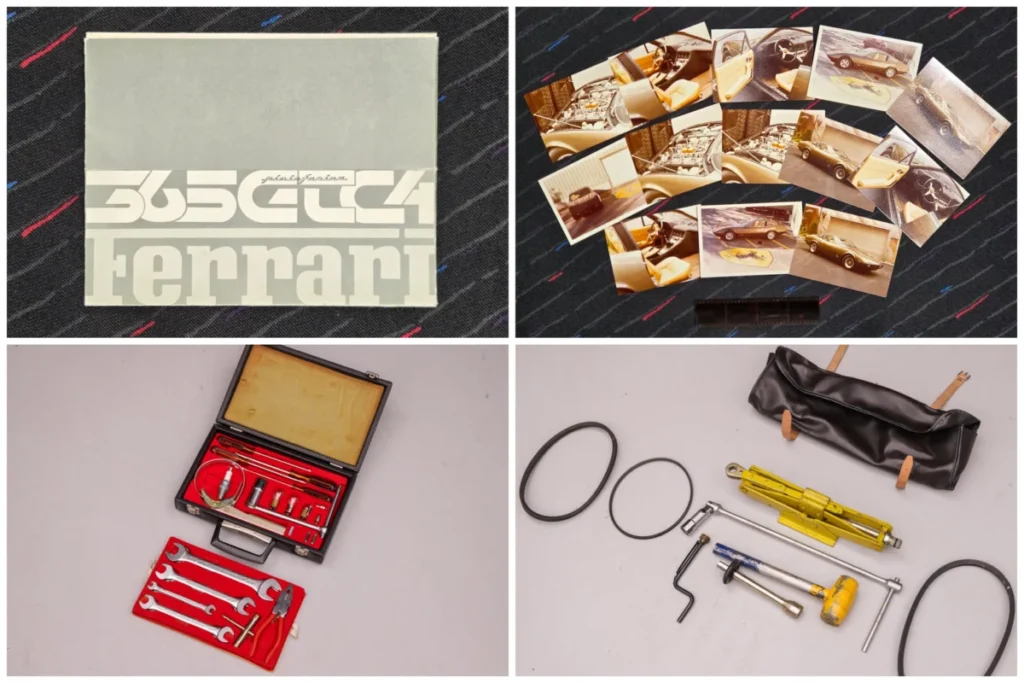
A classic car of this caliber is only as good as its provenance file. The sale of chassis 15647 includes:
- Copies of the original Certificate of Origin
- Historical dealer invoices and partial service records
- An original owner’s manual
- Archival historical photographs of the car
- A matching spare wheel stored beneath the trunk floor
- An authentic tool kit and designated jack bag
Official Responses and Market Perspectives
While the current listing is managed privately through a BaT Local Partner rather than directly via factory channels, market analysts, classic car brokers, and marque historians have closely monitored the trajectory of the 365 GTC/4 model line.

Historically, the GTC/4 was overshadowed by the fierce, competition-bred Daytona. However, modern automotive historians and market experts view the GTC/4 as a vastly superior road car in many respects. Offering easier cabin ingress and egress, lighter power-assisted steering, superior ride compliance courtesy of its self-leveling rear suspension, and genuine 2+2 seating capacity, it represents the ultimate long-distance cruiser of its era.
Marque specialists note that examples with documented ownership chains—such as the Paul Pappalardo provenance associated with chassis 15647—command a significant premium in the current marketplace. Furthermore, vehicles that have undergone documented, high-end restorations by reputable shops like Automotive Restorations offer buyers peace of mind, bypassing the prohibitive costs and lengthy lead times associated with vintage Ferrari mechanical overhauls.
Implications: The Evolution of the Classic Ferrari Market
The public presentation and subsequent sale of chassis 15647 carry broader implications for the vintage Ferrari collector car market.

- The Rise of the "Driver’s GT": For decades, speculative collecting heavily favored pure two-seat sports cars and homologation specials. Today, collectors are increasingly valuing usability. The 365 GTC/4 bridges the gap between raw vintage performance and weekend touring comfort, making it a prime target for enthusiasts who intend to actually drive and enjoy their investments rather than store them in static climate-controlled bubbles.
- The Premium on Provenance and Paperwork: In an era where counterfeit or poorly documented restorations flood the market, comprehensive documentation—ranging from 1970s dealer invoices to modern restoration receipts—acts as a bulletproof insurance policy for buyers. This car’s well-traced history from Chinetti-Garthwaite to Paul Pappalardo sets a gold standard for the model.
- Valuation Correction: As the prices of 365 GTB/4 Daytonas have reached stratospheric heights, the 365 GTC/4 has naturally stepped into the spotlight as an undervalued alternative. Well-maintained examples with rare color combinations like Marrone Colorado over beige are leading a market correction, demonstrating that collectors are willing to pay top dollar for exclusivity, mechanical refinement, and impeccable aesthetic presentation.
Conclusion
The 1972 Ferrari 365 GTC/4 chassis 15647 is more than just a collector’s item; it is a rolling sculpture that encapsulates the golden age of Italian grand touring. With its quad-cam V12 symphony, Pininfarina styling, luxurious Connolly leather interior, and undeniable pedigree, it stands ready to offer its next custodian an uncompromising driving experience. As it crosses the auction block or private sales channel in North Salem, it serves as a timely reminder of why the Prancing Horse remains the most revered badge in automotive history.
