

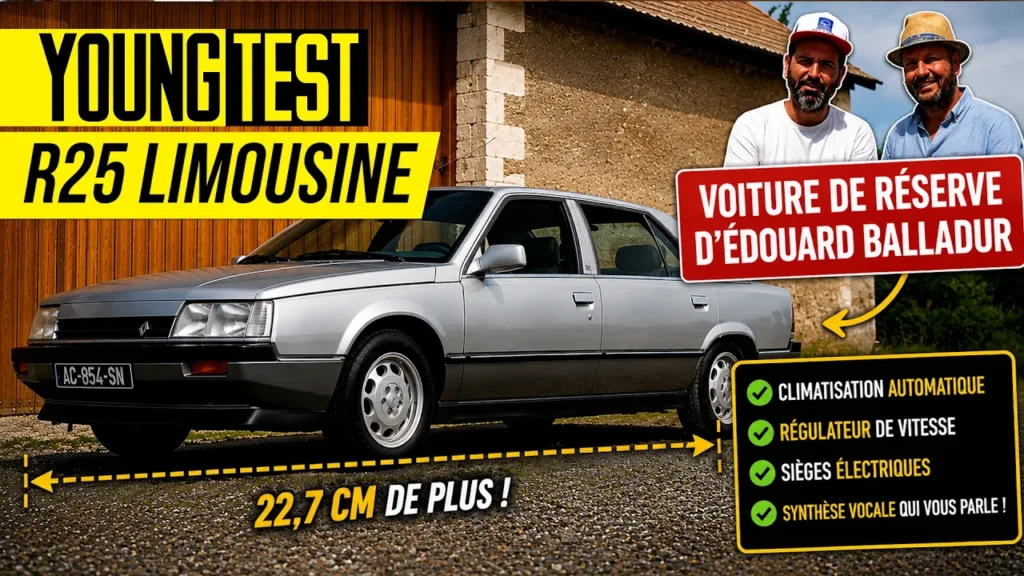
In the pantheon of French automotive history, few vehicles command as much intrigue as the Renault 25 Limousine. While the standard R25 was already a symbol of the French "haut de gamme" in the 1980s, the stretched version—meticulously crafted by the legendary coachbuilder Heuliez—represents a forgotten chapter of industrial ambition, political prestige, and commercial struggle. Recently featured in an in-depth "YOUNGTEST" by Youngtimers La Chaîne, this rare machine has re-emerged to remind us of a time when Renault dared to challenge the German hegemony of Mercedes-Benz and BMW.
Main Facts: A Presidential Pedigree
The vehicle in question is not merely a car; it is a piece of French political history. One of only 832 units ever produced, this specific R25 Limousine served as the official reserve vehicle for Édouard Balladur during his tenure as Minister of Economy, Finance, and Privatization.
The R25 Limousine was designed to be the ultimate statement of French industrial might. By extending the chassis by 22.7 centimeters, Renault and Heuliez created an environment specifically tailored for the nation’s elite. With independent electric rear seats, specialized reading lights, and an executive-class interior, the car was marketed to provide a mobile office for the country’s top decision-makers. However, the prestige came at a cost: the optional "Pack Executive" was so exorbitantly priced that it effectively doubled the cost of the vehicle, landing in the price bracket of an entirely separate Renault Super 5.
Chronology: From Drawing Board to State Service
The Genesis of the Stretch
In the mid-1980s, Renault sought to solidify its position in the executive sedan market. While the R25 was a technological tour de force, it lacked the "stretched" variants that made Mercedes-Benz the undisputed leader of the diplomatic fleet. Partnering with Heuliez, a firm renowned for its expertise in custom bodywork and niche production, Renault launched the Limousine variant.
The Heuliez Collaboration
Heuliez did not simply cut a car in half and add metal. The conversion process was an industrial undertaking that required structural reinforcements to maintain the integrity of the vehicle. By 1985, the first units were rolling off the line. The goal was to provide the "Présidence de la République" and the cabinet ministers with a domestic alternative to the foreign cars that had begun to dominate official motorcades.
The Peak and the Plateau
Throughout the late 1980s, the R25 Limousine became a common sight in the courtyards of the Ministry of Finance and the Élysée Palace. However, as the 1990s approached, the rapid advancement of automotive technology and the shift in consumer preference toward more discreet, reliable, and high-performance German engineering began to eclipse the R25. By the time the Renault Safrane arrived to replace the 25, the Limousine program was already considered a commercial failure, despite its iconic status among collectors today.
Supporting Data: Engineering the "Executive" Experience
To understand why this car was so revered—and so expensive—one must look at the technical specifications and the luxury appointments that defined the era.
Technological Prowess
The R25 Limousine was a flagship for Renault’s technological innovations. It featured:
- Automatic Climate Control: A rarity in the mid-80s, ensuring that ministers remained cool during long, high-stress diplomatic missions.
- Cruise Control: Designed for the long hauls between government facilities.
- Voice Synthesis: Perhaps the most iconic feature of the R25, the car would communicate warnings (e.g., "door open," "low oil pressure") to the driver, a novelty that felt like science fiction at the time.
- Hi-Fi Systems: Equipped with equalizers and high-fidelity sound, allowing the occupant to transition from a grueling budget meeting to the comfort of classical music.
The "Pack Executive"
The most significant aspect of the Limousine was the rear compartment. With nearly 23 centimeters of extra legroom, the back seat was transformed into a boardroom. The independent electric seats allowed for both relaxation and focused work, while the inclusion of cigar lighters and private reading lights catered to the specific habits of the French political class. This "Pack Executive" was an exclusive luxury, representing a level of customization that few manufacturers offered at the time.
Official Responses and Commercial Implications
Why did the R25 Limousine fail to capture the long-term loyalty of the French state? The reasons are multifaceted, spanning economics, reliability, and brand perception.
The German Shadow
The primary competitor for the R25 Limousine was the Mercedes-Benz S-Class (W126). In terms of engineering longevity, engine refinement, and, crucially, a reputation for bulletproof reliability, the German offerings were seen as the "gold standard." While the R25 was innovative, it suffered from the stigma of French electrical reliability—a common complaint of the era that ultimately hindered its adoption as the primary vehicle for high-ranking officials.
Economic Viability
The pricing strategy remains the most puzzling aspect of the project. By charging as much for the Executive package as the price of a small city car, Renault alienated potential private buyers. While the state was the primary client, even government procurement officers began to question the return on investment when foreign alternatives offered lower maintenance costs and higher resale values.
The Legacy of Failure
Despite its commercial struggle, the R25 Limousine succeeded in one major way: it created an enduring legend. Today, the car is a "Youngtimer" icon. It represents a period of French optimism where the government believed it could, and should, support its own automotive industry. The rarity of the 832 units has made them highly sought after by collectors who value the combination of quirkiness, political provenance, and 1980s aesthetic.
Implications: A Lesson for Modern Industry
The story of the Renault 25 Limousine serves as a case study for modern luxury automotive manufacturers. It demonstrates that prestige is not merely a product of high-end features; it is a product of consistency, reliability, and perceived value.
When Nicolas Schumacher, the current owner of the Balladur-era Limousine, speaks of his love for the car, he highlights the "experience." The car is not just a mode of transport; it is a time capsule. It captures the essence of French political culture in the 80s—the style, the ambition, and the slight disconnect between grand industrial dreams and the practical realities of the market.
For modern observers, the R25 Limousine is a reminder that France once possessed the capability to build cars that could stand on the world stage. While it may not have defeated the S-Class in the boardroom, it won the hearts of enthusiasts who appreciate the audacity of a manufacturer that dared to turn a mass-market sedan into a limousine fit for a Prime Minister.
Conclusion
The Renault 25 Limousine Heuliez stands as a monument to a bygone era of French manufacturing. Through the lens of the Youngtimers La Chaîne investigation, we see that the car was more than just a failure or a success—it was a bold experiment in national identity. Whether one would prefer it over a Mercedes-Benz or a BMW is a matter of personal taste, but one cannot deny the historical gravity of the vehicle. As we look back at the, it is clear that the R25 Limousine was, and remains, the ultimate expression of the Renault "haut de gamme" spirit: ambitious, innovative, and unapologetically French.
For those interested in witnessing the majesty of this machine, the recent documentary provided by the team at Youngtimers serves as the definitive look at the history, the mechanics, and the sheer, nostalgic joy of driving a piece of presidential history.
