

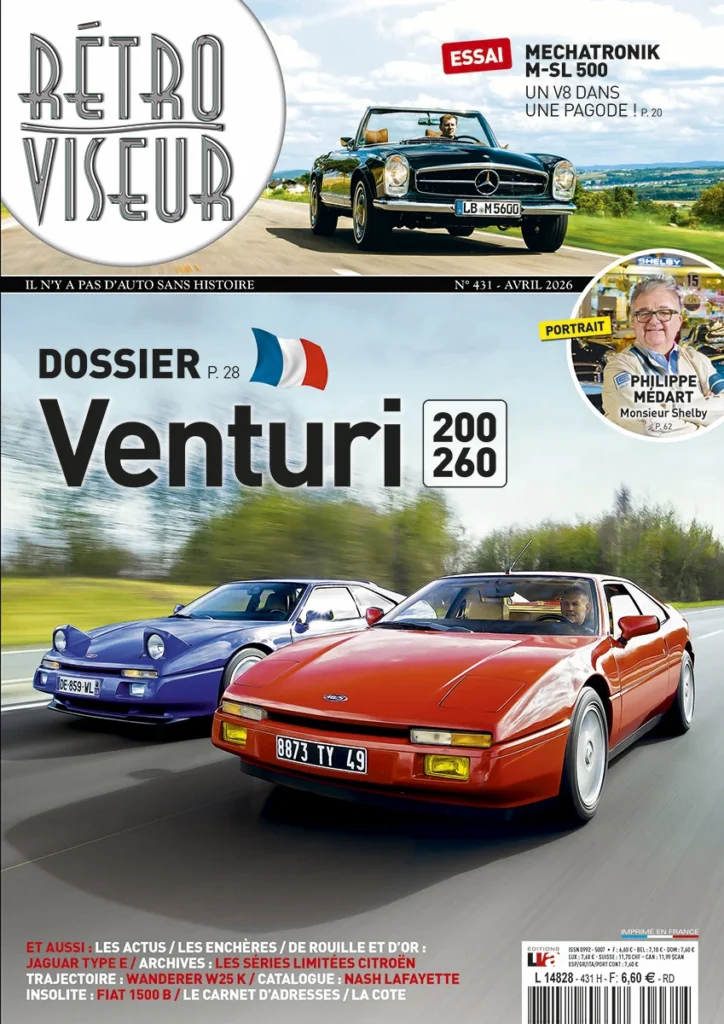
Paris, France – In an era where digital content often dominates, the tactile pleasure and in-depth analysis offered by a meticulously crafted print magazine remain invaluable for dedicated enthusiasts. Such is the case with Rétroviseur, France’s esteemed classic car publication, which, in June 2017, delivered a particularly rich and celebratory issue (N°334) to its readership. Far from being a mere collection of features, this edition served as a vibrant testament to automotive history, marking significant anniversaries for several iconic vehicles and figures that have profoundly shaped the motoring landscape.
From the enduring charm of a post-war French icon to the groundbreaking engineering of a British Formula 1 legend, and the bold statement of a German grand tourer, Rétroviseur N°334 offered a diverse and compelling journey through time. It meticulously explored the legacies of machines and the personalities behind them, presented with the magazine’s characteristic blend of historical rigor, expert analysis, and often, a touch of artistic flair. This issue was not merely a retrospective; it was an affirmation of the cultural significance and lasting appeal of classic automobiles.
Main Facts: A Celebratory Kaleidoscope of Automotive Heritage
The June 2017 issue of Rétroviseur magazine, number 334, was explicitly designed as a special anniversary edition, a vibrant mosaic celebrating pivotal milestones in automotive history. It showcased an eclectic mix of vehicles and an iconic racing personality, spanning different eras, nationalities, and design philosophies, underscoring the rich tapestry of the automotive world.
At the heart of this commemorative issue were three major vehicle anniversaries:
- 70 Years of the Renault 4 CV: France’s beloved "motte de beurre" (butter pat) was honored for its septuagenarian milestone. The magazine delved beyond its well-known role as a symbol of post-war recovery and mass motorization, unearthing rare and original versions, most notably the distinctive Vernet-Pairard coupé. This feature promised a fresh perspective on a car often seen as commonplace, highlighting its versatility and the innovative spirit of its time.
- 50 Years of the Lotus 49: Half a century after its revolutionary debut, the legendary Lotus 49, a machine that fundamentally redefined Formula 1, received a fitting tribute. Rétroviseur‘s team went to extraordinary lengths, locating and featuring the actual chassis driven by the revered Jim Clark. This remarkable find was complemented by an exclusive interview with the son of Colin Chapman, the visionary founder of Lotus, offering unparalleled insights into the car’s design philosophy and its impact on motorsport.
- 40 Years of the Porsche 928: Marking its fortieth anniversary, the audacious Porsche 928, a grand tourer that dared to challenge the very essence of the 911, was not overlooked. The magazine presented a comprehensive test drive of a first-generation model, providing readers with an authentic experience of what it was like to drive this V8-powered icon at its inception. This piece aimed to re-evaluate the 928’s place in Porsche’s pantheon and its enduring appeal.
Beyond these significant vehicular milestones, the issue also paid homage to a human legend:
- Niki Lauda’s 1977 World Championship: The second world title secured by the indomitable Austrian driver Niki Lauda in 1977 was commemorated with a truly unique artistic interpretation. The magazine featured a subject rendered in watercolor, an unconventional approach that promised to capture the spirit and drama of that pivotal championship season in a visually distinctive manner.
Completing this diverse editorial lineup were two additional features on exceptional automobiles:
- The Fiat 8V: This rare and beautiful Italian sports car, often cited as a stylistic precursor to the iconic Ferraris of the 1950s and 1960s, was explored for its design brilliance and historical significance.
- The Maybach Zeppelin V12: Representing the pinnacle of pre-war luxury and engineering, this majestic German limousine offered a glimpse into an era of unparalleled automotive opulence and craftsmanship.
Collectively, these articles underscored Rétroviseur‘s commitment to comprehensive, well-researched, and engaging content, solidifying its reputation as a crucial reference point for classic car enthusiasts worldwide.
Chronology: Tracing the Lines of Automotive History and Publication
The June 2017 issue of Rétroviseur masterfully wove together disparate threads of automotive history, each feature meticulously placed within its own chronological context. To fully appreciate the magazine’s editorial depth, it’s essential to understand the timelines of the subjects themselves, as well as the enduring legacy of Rétroviseur as a publication.
Rétroviseur Magazine: A Pillar of Classic Car Journalism
Rétroviseur has long been recognized as a leading voice in the classic car world, known for its authoritative features, stunning photography, and dedication to historical accuracy. While the exact founding date isn’t in the original snippet, its consistent publication and high standards over decades (implied by issue N°334) establish it as a venerable institution. Its editorial mission consistently revolves around celebrating automotive heritage, unearthing forgotten stories, and providing a platform for expert analysis and passionate discourse among enthusiasts. The June 2017 issue, with its focus on anniversaries, perfectly encapsulates this mission, acting as both a historical record and a contemporary celebration.
The Renault 4 CV: 1947 and Beyond
The Renault 4 CV, often affectionately dubbed "La Motte de Beurre" (the butter pat) due to its rounded shape and pale yellow launch colour, was first unveiled in 1947. Its genesis was rooted in the immediate post-World War II period, a time when France desperately needed affordable, reliable transportation to rebuild its economy and mobilize its population. Designed by Fernand Picard and Edmond Serre, under the guidance of then-Renault CEO Pierre Lefaucheux, the 4 CV became France’s first car to sell over a million units, a monumental achievement that cemented its place in national consciousness. Its 70th anniversary in 2017 was a reminder of its foundational role in French automotive history, a testament to its democratic design and robust engineering that made motoring accessible to the masses. The exploration of "original versions" like the Vernet-Pairard coupé, a creation of the mid-1950s, further illustrated the car’s adaptability and the ingenuity of independent coachbuilders who saw potential beyond its utilitarian origins.
The Lotus 49: The Dawn of a New Era in 1967
The year 1967 marked a seismic shift in Formula 1 with the debut of the Lotus 49. Designed by Colin Chapman and Maurice Philippe, the car’s most radical innovation was its use of the Ford Cosworth DFV engine as a fully stressed structural member, an engineering marvel that revolutionized chassis design. This integration allowed for a lighter, stiffer chassis and improved handling, instantly rendering many contemporary designs obsolete. The 50th anniversary of the Lotus 49 in 2017 was a moment to reflect on its profound impact, not just on the racetrack but on the very philosophy of racing car construction. Jim Clark, a driver synonymous with Lotus, achieved immediate success with the 49, winning on its debut at the Dutch Grand Prix. His association with the chassis featured in the magazine added a layer of profound historical significance, linking the machine directly to one of motorsport’s greatest legends.
The Porsche 928: A Vision for 1977 and Beyond
Introduced at the Geneva Motor Show in 1977, the Porsche 928 represented a bold departure for the Stuttgart marque. Conceived as a potential successor to the iconic 911, it was a luxurious grand tourer with a front-mounted V8 engine and a transaxle layout for optimal weight distribution. Its design, a sleek, futuristic wedge, was a stark contrast to the evolutionary styling of the 911. The 928’s 40th anniversary in 2017 prompted a re-evaluation of its initial reception and its place within the Porsche lineage. While it never fully replaced the 911, it carved out its own niche, offering a different kind of Porsche experience – one focused on long-distance comfort, refined power, and advanced technology for its time. Rétroviseur‘s test of a first-generation model provided crucial insight into the car’s original character, before subsequent iterations added more power and refinements.
Niki Lauda’s 1977 Championship: A Triumph of Resilience
The year 1977 held immense significance for Niki Lauda, marking his second Formula 1 World Championship title. This victory was particularly poignant, coming just a year after his near-fatal crash at the Nürburgring in 1976. His return to competitive racing and subsequent championship win demonstrated unparalleled courage, determination, and mental fortitude. The celebration of this 40th anniversary in 2017 was not merely about statistics; it was about honoring a human spirit that transcended the sport itself. The artistic "watercolor subject" suggests an appreciation for the emotional and aesthetic dimensions of Lauda’s triumph, moving beyond a simple factual recount.
Fiat 8V (1952-1954) and Maybach Zeppelin V12 (1928-1934): Timeless Icons
The Fiat 8V, produced in limited numbers between 1952 and 1954, was an ambitious project for Fiat, an attempt to enter the high-performance sports car market. Its advanced V8 engine and stunning coachbuilt bodies (by firms like Ghia, Zagato, and Vignale) made it a rare and exquisite machine. Its influence on 1950s and 1960s Ferrari styling speaks to its forward-thinking design. The Maybach Zeppelin V12, built between approximately 1928 and 1934, hails from a completely different era. It was a pinnacle of pre-war German luxury, a direct competitor to Rolls-Royce and Cadillac, offering unparalleled opulence and the smooth power of its massive V12 engine. These features, though not anniversary-driven, enriched the issue by showcasing the sheer diversity and craftsmanship across different periods of automotive excellence.
Supporting Data: Unpacking the Details of Engineering and Legacy
The strength of Rétroviseur‘s June 2017 issue lay in its commitment to providing rich supporting data, transforming historical facts into vivid narratives. Each featured vehicle and personality was explored with an attention to detail that satisfied both the casual reader and the most ardent enthusiast.
Renault 4 CV: The French Economic Miracle on Wheels
- Technical Specifications: The 4 CV was powered by a modest 760 cc (later 747 cc) four-cylinder, water-cooled engine mounted in the rear, producing initially around 17 hp, later increasing to 21 hp. This allowed for a top speed of approximately 90-100 km/h (56-62 mph). Its lightweight construction (around 600 kg) and independent four-wheel suspension contributed to its nimble handling and surprising comfort for a car of its class.
- Production Numbers: With over 1.1 million units produced between 1947 and 1961, the 4 CV was instrumental in the mass motorization of France. Its robust construction made it suitable for diverse uses, from family transport to light commercial duties.
- Cultural Significance: Beyond its utility, the 4 CV became a cultural icon, symbolizing post-war resilience and the democratization of motoring. It was affectionately known as "La 4 Pattes" (the four paws) or "La Motte de Beurre."
- The Vernet-Pairard Coupé: This specific version, likely featured for its originality, was one of several coachbuilt variants. Vernet and Pairard were French tuners and coachbuilders who, in the mid-1950s, transformed the humble 4 CV into a sleek, aerodynamic coupé, often for racing purposes (e.g., at Le Mans or the Mille Miglia). These limited-production models showcased the car’s underlying chassis potential and the ingenuity of independent artisans, moving it from a basic family car to a sporty, albeit small, GT.
Lotus 49: The Cosworth DFV Revolution
- Technical Details: The heart of the Lotus 49 was the revolutionary Ford Cosworth DFV (Double Four Valve) V8 engine. This 3.0-liter, normally aspirated engine produced approximately 400-410 hp, a significant increase over its predecessors, and was integrated directly into the chassis as a fully stressed member. This innovative approach eliminated the need for a traditional subframe for the engine, reducing weight and increasing torsional rigidity. The car featured a semi-monocoque construction, disc brakes all around, and advanced suspension geometry.
- Impact on F1 Design: The DFV engine’s structural integration became the standard for F1 car design for decades, influencing countless subsequent chassis. The 49’s performance, combined with Jim Clark’s talent, led to immediate success, winning on its debut.
- Jim Clark’s Connection: Clark’s mastery of the Lotus 49 (he won four races with it in 1967 and the 1968 South African Grand Prix) cemented its legendary status. The feature on his specific chassis offered a tangible link to a pivotal moment in motorsport history and one of its greatest drivers.
- Colin Chapman’s Son Interview: The interview with Clive Chapman, Colin Chapman’s son and director of Classic Team Lotus, would undoubtedly provide invaluable insights into his father’s design philosophy: "Simplify, then add lightness." It would likely cover the challenges and triumphs of the 49’s development, its impact on the team, and perhaps personal anecdotes about Jim Clark and the era.
Porsche 928: The Grand Tourer Statement
- Technical Details: The 928 was powered by an all-aluminium, water-cooled 4.5-liter SOHC V8 engine, initially producing 240 hp. This was mated to a rear-mounted transaxle (either a 5-speed manual or 3-speed automatic), ensuring near-perfect 50/50 weight distribution. Its innovative "Weissach axle" was a passive rear-wheel steering system designed to counteract lift-off oversteer, enhancing stability.
- Design Philosophy: The 928 was envisioned as a sophisticated, comfortable, and powerful grand tourer, aimed at a more mature and affluent clientele than the raw 911. Its sleek, aerodynamic body with integrated bumpers and pop-up headlights was a clear break from Porsche tradition.
- Performance Figures: A first-generation 928 could accelerate from 0-100 km/h (0-62 mph) in around 6.8 seconds and reach a top speed of approximately 230 km/h (143 mph), making it a formidable performer for its time.
- Test Drive of a First-Generation Model: This focused approach allowed Rétroviseur to capture the unadulterated essence of the original 928, before later iterations introduced larger engines, more power, and subtle design changes. It would highlight the car’s initial blend of luxury, performance, and advanced engineering.
Niki Lauda’s 1977 Season: Resilience in Watercolor
- Specifics of the Season: Lauda, driving for Scuderia Ferrari, demonstrated incredible consistency and strategic brilliance throughout the 1977 season. Despite internal team tensions and his continued physical recovery, he secured three wins and consistent podium finishes, ultimately clinching the championship before the final two races.
- The "Watercolor Subject": This artistic choice suggests a departure from traditional race photography or technical diagrams. A watercolor depiction would likely focus on capturing the emotion, the movement, and the dramatic atmosphere of Lauda’s season, perhaps illustrating specific race moments or portraits in a softer, more evocative style, lending a unique artistic interpretation to a historical sporting triumph.
Fiat 8V & Maybach Zeppelin V12: Design and Opulence
- Fiat 8V: This rare gem (only 114 produced) featured an advanced 2.0-liter V8 engine producing around 105 hp. Its most striking feature, however, was its diverse array of coachbuilt bodies from Italy’s finest carrozzerias – Ghia’s "Supersonic," Zagato’s double-bubble roof, Vignale’s elegant designs. Rétroviseur would detail how these design cues, particularly the flowing lines and aggressive stance, influenced subsequent Italian sports car design, notably shaping the aesthetics of early Ferraris and Maseratis.
- Maybach Zeppelin V12: Representing automotive royalty, the Zeppelin featured a massive 7.0-liter or 8.0-liter V12 engine, producing around 150-200 hp. This enormous power unit propelled a chassis adorned with custom coachwork from firms like Spohn, offering unparalleled luxury amenities for the era, including lavish interiors, bespoke fittings, and an air of exclusivity. Rétroviseur‘s feature would undoubtedly highlight its engineering marvel, its opulent design, and its status as a symbol of pre-war industrial grandeur and personal wealth.
Official Responses: Echoes from History and the Present
For a magazine issue celebrating historical anniversaries, "official responses" can be interpreted in several ways: the voices of those directly involved, the official stance of the manufacturers on their heritage, and the broader reception within the classic car community.
- Voices from the Past and Present: The most direct "official response" within the June 2017 issue came from the interview with Clive Chapman, son of Lotus founder Colin Chapman. His insights into the Lotus 49 would offer an invaluable perspective, not just on the technical development but on the ethos of Team Lotus during its golden era. Such an interview serves as a direct link to the creative and competitive spirit that birthed the car. Similarly, articles on the Renault 4 CV or Porsche 928 would likely incorporate historical quotes from their designers, engineers, or marketing teams, providing context to their original intent and challenges.
- Manufacturer Heritage Stance: While not explicitly stated as "official responses" in the snippet, it’s highly probable that Rétroviseur would reflect the contemporary attitudes of Renault, Lotus (via Classic Team Lotus), and Porsche towards their respective heritage models. These manufacturers actively celebrate their past, maintaining heritage collections, supporting classic events, and often reissuing parts. Their implicit "response" to these anniversaries is one of pride and recognition of their foundational contributions to automotive history. Renault, for instance, often highlights the 4 CV as a cornerstone of its post-war recovery and its first million-seller, a symbol of French ingenuity. Porsche, while initially hesitant about the 928’s legacy compared to the 911, has increasingly embraced it as a significant part of its grand tourer lineage.
- The Classic Car Community’s Endorsement: The publication of such a comprehensive and celebratory issue by Rétroviseur itself constitutes an "official response" from the classic car journalistic establishment. It signals that these vehicles and individuals are deemed worthy of significant recognition, reinforcing their status as icons. The magazine, acting as a curator of automotive history, officially endorses the enduring relevance and cultural impact of these anniversaries, encouraging enthusiasts to revisit and appreciate their legacies.
- Artistic Interpretations as Response: The decision to feature Niki Lauda’s 1977 championship in watercolor can also be seen as an editorial "response" to the traditional modes of historical reporting. It’s an official endorsement of artistic expression as a valid and evocative way to convey historical significance, adding emotional depth that purely factual accounts might miss. It’s a statement about the multi-faceted nature of automotive appreciation, extending beyond mechanical specifics to the realm of art and human drama.
Implications: Beyond the Page – Impact and Legacy
The June 2017 issue of Rétroviseur was more than just a collection of articles; its meticulous curation and celebratory tone carried significant implications for the classic car community, the featured marques, and the broader appreciation of automotive history.
- For Rétroviseur Magazine: Reinforcing Editorial Leadership: The publication of such a rich and diverse anniversary issue solidified Rétroviseur‘s position as a leading authority in classic car journalism. By going to the effort of finding Jim Clark’s Lotus 49 chassis and interviewing Colin Chapman’s son, the magazine demonstrated its commitment to unparalleled research and exclusive content. This enhances its reputation for editorial depth and strengthens its appeal to discerning readers who seek more than superficial articles. It underscores the continued relevance of high-quality print media in an increasingly digital landscape, proving that curated, in-depth narratives still hold immense value.
- For Classic Car Enthusiasts: Education, Inspiration, and Preservation: For the readership, the implications were profound. The issue provided invaluable educational content, offering fresh perspectives on well-known models (like the 4 CV’s original versions) and deep dives into engineering marvels (Lotus 49, Porsche 928). Such detailed features inspire new generations of enthusiasts, encouraging them to explore the history, mechanics, and aesthetics of these vehicles. By celebrating these anniversaries, Rétroviseur also implicitly champions the cause of classic car preservation, reminding owners and collectors of the historical significance of their machines and the importance of their upkeep. The blend of technical data, historical context, and personal stories (like Lauda’s resilience) enriches the enthusiast’s understanding and appreciation of automotive heritage.
- For the Automotive Industry: Acknowledging Heritage and Brand Storytelling: For manufacturers like Renault, Lotus (via Classic Team Lotus), and Porsche, such comprehensive coverage in a respected publication is invaluable. It serves as a powerful form of brand storytelling, reminding contemporary consumers and industry professionals of the rich history, innovation, and design legacy that underpin their current products. Celebrating anniversaries through media coverage helps to reinforce brand identity, evoke nostalgia, and demonstrate a continuous thread of engineering excellence and cultural impact across decades. It allows these marques to connect their past glories with their future aspirations.
- Broader Cultural Impact: Automotive History as a Reflection of Society: The diverse selection of vehicles in the issue, from the post-war austerity and democratization represented by the Renault 4 CV, to the technological leaps and competitive spirit of the Lotus 49, and the luxury and engineering prowess of the Porsche 928 and Maybach Zeppelin, collectively illustrate how automobiles are not merely modes of transport but cultural artifacts. They reflect the economic conditions, technological capabilities, design trends, and societal aspirations of their respective eras. The issue, therefore, contributes to a broader understanding of automotive history as an integral part of human cultural and industrial development.
- Market Implications: Reinforcing Value and Interest: While a single magazine issue might not directly cause market shifts, consistent, high-quality coverage of classic cars, especially those marking significant anniversaries, contributes to the overall narrative that underpins their value and collector interest. By highlighting rare versions (Vernet-Pairard 4 CV) or significant historical examples (Jim Clark’s chassis), Rétroviseur subtly reinforces the desirability and historical importance of these vehicles, which can, over time, contribute to their appreciation in the collector market.
In essence, Rétroviseur‘s June 2017 anniversary issue was a masterclass in automotive journalism. It not only celebrated the past but also underscored the enduring relevance and profound implications of classic cars in shaping our present and informing our future understanding of engineering, design, and cultural evolution.
