

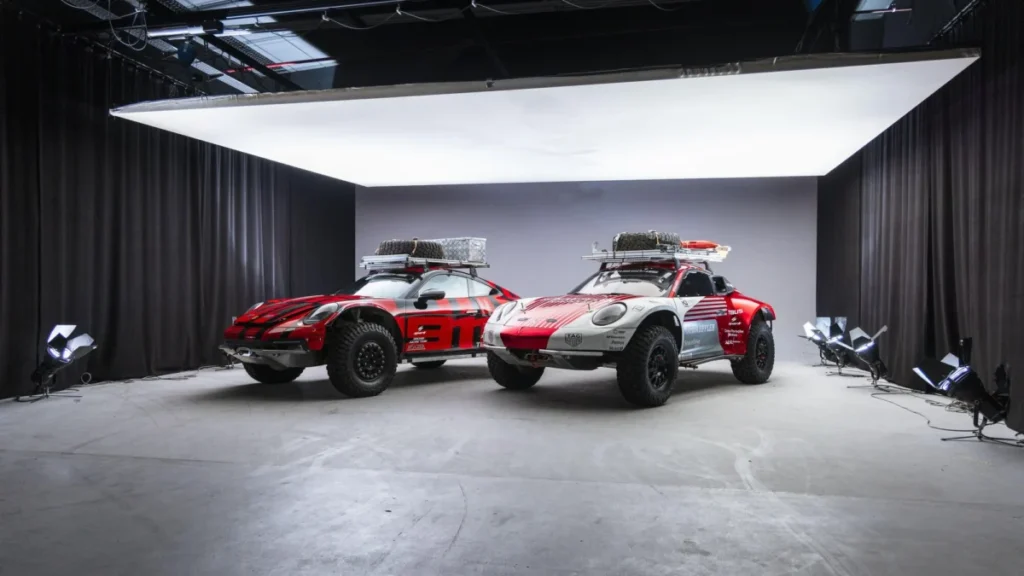
Forget the hallowed asphalt of the Nürburgring Nordschleife or the high-speed validation runs on the German Autobahn. Porsche, a brand synonymous with track-focused precision and record-breaking lap times, has officially shifted its gaze toward the heavens. In a daring feat of engineering and human endurance, the Stuttgart-based manufacturer has redefined the boundaries of automotive capability by conquering the Ojos del Salado in Chile—the highest active volcano on the planet.
Until June 28, 2026, the Porsche Museum in Stuttgart is playing host to an extraordinary exhibition titled "Summit of Achievement." The stars of this show are not sleek, low-slung supercars, but rather two rugged, battle-hardened prototypes affectionately dubbed "Edith" and "Doris." These two 911s did not just drive; they ascended to an altitude of 6,721 meters, setting a world record for terrestrial vehicles and proving that the spirit of the Porsche 911 is truly boundless.
Main Facts: The Anatomy of a High-Altitude Predator
At first glance, the casual observer might mistake these machines for the standard 992-generation Carrera 4S. However, under the skin, these vehicles represent a radical departure from the refined sports cars found in suburban garages. The mission was clear: traverse terrain that would stop a standard off-roader in its tracks and survive in an environment where oxygen levels are thin enough to starve a standard internal combustion engine.
"Edith" and "Doris" were born from the necessity of exploration. "Doris" served as the initial development mule, providing the data necessary to refine the suspension and cooling systems, while "Edith" represents the final, lightweight iteration. To achieve the 6,721-meter summit, engineers implemented a series of modifications that push the limits of automotive physics:
- Portal Axles: These were integrated to increase ground clearance significantly, allowing the vehicles to clear jagged volcanic rocks that would otherwise destroy the undercarriage.
- Aramid Underbody Protection: The belly of each car was shielded by ultra-resilient, lightweight fiber-aramid plates, designed to withstand the crushing weight and sharp edges of the Chilean volcanic scree.
- Weight Reduction: "Edith," the final evolution, underwent a draconian diet, shedding 360 kilograms of mass to improve power-to-weight ratio in the oxygen-deprived thin air.
- Steer-by-Wire: To manage the unpredictable terrain, the steering system was adapted to ensure precision despite the jarring impacts of boulder fields.
Chronology: A Journey to the Clouds
The expedition was not a weekend excursion; it was the culmination of years of logistical planning and mechanical trial-and-error. Led by Romain Dumas, a legendary Porsche factory driver and Le Mans winner, the team faced conditions that shifted from arid desert heat to sub-zero alpine temperatures in a matter of hours.
Phase 1: The Foundation (Development)
Before the vehicles touched Chilean soil, Porsche engineers spent months in the laboratory. The primary challenge was the internal combustion engine. At 6,000 meters, the air pressure is approximately half that at sea level. The engine management systems had to be completely remapped to prevent the 911s from stalling or overheating.
Phase 2: The Ascent
The expedition began at the base of the Ojos del Salado. As the vehicles climbed, the terrain transitioned from dusty trails to steep, rock-strewn inclines. The team had to navigate fields of "penitentes"—sharp, blade-like snow formations—that required constant adjustment of the 911’s drive modes.
Phase 3: The Record
On the final push, the team encountered extreme weather and altitude sickness. Romain Dumas described the final meters as a battle of attrition, where every input on the steering wheel had to be deliberate. When the GPS confirmed 6,721 meters, the team didn’t just break a record; they validated a philosophy.
Supporting Data: Engineering in the Death Zone
To understand the magnitude of this achievement, one must look at the constraints of the environment. At the summit of Ojos del Salado, the air is not just thin; it is hostile. Standard engine combustion is severely hampered, and the lack of atmospheric pressure makes cooling radiators significantly less efficient.
| Metric | Standard 911 Carrera 4S | 911 "Edith" Prototype |
|---|---|---|
| Ground Clearance | 120 mm | 350 mm |
| Weight | ~1,565 kg | ~1,205 kg |
| Tire Profile | Performance Road | Large-Diameter Off-Road |
| Engine Cooling | Standard | High-Altitude Optimized |
The use of portal axles was perhaps the most critical engineering decision. By offsetting the wheel center from the axle center, the team achieved a ground clearance that allows the car to "step" over obstacles that would ground a standard vehicle. Furthermore, the specialized tires were engineered to be run at exceptionally low pressures, providing a massive contact patch on loose volcanic ash.
Official Responses and Curatorial Vision
The curation of the Porsche Museum exhibition reflects the gravity of the feat. Tanja Schleicher, the lead curator, insisted that the cars be placed at the highest point of the museum’s architectural path—a symbolic "epilogue" to the visitor’s journey through Porsche’s history.
"We wanted to translate the altitude record into a spatial experience," Schleicher explained during the exhibition’s opening. "When you walk through the museum, you ascend chronologically. Placing Edith and Doris at the literal peak of the building underscores that this is not just a footnote in our history; it is the current ceiling of our ambition."
Romain Dumas, reflecting on the expedition, highlighted the human element: "It was never just about the machine. It was about trust. I had to trust that the car, which had been modified so extensively, would not fail me when the nearest mechanic was hours away. The 911 is a robust platform, but at 6,000 meters, you realize you are merely a guest on the mountain."
Implications: The Future of Porsche Adventuring
The success of the "Sonderwunsch" (special wish) project behind the Ojos del Salado expedition has sent ripples through the automotive industry. It has effectively decoupled the Porsche brand from the narrow definition of "track car."
By proving that the 911 architecture is modular and resilient enough to survive the world’s most extreme environments, Porsche has opened a door to a new customer demographic: the luxury adventurer. The technology developed for "Edith"—particularly in the realms of advanced cooling and lightweight structural reinforcement—will likely find its way into future "Dakar" or "Safari" variants of the 911, which are seeing unprecedented demand.
Moreover, the expedition serves as a powerful marketing statement regarding the 911’s reliability. In an era where many performance cars are viewed as "fragile," the image of a 911 covered in volcanic dust at 6,721 meters serves as a badge of honor. It suggests that the 911 is not a car to be kept in a climate-controlled garage, but a tool meant for exploration, regardless of the terrain.
For those unable to visit Stuttgart, Porsche has released the 15-minute documentary Raceborn Moment on their official YouTube channel. The film is a visceral, high-definition look at the expedition, capturing the anxiety of the team and the sheer impossibility of the terrain. It serves as a fitting tribute to the 75th anniversary of Porsche in motorsport—a celebration that looks back at the track but keeps its eyes firmly on the horizon.
As we look toward the future, one question remains: if a 911 can climb the highest volcano on Earth, what is left for it to conquer? Perhaps the desert dunes of the Sahara, or the frozen tundra of the Arctic. For Porsche, the altitude of 6,721 meters is not a final destination; it is simply the new baseline.
