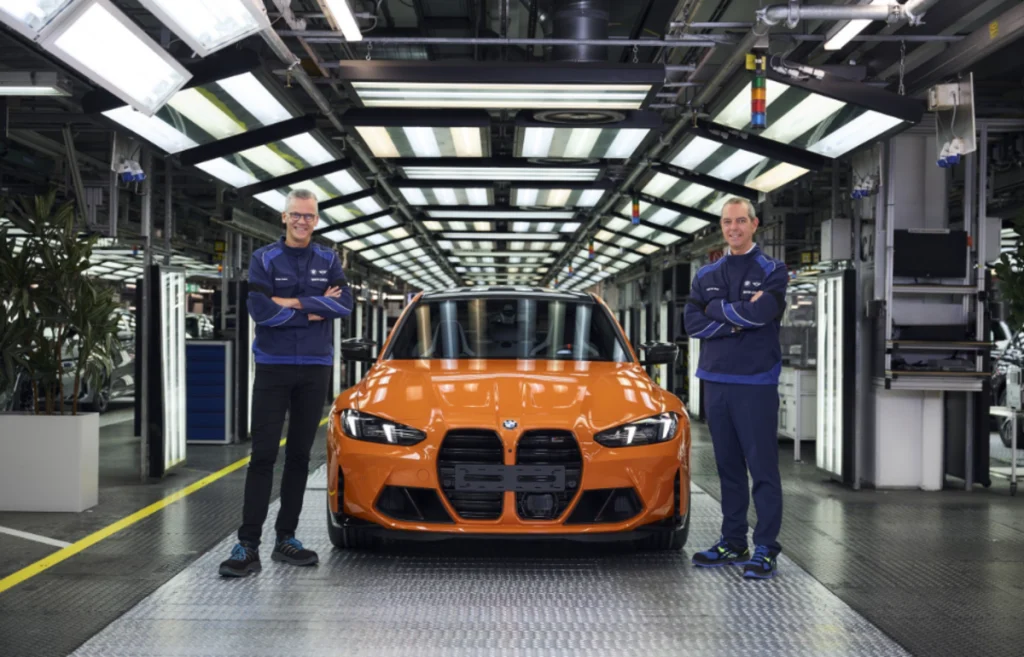
MUNICH, Germany — In an industrial milestone that bridges five decades of motorsport heritage with the dawn of the electric vehicle (EV) revolution, BMW M has officially produced its one-millionth vehicle. The landmark model—a high-performance BMW M3 finished in a striking, bespoke BMW Individual Fire Orange III paintwork—rolled off the assembly line at the historic BMW Group plant in Munich.
During an official ceremony that underscored both past triumphs and future ambitions, Peter Weber, Director of the Munich plant, presented the milestone vehicle to Franciscus van Meel, CEO of BMW M GmbH. This achievement marks more than 50 years of high-performance engineering, technological innovation, and an unwavering commitment to emotional driving dynamics. However, the celebration of this numeric plateau is equally a launchpad for the future: BMW M used the occasion to officially detail its roadmap toward electrification, headlined by the upcoming development of the first-ever 100% electric BMW M3, built upon the revolutionary Neue Klasse architecture.
Main Facts: A Million Icons of Performance
The production of the one-millionth BMW M vehicle is a testament to the enduring appeal of a brand that successfully democratized track-ready performance without sacrificing everyday usability.
- The Milestone Vehicle: A BMW M3 Sedan finished in BMW Individual Fire Orange III, symbolizing the vibrant and rebellious spirit of the M division.
- The Location: The core BMW Group plant in Munich, a facility with over a century of industrial heritage.
- The Leadership Handover: Presented by Munich Plant Director Peter Weber to BMW M CEO Franciscus van Meel.
- The Next Frontier: Confirmation that the next-generation BMW M3 will be fully electric, utilizing the cutting-edge Neue Klasse EV platform.
- The Industrial Transformation: The Munich plant is undergoing a massive €650 million overhaul, transitioning exclusively to all-electric vehicle production by 2027.
For Franciscus van Meel, the million-vehicle milestone proves that the foundational ethos of BMW M remains as potent today as it was when the first M-badged road cars took to the asphalt.
"BMW M has always stood for the ultimate synthesis of road-going capability, circuit-bred performance, and uncompromised daily practicality," van Meel stated during the ceremony. "Reaching one million units is a profound validation of our customers’ passion. As we approach the 40th anniversary of the commercial launch of the very first BMW M3, this milestone serves not as a finish line, but as a catalyst. We are aggressively expanding our high-performance portfolio, and the upcoming BMW M Neue Klasse models—featuring our first high-performance battery-electric vehicles—will redefine what is possible in the segment."
Chronology: Five Decades of Adrenaline and the Road to One Million
To understand the weight of BMW M’s latest milestone, one must look back at the evolutionary timeline of the Munich-based performance division, which transformed from a specialized motorsport department into a global powerhouse of luxury performance.
1972–1985: The Genesis of Motorsport
BMW Motorsport GmbH was founded in May 1972 under the leadership of Jochen Neerpasch, initially conceived to consolidate BMW’s various racing activities. Armed with the legendary tri-color stripe (Light Blue, Dark Blue, and Red), the division quickly dominated touring car racing. While early projects like the mid-engined BMW M1 captured imaginations, it was the decision to inject racing DNA into series-production sedans that changed automotive history forever.
1986: The Birth of a Legend — The E30 M3
Originally developed as a homologation special for Group A touring car racing, the first BMW M3 (based on the E30 3 Series) debuted in 1986. Featuring a high-revving naturally aspirated four-cylinder engine, widened fenders, and a vastly revised chassis, the E30 M3 dominated global motorsport and instantly won over driving enthusiasts. It laid the commercial and emotional bedrock for what would become the most successful letter in automotive history.
The Expansion of the Portfolio
Over the subsequent decades, the "M" treatment expanded systematically across BMW’s lineup. From the iconic inline-six engines of the E36 and E46 generations to the high-revving V8s and twin-turbocharged powerplants of the modern era, the M badge grew from a niche enthusiast symbol into a global phenomenon. Models like the M5, M4, and various SAV (Sports Activity Vehicle) derivatives such as the X5 M and X3 M broadened the brand’s reach.
2020–Present: The Current Generation and Electrified Horizons
Production of the current-generation M3 kicked off in Munich in 2020, forging a deep emotional bond between the current workforce and the vehicle. Now, with the completion of the millionth unit, BMW M stands on the precipice of its greatest technological transition yet: moving away from pure internal combustion engines toward high-performance electrification without losing the soul of the drive.
Supporting Data: The Industrial Transformation of Munich
The transition to electrification is not merely a product strategy; it requires a radical reimagining of manufacturing infrastructure. The choice of the Munich plant to build the upcoming electric M3 is a deliberate nod to history, marrying the birthplace of the M3 with the future of BMW manufacturing.
The €650 Million Investment
To prepare the historic Munich site for the Neue Klasse era, the BMW Group is investing approximately €650 million. This capital expenditure is transforming the century-old plant into a cutting-edge facility capable of manufacturing next-generation electric vehicles alongside legacy models during the transitional phase.
A Factory Transformed
Approximately one-third of the total plant area has been completely overhauled or newly constructed. This includes:
- A State-of-the-Art Body Shop: Engineered specifically to handle the structural demands and lightweight materials of Neue Klasse architectures.
- Advanced Assembly Lines: Integrating flexible, highly digitalized manufacturing processes that allow seamless integration between different powertrain types.
- Optimized Logistics Zones: Designed to streamline supply chains and component delivery, particularly for heavy high-voltage battery packs.
The 2027 All-Electric Deadline
The Munich plant is on a strict timetable. Starting in 2027, the factory will phase out internal combustion engine production entirely. From that year forward, the Munich site will build 100% electric vehicles exclusively. The plant’s second Neue Klasse model will be the fully electric high-performance M3, proving that sustainable mobility and extreme track-capable performance can coexist on the same assembly line.
Official Responses and Leadership Insights
The leadership team at BMW Group and BMW M views the one-millionth vehicle milestone not as a retrospective celebration, but as an operational springboard.
Peter Weber, Director of the Munich Plant:
"There is a profound emotional connection between our workforce here in Munich and the BMW M3. Many of our employees have been building the current generation since 2020, putting their expertise and heart into every single car. To be chosen as the exclusive manufacturing home for the first-ever fully electric M3 is a tremendous honor. It validates our strategy, secures the long-term future of this historic site, and proves that our workforce is fully equipped to lead BMW into the electric age."
Franciscus van Meel, CEO of BMW M GmbH:
"Reaching one million vehicles is a landmark that belongs to our fans, our engineers, and our production teams. But automotive passion cannot rest on past glories. Our customers expect the next million vehicles to deliver the same pulse-quickening dynamics they have come to love. By leveraging the revolutionary technology of the Neue Klasse, our future high-performance electric vehicles will open up entirely new dimensions of driving dynamics, agility, and precision."
Implications: What the Electric M3 Means for the Performance Car Industry
The announcement of an all-electric BMW M3 based on the Neue Klasse architecture carries profound implications for the high-performance automotive sector.
1. Redefining Electric Dynamics
For years, skeptics argued that battery-electric vehicles (BEVs) were too heavy and devoid of emotional engagement to wear a genuine motorsport badge. BMW M’s integration into the Neue Klasse platform aims to shatter this narrative. The Neue Klasse architecture introduces radical innovations in battery cell design, thermal management, and multi-motor torque vectoring. For an M3, this means instantaneous throttle response, hyper-precise chassis control, and power delivery that can match—and potentially exceed—the capabilities of legacy combustion engines.
2. Safeguarding Heritage in a Zero-Emission World
By anchoring the future electric M3 in Munich—the very cradle of the M3 lineage—BMW is sending a clear psychological signal to purists. The brand is not abandoning its heritage to chase environmental regulations; rather, it is weaponizing electrification to elevate its heritage. The transition proves that high-performance brands can embrace net-zero targets without diluting the core DNA that made them legends in the first place.
3. Setting a Manufacturing Benchmark
The €650 million overhaul of the Munich plant establishes a blueprint for how legacy automotive manufacturing hubs can successfully pivot to electric vehicle production without shutting down operations. By integrating modern digital tools, flexible assembly layouts, and sustainable logistics into a 100-year-old facility, BMW is demonstrating industrial resilience at the highest level.
Conclusion
As the BMW Individual Fire Orange III M3 rolls into a museum or a private collection as the millionth M vehicle, the countdown has already begun for its successor. When the first all-electric M3 emerges from the newly modernized Munich plant, it will not only inaugurate a new chapter for BMW M—it may well redefine what the world expects from a high-performance sports sedan.