

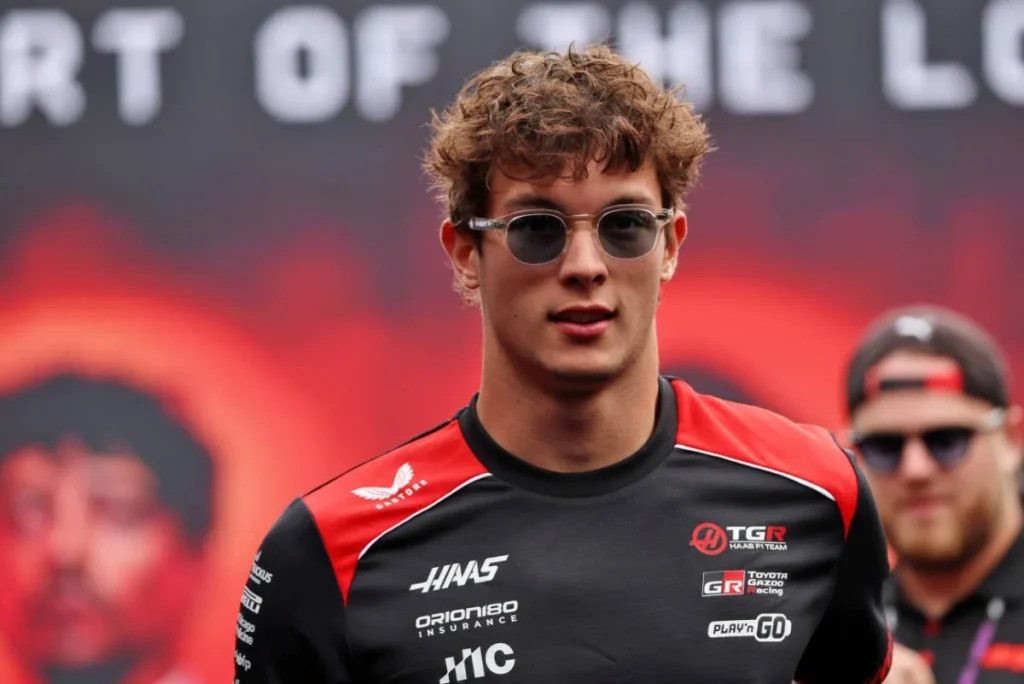
The Formula 1 paddock is no stranger to heated debates over the consistency of race stewarding, but the aftermath of the United States Grand Prix at the Circuit of the Americas (COTA) has reignited the conversation with renewed intensity. At the center of the controversy is Haas rookie Oliver Bearman, whose promising outing in Austin ended in an early retirement, punctuated by a ten-second time penalty that he has publicly decried as "completely disproportionate" and "shocking."
For the young Briton, the penalty—issued following a mid-race collision with Alpine’s Pierre Gasly—represents more than just a regulatory dispute; it highlights a broader concern regarding the perceived lack of consistency in how the FIA stewards apply rules to on-track battles. As the dust settles on the Austin weekend, the incident serves as a microcosm of the pressures faced by drivers attempting to navigate the thin line between aggressive racing and regulatory compliance.
The Incident: A Strategic Gamble Gone Wrong
The flashpoint occurred shortly after the restart following a Virtual Safety Car (VSC) period. Having managed his restart with precision, Bearman found himself locked in a tactical battle with Pierre Gasly. As the field thundered toward the heavy braking zone of Turn 12, Bearman sensed an opportunity. Capitalizing on the slipstream and the unique geometry of the COTA layout, the Haas driver committed to an ambitious move down the inside at Turn 13.
In his pursuit of the overtake, Bearman mounted the curb to maximize his angle and velocity. While he successfully drew level with the Alpine, a slight miscalculation—or perhaps the inherent difficulty of the maneuver—resulted in his front-left tire making contact with the right sidepod of Gasly’s car.
The stewards, tasked with policing "causing a collision," acted swiftly. Within moments, they placed the incident under investigation and subsequently handed down a ten-second time penalty to the Haas rookie. While the contact was relatively light in terms of raw kinetic energy, the mechanical consequences for Bearman’s VF-24 were, ironically, catastrophic.
A "Shocking" Ruling: Bearman’s Defense
Speaking to the media after his retirement, a clearly agitated Bearman did not mince words. He expressed disbelief at the severity of the sanction, arguing that the maneuver was a textbook example of a racing incident that should have been left unpunished.
"I was quite shocked, to be honest," Bearman stated. "At worst, it was a racing incident. I found it particularly unfair to receive a ten-second penalty, especially when you look at certain incidents that have occurred throughout this year that resulted in no sanction, or at most five seconds. Ten seconds for this type of incident seems truly excessive, given the context."
Bearman’s core argument centers on the principle of "fair racing." He asserts that he had performed the initial phase of the overtake perfectly, maintaining control of his vehicle without locking his brakes or sliding off-track. "I was on the inside, I had the positioning, and I was making the corner," he added. "Once I had committed to the move, I couldn’t simply disappear. I didn’t lock a wheel, and I didn’t lose control. To be penalized so heavily for a tight, hard-fought wheel-to-wheel battle is, in my view, completely crazy."
The Domino Effect: From Contact to Catastrophe
While the ten-second penalty dominated the post-race headlines, Bearman was quick to point out that the regulatory punishment was secondary to the physical damage the car sustained. The contact, though appearing minor to observers, had dealt a lethal blow to the Haas’s underbody.
"The most penalizing aspect was the damage," Bearman explained. "The contact was light, but it practically detached a portion of the floor. Under the vibration of high-speed cornering, the damage propagated. For about five laps, the car held together, but then it began to deteriorate rapidly until it became unmanageable."
The failure of the floor, a critical component for generating downforce in modern ground-effect F1 cars, rendered the Haas unstable. As the car’s handling characteristics shifted from lap to lap, Bearman found himself fighting a losing battle. Eventually, for safety reasons and to protect the power unit and other internal components from further stress, the team and driver agreed that retiring the car was the only logical course of action.
"It was becoming dangerous," he noted. "The car was totally unpredictable. I had to consider the mileage on the engine and the other components. I went from having manageable damage to catastrophic failure in a very short span of time. At that point, I knew my race was effectively over."
Team Dynamics: The "Selfless" Decision to Yield
Perhaps the most revealing moment of Bearman’s race occurred just before his retirement. Recognizing that his car was compromised and that his teammate, Esteban Ocon, was in a position to push for a better result, Bearman made the unilateral decision to let the Frenchman pass without waiting for instructions from the pit wall.
This act of sportsmanship highlights the internal culture at Haas, where the fight for the Constructors’ Championship—specifically their battle against Audi—takes precedence over individual ego.
"I didn’t want to hold him up," Bearman explained. "That’s not why I’m here. We are fighting as a team. I knew that if I hadn’t made the move, the team would have asked me to do so a lap later. But that half-lap could have cost Esteban a second or more, given how damaged my car was. It was an obvious decision."
This level of maturity is rare in a rookie, yet it underscores the professional standards Haas expects from its drivers. By sacrificing his own track position, Bearman prioritized the team’s points tally, even though his own race would ultimately end in the garage.
Implications for the Championship and Stewarding
The fallout from the COTA incident reaches beyond the specific frustration of one driver. It serves as a reminder of the ongoing challenge the FIA faces regarding the consistency of the "Driver Guidelines." Throughout the 2024 season, the threshold for what constitutes an illegal overtake has fluctuated, leading to widespread confusion among drivers and teams alike.
When drivers like Bearman cite "previous incidents" as a point of comparison, they are pointing to a systemic issue: the subjective interpretation of the rules. If one driver is penalized ten seconds for a minor touch while another escapes unscathed for a more aggressive maneuver, the integrity of the sporting regulation is called into question.
For Haas, the result in Austin was a missed opportunity to consolidate their position in the standings. With the midfield battle being as tight as it is, every point matters. The loss of a potential points-paying finish due to a combination of mechanical failure and what the team perceives as a harsh penalty is a bitter pill to swallow.
Looking Ahead: A Learning Curve
As the F1 circus moves to the next venue, Oliver Bearman will likely put the Austin disappointment behind him, but the questions raised will remain. The young driver has proven his pace, his ability to manage race starts, and his commitment to team goals. However, the incident at Turn 13 will be a lesson in the realities of F1 officiating.
The FIA stewards will undoubtedly continue to face pressure to standardize their decision-making process. For drivers, the onus remains on navigating the narrow gap between success and a trip to the stewards’ office.
In the final analysis, Bearman’s race in the United States was a tale of two halves: a display of genuine promise in the opening stages, followed by the cruel reality of mechanical fragility and regulatory scrutiny. While his frustration is palpable, his willingness to engage in the debate and his selfless act on behalf of his teammate suggest that he is a driver who understands both the technical and political complexities of the sport. As he continues his development in the Haas cockpit, the lessons learned in the heat of the Texas sun will likely serve as a foundational experience in his burgeoning Formula 1 career.
