Introduction: A Symphony of Smoke and Rebellion
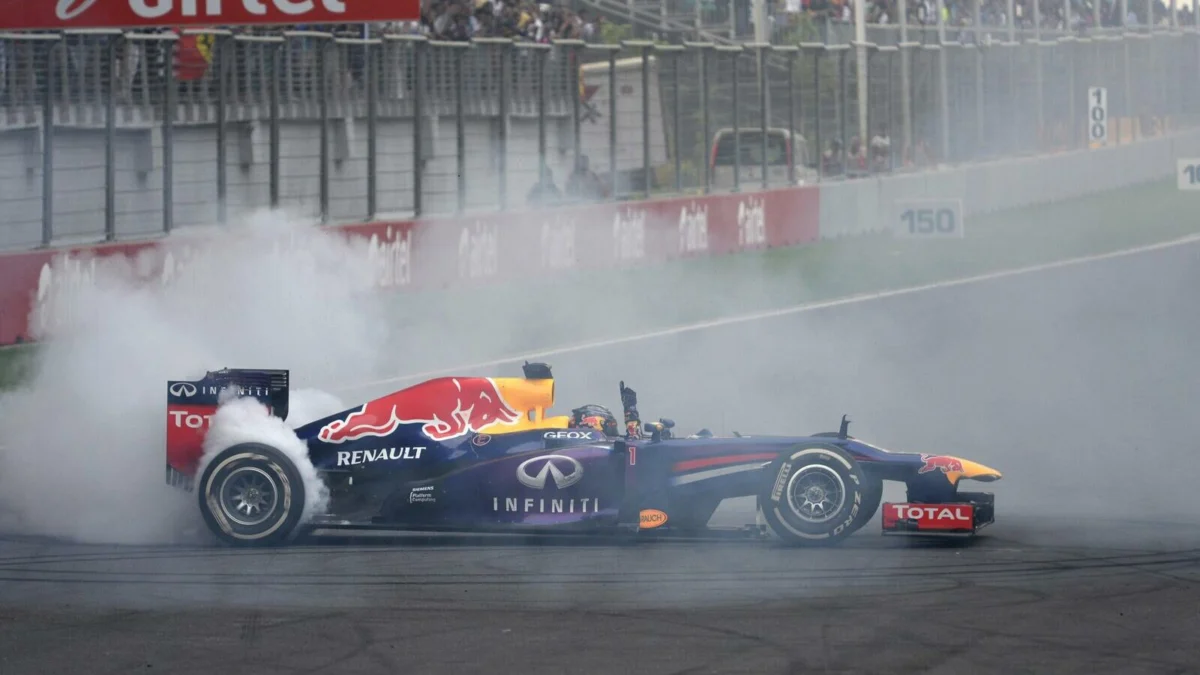
October 27, 2013, Buddh International Circuit, India. The air was thick with the scent of burnt rubber and the roar of a crowd witnessing history. As Sebastian Vettel crossed the finish line to secure his fourth consecutive Formula 1 World Drivers’ Championship, the expected protocol—a slow, celebratory cool-down lap followed by a controlled arrival in parc fermé—was abruptly abandoned.
Instead, the young German chose a path of raw, unbridled emotion. He stopped his Red Bull RB9 dead in the center of the start-finish straight, locked the front brakes, engaged first gear, and proceeded to execute a series of tire-shredding "donuts." The V8 Renault engine screamed at the rev-limiter, turning expensive Pirelli rubber into ribbons of smoke. It was a spectacle of pure triumph, yet behind the scenes, it triggered a frantic race against the clock, a high-stakes technical gamble, and a stern rebuke from the sport’s governing body.
The Chronology of a High-Stakes Celebration
The sequence of events on that Sunday afternoon remains etched in the annals of Formula 1 folklore. After securing his tenth victory of the 2013 season with a dominant 29-second lead over Nico Rosberg, Vettel decided to deviate from the script.
By failing to complete his cool-down lap and parking his car on the track rather than in the pits, Vettel violated the most basic tenet of the FIA’s post-race protocol. As he climbed onto the nose of his car, discarded his gloves into the grandstands, and bowed before his machine, the atmosphere at the Red Bull pit wall was far from celebratory.
Guillaume Rocquelin, Vettel’s race engineer, and Team Principal Christian Horner were acutely aware that their driver’s exuberance had placed the team in a precarious legal position. The car remained stranded on the track, forcing Indian marshals to physically push the championship-winning machine to the pits, further complicating the technical verification process. By 5:30 PM, the gravity of the situation became clear: Vettel and Horner were summoned to appear before the FIA stewards to explain the breach of protocol.
Technical Jeopardy: The Fuel Sample Crisis
At the heart of the controversy lay the stringent technical regulations governing Formula 1, specifically Article 6.5.1. This regulation mandates that every car must be capable of providing a minimum of one liter of fuel for post-race analysis to ensure that the chemical composition of the fuel matches the samples provided to the FIA at the start of the weekend.
Vettel’s unauthorized celebration was not merely a breach of etiquette; it was a consumption of vital resources. During his nearly minute-long burnout, the engine burned approximately two kilograms of fuel. In the Red Bull garage, telemetry analysts at Renault Sport watched the fuel levels plummet in real-time. If the quantity remaining in the tank fell below the one-liter threshold during the mandatory FIA draining procedure, the penalty would be absolute: disqualification from the Grand Prix.
For the stewards, the case was binary. Was the driver’s celebration an act of passion, or was it a deliberate attempt to hide potential irregularities by burning through excess fuel? The silence in the paddock during the hour-long deliberation was palpable.
The Stewards’ Verdict and Official Responses
The hearing was presided over by a distinguished panel: Gerd Ennser, Steve Chopping, and the legendary endurance racer Tom Kristensen. Christian Horner presented a defense rooted in the sheer magnitude of the moment. He argued that the emotion of a fourth world title had clouded the driver’s judgment, while candidly admitting that the team had failed to remind Vettel via radio to return to the pits immediately.
At 6:45 PM, the stewards released "Document 44." The ruling was a masterclass in balancing the letter of the law with the spirit of the sport. Sebastian Vettel was issued a formal reprimand—his first of the season—for failing to follow the procedure of returning to the pits. Crucially, as this was his first infraction, it avoided the dreaded ten-place grid penalty that a third reprimand would have triggered for the subsequent race in Abu Dhabi.
However, the team did not walk away unscathed. Infiniti Red Bull Racing was hit with a €25,000 fine for failing to instruct their driver to return to the pits, effectively holding the team accountable for the lack of operational discipline.
The final sigh of relief came from the FIA technical delegate, Jo Bauer. Upon draining the RB9’s tank, he confirmed that 1.6 liters of fuel remained—comfortably above the minimum requirement. The victory stood, the title was confirmed, and the championship party could finally begin.
Regulatory Implications and the Evolution of Celebration
The aftermath of the Indian Grand Prix sparked a polarized debate among fans, pundits, and team principals. Some argued that the rules were too rigid, stifling the personality and joy of the drivers at the pinnacle of their achievement. Others maintained that in a sport defined by technical precision and weight-based performance, every rule must be strictly enforced to ensure a level playing field.
The FIA, recognizing the public backlash and the evolving nature of digital sports media, acknowledged that the spectacle of a championship celebration was a valuable asset for the sport’s image. Consequently, the governing body chose to evolve.
The 2014 Rule Amendment
Starting with the 2014 season, the FIA amended Article 43.3. The revised regulation offered a pragmatic middle ground: the race winner was now permitted to perform celebratory maneuvers on the track, provided that two conditions were strictly met:
- Safety: The maneuver must not endanger other drivers, officials, or track marshals.
- Technical Compliance: The car must still contain the mandatory one-liter fuel sample upon inspection at parc fermé.
This change represented a rare moment where the sport’s governing body listened to the voice of the fans and the drivers, successfully integrating the "show" of Formula 1 with the technical rigor that defines it.
Conclusion: A Legacy of Passion
Looking back, the events of October 2013 serve as a microcosm of the Sebastian Vettel era: a blend of absolute dominance, technical perfection, and a deep, genuine love for the sport. While the €25,000 fine was a minor financial footnote for a team of Red Bull’s stature, the incident remains a significant chapter in the history of modern Formula 1.
It reminds us that even at the highest levels of professional motorsport, the human element—the raw, unfiltered joy of a champion—will always attempt to transcend the rulebook. Thanks to the sensible policy shift that followed, modern fans are now treated to the celebratory donuts that have since become a staple of the podium experience, a legacy that can be traced directly back to that smoky afternoon in Buddh.