

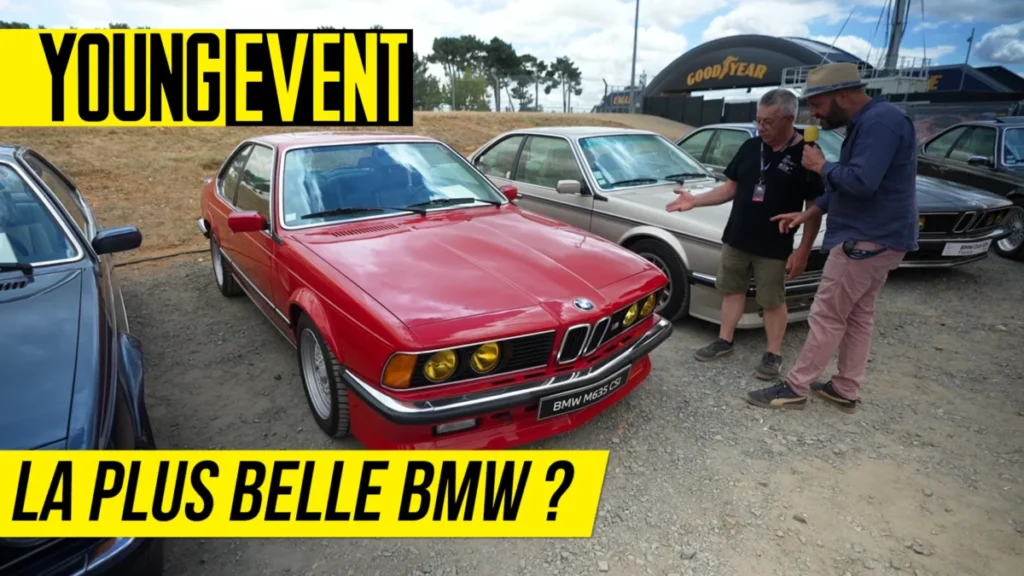
In the pantheon of grand touring automobiles, few silhouettes command as much respect and immediate recognition as the BMW E24 6 Series. Often referred to by enthusiasts as the "Shark," this quintessential Bavarian coupe celebrates its 50th anniversary in 2026. To mark this milestone, Youngtimers La Chaîne ventured to the hallowed grounds of Le Mans Classic 2026, where a spectacular gathering of the French BMW Club provided a unique window into the enduring legacy of this high-performance machine.
Main Facts: The Concept of the "Executive Express"
The E24 6 Series was not merely a new car; it was a bold statement of intent from BMW in the mid-1970s. Launched in 1976 as the successor to the E9 coupe, the E24 was tasked with bridging the gap between sporty agility and executive luxury.
Technically, the E24 was a masterful exercise in platform sharing. It was developed upon the chassis of the E12 5 Series, inheriting its reliable and balanced architecture. However, its positioning was entirely different. At the time of its release, the E24 commanded a price tag comparable to the 7 Series, signaling that this was not a car for the masses, but a status symbol for the discerning driver. It was designed to consume continental distances at high speeds, offering a synthesis of comfort and driver engagement that few competitors could replicate.
Chronology: The Evolution of an Icon
The history of the E24 is a 13-year journey of refinement, spanning from 1976 to 1989.
- 1976: The Genesis. The E24 debuts with the 630 CS and 633 CSi models. Its design, penned by the legendary French designer Paul Bracq, immediately set a new standard. Bracq, already famous for the "Pagoda" Mercedes-Benz, brought a sleek, shark-like nose and an elegant, sweeping greenhouse to the BMW lineup.
- 1978: The 635 CSi Arrival. BMW introduces the 635 CSi, which would go on to become the definitive version of the model. With a larger engine and performance-oriented chassis tweaks, it cemented the car’s reputation as the "world’s fastest coupe" in the eyes of many period journalists.
- 1982: Technical Overhaul. The E24 platform shifts from the E12 base to the newer E28 5 Series platform. This allowed for significant improvements in suspension, electronic management, and interior ergonomics.
- 1984: The M-Power Era. The launch of the M635 CSi, featuring the M88/3 engine derived from the M1 supercar, transformed the 6 Series into a true thoroughbred. It was a high-water mark for BMW’s performance division.
- 1989: The Final Bow. Production concludes after 86,216 units, leaving behind a legacy that would define BMW’s coupe strategy for decades.
Paul Bracq: The Architect of Elegance
To understand the E24 is to understand the vision of Paul Bracq. During his tenure at BMW in the 1970s, Bracq was responsible for a design language that balanced aggression with timeless proportions. The E24’s shark-nose front end, characterized by the forward-leaning grille and distinct four-headlight configuration, created a visual "predatory" stance that remains fresh even half a century later. His influence ensured that the 6 Series was not just a technical instrument, but a piece of automotive sculpture that captured the optimism and ambition of the era.
Supporting Data: Market Realities and Ownership Costs
For the modern collector or enthusiast, the E24 represents a complex investment. During our investigation at Le Mans Classic, we spoke with various owners to demystify the current state of the market.
Current Market Valuation
The market for the E24 has seen a steady, rational appreciation. While early, lower-spec models (628 CSi) remain relatively accessible, the M635 CSi has reached blue-chip collector status, with pristine examples fetching premium prices at auctions globally. The "sweet spot" for many remains the late-model 635 CSi with the high-compression engine, which balances performance and ease of maintenance.
Maintenance and Ownership Constraints
The E24 is a complex machine by 1980s standards. Maintenance requires a specialized touch, particularly regarding:
- The Cooling System: These engines are sensitive to thermal management; original components are prone to age-related failure.
- Corrosion: As with many cars of this vintage, bodywork and chassis rust are the primary threats to long-term preservation.
- Electronics: While robust for the time, the early Bosch fuel injection and auxiliary electrical systems require a knowledgeable technician who understands vintage diagnostic procedures.
Owners emphasize that while the parts cost can be significant, the availability of OEM parts through the BMW Group Classic program provides a level of support that is superior to many other European manufacturers of that era.
Official Perspectives: Why the Passion Persists
Why do owners persist with the E24 when modern luxury cars offer more convenience and reliability? The answer, according to the enthusiasts we met, lies in the "analog" driving experience.
"The E24 is the last of the truly mechanical BMW grand tourers," one owner remarked. "It offers a tactile connection to the road that you simply cannot replicate with electronic steering and computer-controlled suspension."
The owners highlighted several factors driving their loyalty:
- Timeless Aesthetic: The car does not look out of place in modern traffic; its proportions are classically beautiful.
- Touring Capability: It remains a genuinely comfortable car for long-distance travel, easily keeping pace with modern highway traffic.
- Community: The global BMW Classic network creates a sense of belonging. The exchange of knowledge, parts, and stories keeps the spirit of the E24 alive.
Implications: The Future of the E24
As the E24 moves further into the "classic" category, its status is shifting from a used luxury car to a historical artifact. The implications for the future are twofold:
- Preservation vs. Modification: There is an ongoing debate within the community regarding "restomodding." While some purists insist on factory-correct specifications, others are integrating modern suspension components and engine upgrades to make the cars more "usable" in a modern context.
- The Rise of the "Youngtimer" Movement: The E24 is a cornerstone of the Youngtimer movement—cars that are too old to be daily drivers but too young to be considered "antiques." This movement has breathed new life into the model, encouraging younger generations to appreciate the engineering and design prowess of the late 20th century.
Conclusion: A Legacy Secured
Looking back at 50 years of the BMW 6 Series E24, it is clear that the car has achieved more than just commercial success. It has become a symbol of a specific epoch in automotive history—an era where engineering integrity was matched by artistic flair.
Whether it is the raw, untamed power of the M635 CSi or the refined, effortless cruising of the 635 CSi, the E24 remains one of the most beautiful automobiles to ever roll out of Dingolfing. As we look toward the next 50 years, the "Shark" is unlikely to disappear. Its elegant lines, storied performance, and the sheer dedication of its owners ensure that the E24 will continue to prowl the roads, reminding us all of a time when BMW design was at its most daring and distinctive.
For those looking to enter the world of classic BMW ownership, there is perhaps no better entry point than the E24. It is a car that demands your attention, rewards your maintenance, and ultimately, captures your heart. As the enthusiasts at Le Mans Classic proved, the 6 Series is not just a car; it is a way of life.
