

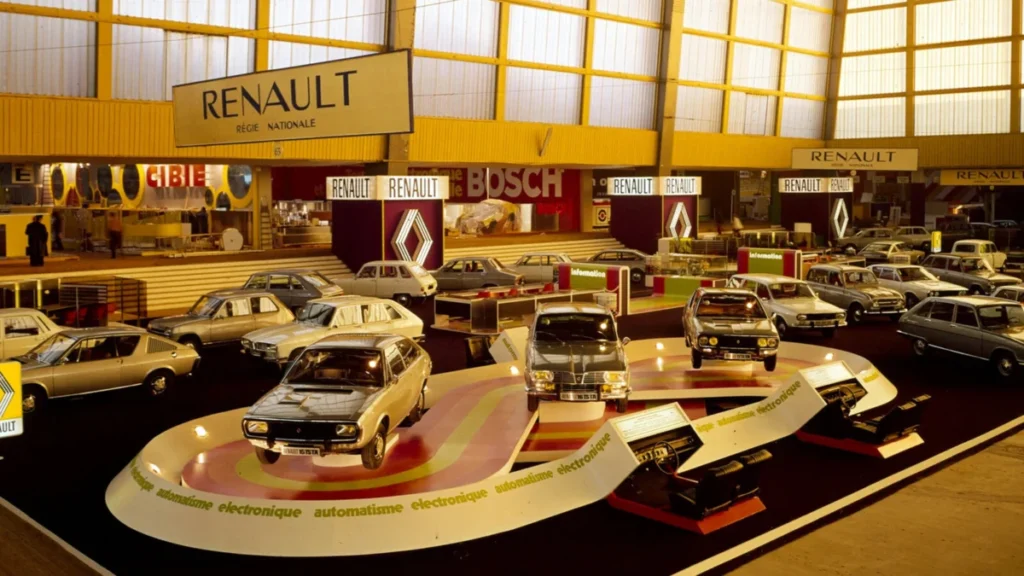
The air at the Porte de Versailles on Sunday, October 15, 1972, was thick with the scent of premium tobacco, high-octane gasoline, and the dust stirred up by thousands of shuffling feet. As the 59th Paris Motor Show drew to its closing hours, a palpable tension hung over the exhibition halls. It was not merely the end of an industry event; it was the conclusion of a decade-long ideological battle. Families and enthusiasts alike crowded around two specific stands, witnessing a trench war between France’s automotive titans. Two vehicles, sharing a singular goal—to conquer the urban landscape and become the definitive "second car" for the modern French household—faced off: the Peugeot 104 and the Renault 5.
The Genesis of a Clash: Architecture vs. Intuition
The automotive landscape of the early 1970s was shifting. As urbanization accelerated, the "family car" was no longer sufficient for the burgeoning middle class. The industry needed smaller, more agile, yet practical solutions.
On the Peugeot stand, the star of the show was the 104. Making its public debut, it was a masterclass in engineering efficiency. Peugeot’s engineers had achieved the impossible: housing four full-sized doors and comfortable seating for four adults within a chassis measuring a mere 3.58 meters in length. Peugeot’s marketing department trumpeted the slogan: "The smallest four-door sedan in the world." To achieve this, the mechanical layout was revolutionary, featuring a four-cylinder aluminum engine tilted 72 degrees rearward, with the gearbox tucked beneath the block.
Yet, Sochaux was steeped in tradition. The 104 was a "bourgeois" car in spirit. The board of directors had famously refused to incorporate a fifth door (a hatchback), opting instead for a traditional, separate trunk with a small, hinged metal flap. The logic was rooted in provincial common sense: a full-opening tailgate was viewed as an invitation for cold drafts, dust, and luggage odors to permeate the passenger cabin.
Just a few aisles away, the Renault 5 represented the antithesis of this philosophy. Launched eight months earlier in February 1972, the "Billancourt Frog" was an act of design defiance. Conceived by the visionary stylist Michel Boué—who tragically passed away from cancer in late 1971 before witnessing the full magnitude of his creation’s success—the R5 introduced the "bicorps" (two-box) silhouette to the masses. It was a three-door hatchback with smooth flanks, hidden door handles, and innovative polyester resin bumpers that could absorb low-speed parking impacts without a scratch.
Chronology of the Conflict
- February 1972: Renault launches the R5, stunning the market with its daring, modern design and functional hatchback.
- October 1972: The 104 is unveiled at the Paris Motor Show, positioning itself as a sophisticated, four-door alternative to the "utilitarian" R5.
- 1973: The global oil crisis shifts consumer priorities. Performance takes a backseat to fuel efficiency and interior versatility.
- 1974: Renault’s dominance in the segment grows as the R5 becomes an icon of the "post-oil" era.
- 1979: Recognizing the shift in consumer demand, Peugeot finally introduces a hatchback version of the 104, effectively admitting that the "separate trunk" era had ended.
Supporting Data: Engineering and Market Positioning
The rivalry was not just aesthetic; it was deeply mechanical. The Peugeot 104 was technically superior in terms of build quality and luxury feel, but it was also significantly more expensive to produce. The use of an all-aluminum engine and the complex four-door architecture required a higher retail price.
Renault, conversely, leveraged the "utility" aspect of the R5 to keep costs down while maximizing appeal. The R5’s folding rear bench transformed the car into a micro-van, capable of hauling washing machines or furniture—a level of versatility that the 104 simply could not match at the time.
Market research from the period shows that while the 104 appealed to the "traditionalist" family man who prioritized comfort and ease of entry for children, the R5 captured the imagination of the younger, female, and urban demographics. The R5 was seen as "insolent," "fun," and "progressive." Its square headlights and rounded corners became the visual shorthand for the 1970s, whereas the 104 felt like a refined, smaller version of the 504 sedan.
Official Responses: The Philosophy of the Trunk
The refusal of Peugeot to adopt the hatchback in 1972 was not a mistake by the engineers, but a rigid adherence to a corporate mandate. The Peugeot family and the executive board viewed the hatchback as an "agricultural" or "commercial" feature—something fit for a baker’s van or a plumber’s truck, but beneath the dignity of a Peugeot passenger car.
From an engineering standpoint, the decision was also governed by structural rigidity. Cutting a large hole in the rear of a unibody chassis required heavy, expensive steel reinforcements to maintain safety standards and prevent the car from twisting. To keep the 104 under its 760kg weight target, Peugeot opted for the more rigid, traditional three-volume structure.
Renault’s response was to ignore these "statutory" concerns. By using modern materials and focusing on the democratization of the automobile, they realized that the public cared less about "status" and more about "utility." When asked about the R5’s design, Renault executives often pointed to the changing nature of the city: "The car must adapt to the city, not the other way around."
The Implication: A Paradigm Shift
As the lights dimmed on that Sunday evening in 1972, neither the team at Peugeot nor the team at Renault could have foreseen the cataclysm that was to follow. Less than a year later, the 1973 oil crisis brought the "Golden Age" of the post-war era to an abrupt halt.
The economic fallout of the Yom Kippur War and the subsequent fuel shortages changed everything. Suddenly, the "insouciance" of the 1960s was replaced by a desperate need for efficiency. The R5 and the 104 were no longer just city runabouts; they were the vehicles that would save their respective companies’ balance sheets.
However, the design war had already been won by Renault. The R5’s hatchback design set the standard for the modern compact car. Peugeot eventually realized that to remain relevant, it had to follow the path carved by its rival. The introduction of the 104 Z (a short-wheelbase coupe) and the eventual adoption of the fifth door across the 104 range in 1979 were clear signals of a total surrender to the "hatchback revolution."
In retrospect, the 1972 Paris Motor Show was the moment the automotive industry transitioned from the era of the "scaled-down luxury car" to the "purpose-built urban tool." While Peugeot’s 104 remained a triumph of engineering and a favorite among those who valued classic French craftsmanship, the Renault 5 changed the trajectory of automotive design forever. It proved that a car could be small, affordable, and incredibly practical—a lesson that every manufacturer on the planet would eventually learn. The "cube of Sochaux" and the "frog of Billancourt" remain, to this day, the two pillars upon which the modern European hatchback was built.
