At the 2026 Paris Motor Show, amidst a sea of aggressive, angular electric SUVs and high-performance hypercars, one manufacturer has dared to step off the beaten path to celebrate the beauty of utility. Fiat has unveiled the "Multiplay," a visionary concept vehicle that serves as a spiritual successor to the legendary Fiat Multipla—a car that remains one of the most polarizing and beloved designs in automotive history. By prioritizing interior livability over aerodynamic vanity, Fiat is making a bold statement: the future of mobility should be about how we live inside our cars, not just how they look on the road.
The Main Facts: A Bold Reinterpretation of "People-First" Design
The Fiat Multiplay concept is not a direct remake of the 1998 classic, but rather an evolution of the philosophy that birthed it. While the original Multipla is remembered for its "two-story" front end and unconventional seating layout, the Multiplay translates those core values—spaciousness, modularity, and sheer joy—into the electric age.
At its core, the Multiplay is a "living room on wheels." It discards the industry-standard obsession with aggressive sportiness, focusing instead on the human experience. With a vibrant green exterior, a white contrasting roof, and a radical, modular interior, the concept challenges the status quo of modern cabin design. It is a vehicle designed for families, social groups, and creators, emphasizing the "life on board" above all else.
Chronology: From the Cult Classic to the Modern Vision
To understand the significance of the Multiplay, one must look back at the trajectory of the Fiat Multipla.
- 1998: The Debut. The original Multipla is launched. With its six-seat, two-row configuration and iconic "belt-line" bulge, it instantly becomes a design lightning rod. Critics mocked it, yet families and taxi drivers praised its unparalleled visibility and versatility.
- 2004: The Facelift. Fiat moves toward a more conventional aesthetic, stripping away the unique charm of the original design in an attempt to appeal to a broader, more conservative market. This decision is often cited by design historians as the moment the car lost its "soul."
- 2024–2025: The Development Phase. Fiat’s design center, led by a new philosophy of "joyful mobility," begins exploring how to capture the spirit of the original Multipla without resorting to mere nostalgia. The goal was to create a modular platform that could adapt to the needs of the 2030s.
- October 2026: The Paris Unveiling. The Multiplay is revealed at the Paris Motor Show. It is greeted with a mix of nostalgia, curiosity, and genuine admiration for its willingness to prioritize passenger comfort over conventional "cool."
Supporting Data: Engineering a "Salon on Wheels"
The Multiplay’s engineering choices are dictated by the desire to maximize interior volume. Unlike traditional crossovers that sacrifice interior space for a "fastback" roofline, the Multiplay embraces a "rounded, chubby" silhouette that maximizes head and shoulder room.
Exterior Specifications and Aesthetics
The vehicle features a smooth, organic design language. The body is characterized by:
- Dimensions: A high-roof architecture that provides a greenhouse-like environment for all passengers.
- Lighting Signature: A horizontal LED band runs across the front, featuring the "FIAT" logo in illuminated lettering. This is flanked by modern, circular headlamps that pay homage to the original 90s model.
- Visual Flair: The side profiles feature integrated LED light strips that serve as both design accents and functional lighting. The wheels, while large in diameter, are wrapped in aerodynamic covers that emphasize the brand’s playful, two-tone color scheme.
Interior Modularity
The interior is the showstopper. By utilizing a flat, EV-dedicated architecture, Fiat has created a "blank canvas" floor:
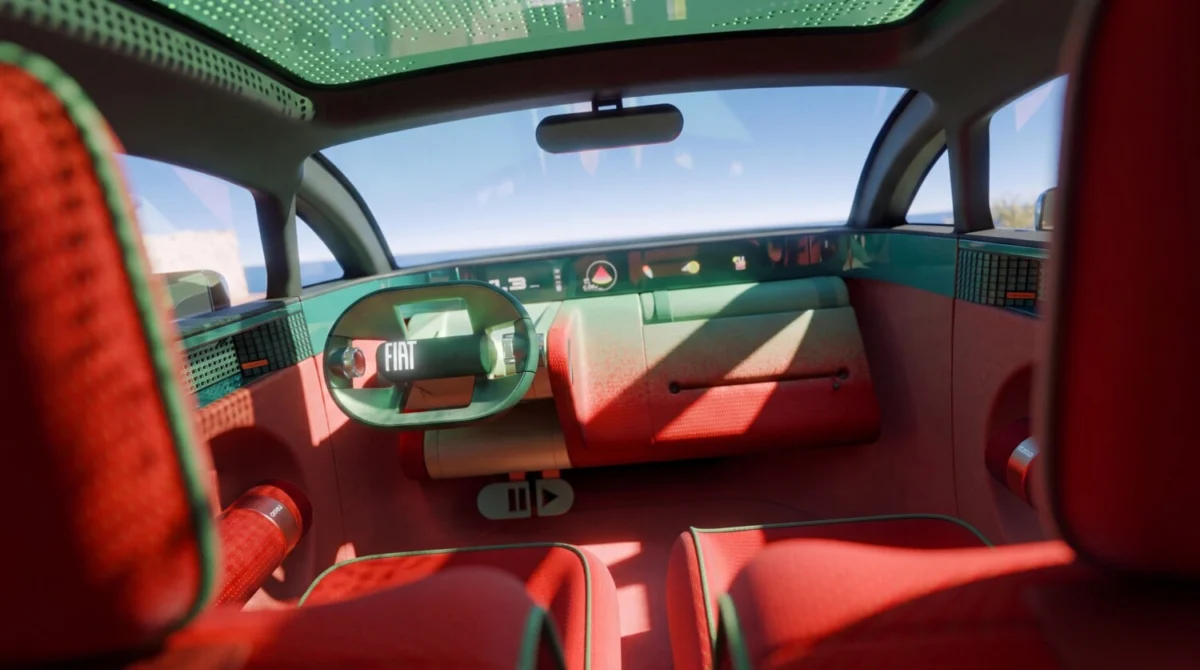
- The Seating System: Four individual, bright red seats are mounted on a flexible rail system. They can be rotated, slid, or removed, allowing the cabin to be transformed from a traditional travel mode to a face-to-face social configuration.
- The "Pink" Floor: The cabin features a flat, pale pink floor surface that underscores the brand’s move away from the "all-black/all-grey" interiors of the early 2020s.
- Digital Interface: The dashboard is a study in minimalism. A horizontal, curved digital interface houses the instrument cluster and central infotainment, while a dedicated passenger screen provides additional functionality, all controlled via a distinctive, oval-shaped steering wheel.
Official Responses: Fiat’s Design Philosophy
During the unveiling, Fiat’s design team emphasized that the Multiplay is a rejection of "aggressive design trends."

"We asked ourselves why cars have become so angry," noted a senior spokesperson at the Paris event. "The original Multipla was loved because it was honest. It was a tool for living. With the Multiplay, we aren’t chasing the drag coefficient record; we are chasing the comfort record. We want our users to feel that the interior is a space they want to inhabit, whether the vehicle is in motion or parked."
The brand has made it clear that while this is a concept, the technologies regarding seat modularity and the minimalist user interface are being actively tested for upcoming production models in the Fiat "family" range.
Implications: A Shift in Automotive Priorities
The introduction of the Multiplay has significant implications for the automotive industry at large.
1. The Death of the "Aggressive" Crossover?
For years, the market has been saturated with SUV designs that emphasize "toughness" and "sharp edges." The Multiplay represents a potential pivot point. By successfully marketing a vehicle that looks "soft" and "friendly," Fiat is testing the waters to see if consumers are ready to move away from the intimidation factor of modern car design.
2. The Rise of "Living Space" Mobility
As autonomous driving technology matures, the car is increasingly viewed as a "third space"—an environment between home and the office. The Multiplay’s focus on swivel seats and a lounge-like atmosphere suggests that Fiat is positioning itself to be a leader in this transition. The focus is no longer on how fast a car can take a corner, but how comfortably it can host a conversation.
3. Sustainability through Longevity
By emphasizing modularity, Fiat is also touching on the concept of sustainable ownership. If an interior can be reconfigured or upgraded without replacing the entire vehicle, the lifespan of the car increases. The Multiplay’s design encourages owners to interact with the vehicle as a multi-purpose tool, which could lead to a decrease in the "throwaway" culture often associated with rapidly updating consumer electronics and vehicles.
Conclusion: A Joyful Future
The Fiat Multiplay is more than just a nod to the past; it is a calculated gamble on the future. By reclaiming the "Multipla spirit," Fiat has reminded the automotive world that design is not just about aerodynamics or brand aggression—it is about the people inside. Whether the Multiplay reaches the production line in its current form remains to be seen, but its presence in Paris has already succeeded in its primary goal: starting a conversation about what a car should actually be. In an era of increasing digital isolation, Fiat is betting that people still want their vehicles to be spaces for connection, comfort, and, above all, a little bit of fun.