

October 20, 2026 — When automotive historians and enthusiasts discuss the golden era of 1960s Italian Grand Tourers, the conversation invariably gravitates toward the pantheon of Maranello, Sant’Agata Bolognese, or Modena. Ferrari, Maserati, and Lamborghini have long monopolized the spotlight, casting a giant shadow over smaller, more esoteric boutique manufacturers. Yet, the margins of automotive history are often where the most fascinating creations lie.
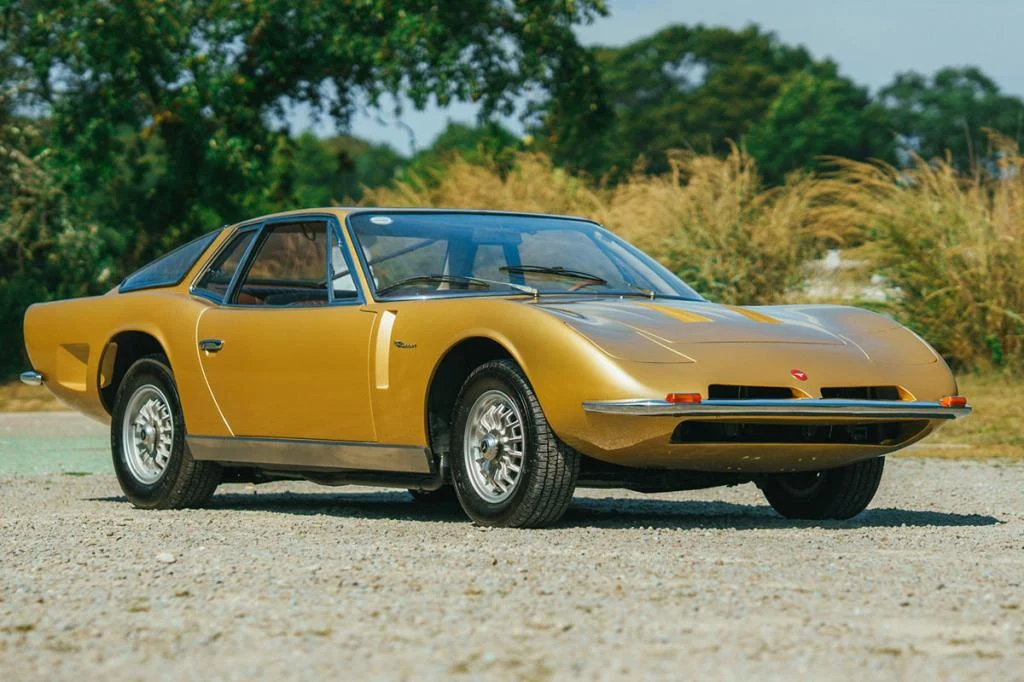
Among these elusive masterpieces is one of the most original and rarest automobiles ever conceived by Giotto Bizzarrini: the breathtaking Bizzarrini GT America 2+2.
Founded in 1964 by the brilliant Italian engineer whose resume included crafting the legendary Ferrari 250 GTO, Automobili Bizzarrini was an ultra-exclusive enterprise. Across a tumultuous five-year operational lifespan, the boutique marque produced a mere 140 cars. This extreme scarcity has imbued every surviving chassis with an almost mythic status today—making the upcoming public offering of a singular prototype a momentous event in the collector car market.
Main Facts: The Anatomy of a Rarity
The vehicle in question is not merely a rare vintage GT; it is a one-off prototype that bridges the gap between raw, track-bred performance and refined transcontinental cruising.
Key Vehicle Specifications:
- Model: Bizzarrini GT America 2+2 Prototype
- Debut: 1968 Turin Motor Show
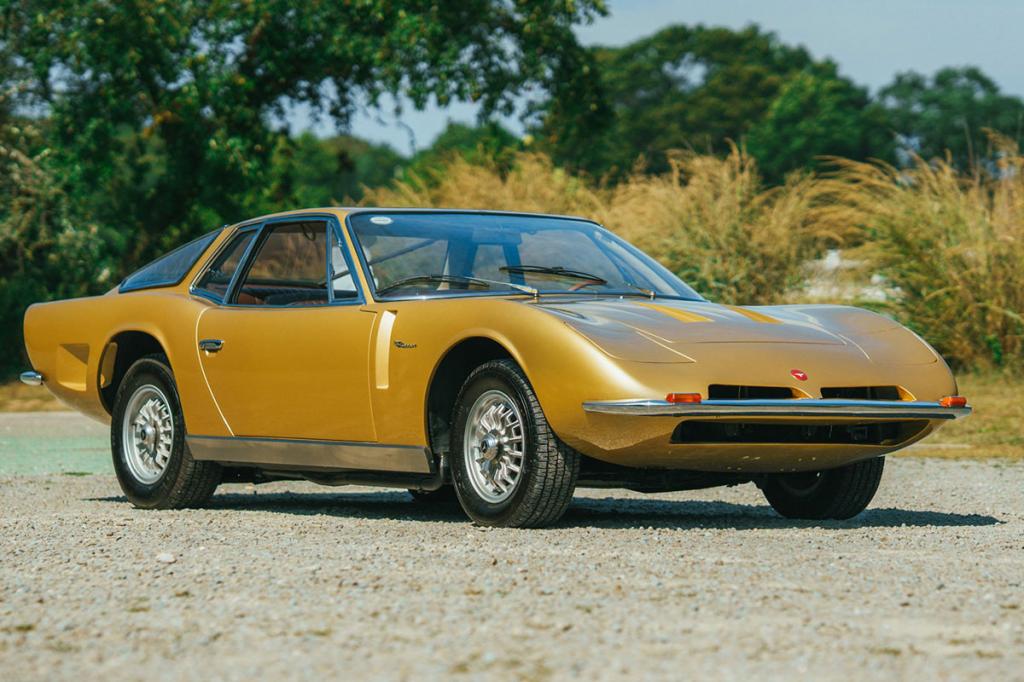
- Coachwork: Hand-formed aluminum body over a bespoke chassis, finished in Champagne Metallic
- Engine: 5.4-liter (327 ci) Chevrolet "Small-Block" V8
- Transmission: 4-speed manual Borg-Warner (or Muncie-derived) gearbox sending power to the rear wheels
- Output: Approximately 360 horsepower
- Mileage: 5,452 kilometers (approx. 3,387 miles) since a meticulous 2008 restoration
- Auction House: Broad Arrow Auctions
- Estimated Value: $400,000 – $500,000 USD
Positioned somewhere conceptually between a Ferrari 365 GT and an Iso Rivolta, the GT America 2+2 represents a time when automotive design was driven by individual passion rather than corporate homogenization.
Chronology: The Genesis and Evolution of Bizzarrini
To understand the significance of the GT America 2+2, one must trace the trajectory of Giotto Bizzarrini himself, a man whose engineering genius shaped some of the most iconic racing cars in history.

The Foundation of an Icon (1962–1964)
- The Breakup (1962): Following the infamous "palace revolt" at Ferrari, where several top engineers and executives left Maranello, Giotto Bizzarrini initially worked independently, contributing to ASA and Renzo Rivolta’s Iso Grifo project.
- Birth of Automobili Bizzarrini (1964): Operating out of Livorno, Italy, Bizzarrini established his own marque with a singular vision: to build uncompromising sports cars that combined Italian styling with reliable, high-output American muscle. His early masterwork, the 5300 GT Strada, cemented his reputation for building brutally fast, gorgeous competition-derived road cars.
The Quest for Grand Touring (1967–1968)
- Moving Beyond Two Seats: While the 5300 GT was a strict two-seater designed with racing homologation in mind, Bizzarrini recognized a demand among wealthy clientele for a true Grand Tourer—a car capable of high-speed, long-distance travel with additional passenger accommodation.
- The Turin Debut (1968): The GT America 2+2 was unveiled as a prototype at the prestigious Turin Motor Show. It was intended to evolve the successful formula of the 5300 GT Strada into a more sophisticated, versatile GT car without losing the brand’s trademark aggression.
Preservation and Modern History (2008–Present)
- The Restoration (2008): After decades in private collections and decades of relative obscurity, the car underwent a comprehensive, high-level restoration that preserved its unique mechanical and aesthetic identity while ensuring mechanical readiness.
- The Broad Arrow Auction (Late 2026): Showing just over 5,400 kilometers on the odometer, this irreplaceable piece of automotive heritage is slated to cross the auction block, offering a new custodian the keys to one of Italy’s greatest hidden treasures.
Supporting Data: Design, Interior, and Transatlantic Engineering
Exterior Styling: Muscle Meets Elegance
The silhouette of the GT America 2+2 is a masterclass in proportion. Its hand-beaten aluminum bodywork combines taut, athletic lines with subtle aerodynamic touches.
The front end is dominated by pop-up headlamps—a remarkably modern touch for the late 1960s—flanked by delicate chrome bumpers and functional cooling louvers carved into the front fenders. The car rides on lightweight magnesium wheels, which hint at its motorsport lineage. Bathed in its signature Champagne Metallic paint, the car avoids the overt flashiness of some of its contemporaries, opting instead for a quiet, sophisticated menace.
The Interior: A Unique 2+2 Layout
Stepping inside reveals a cabin tailored for transcontinental journeys. The interior is swathed in rich brown leather, complemented by a traditional wood-rimmed steering wheel and classic Italian Jaeger instrumentation.

What truly sets this model apart, however, is its rear accommodation. Unlike the cramped, emergency-only "plus-two" spaces found in many sports cars of the era, the GT America features two individual rear bucket seats separated by a wide, sweeping central console. While legroom remains at a premium, the execution is as functional as it is visually stunning, offering an intimate, cocoon-like environment for four occupants.
The Heart: American V8 Muscle
True to the "Italo-American" hybrid recipe popularized by boutique builders in the 1960s, Bizzarrini bypassed complex, high-maintenance Italian V12s in favor of Detroit muscle.
Under the exceptionally long, louvred hood sits a 5.4-liter Chevrolet Corvette V8. Pumping out an estimated 360 horsepower, this small-block engine was a stroke of engineering genius. It provided explosive acceleration, effortless high-speed cruising, and bulletproof reliability—traits that hand-built Italian engines of the era often lacked. Power is delivered to the rear axle via a robust 4-speed manual transmission, allowing drivers to exploit the engine’s prodigious low-end torque.

Official Responses and Expert Perspectives
Automotive historians and auction specialists have long heralded the Bizzarrini works as undervalued masterpieces. Representatives from Broad Arrow Auctions have emphasized the unique nature of this offering:
"The GT America 2+2 represents the absolute zenith of Giotto Bizzarrini’s independent manufacturing vision," notes a senior automotive specialist at Broad Arrow. "It takes the DNA of a race-bred supercar and wraps it in a sophisticated touring package. To find a one-off prototype with such minimal mileage and a pristine restoration is an extraordinary opportunity for any serious international collector."
Restoration experts who have examined the chassis underscore the authenticity of the build, noting that the integration of the Chevrolet V8 was executed with a level of engineering precision that rivals factory-backed hybrid programs of later decades.

Implications: The Legacy and Market Value of Forgotten Divas
The appearance of the Bizzarrini GT America 2+2 at auction carries several broader implications for the classic car market:
- Re-evaluating Boutique Manufacturers: As top-tier Ferrari and Porsche prices reach astronomical plateaus, collectors are increasingly turning their attention toward rare coachbuilt specials from minor manufacturers. Cars like the GT America offer greater exclusivity and conversation value than mainstream exotics.
- The Strength of Italo-American Hybrids: Vehicles such as the Iso Grifo, De Tomaso Mangusta, and Bizzarrini 5300/GT America occupy a sweet spot in the collector ecosystem. They offer the drop-dead gorgeous aesthetics of Italian design coupled with the ease of maintenance and ferocious performance of American V8 mechanics.
- Market Resilience: With an pre-auction estimate of $400,000 to $500,000, the sale will serve as a bellwether for the health of the upper-middle tier of the collector car market—proving whether rare historical prototypes can command top-dollar figures in an evolving economic landscape.
Ultimately, the Bizzarrini GT America 2+2 stands as a rolling monument to an era when independent engineers could follow their instincts without corporate interference. It is a harmonious marriage of Italian artistry and American muscle—a diva of the highway that remains as captivating today as it was on the rotating stands of Turin nearly six decades ago.
