

Updated September 21, 2026
The recreational use of nitrous oxide—commonly known as "laughing gas"—has long posed a public health challenge in France, particularly among young adults. However, its transition from a festive novelty to a severe road safety hazard has forced the French government, local municipalities, and lawmakers to step up enforcement. With the introduction of the landmark "RIPOST" law in August 2026, authorities now possess powerful legal tools to combat substance-impaired driving. Yet, translating these legislative ambitions into everyday roadside enforcement presents significant technological, legal, and scientific hurdles.
Can law enforcement reliably test for nitrous oxide during a routine traffic stop? What are the legal thresholds, and how severe are the penalties? A comprehensive look at the state of nitrous oxide detection and driving laws reveals a complex landscape in rapid evolution.
Main Facts: The Reality of Nitrous Oxide on the Road
Nitrous oxide ($N_2O$), traditionally used in culinary applications like whipped cream siphons and in medical settings as an anesthetic, has been widely diverted for psychoactive use. When inhaled, it produces a brief euphoric state, but it also triggers acute side effects: disorientation, dizziness, sudden loss of consciousness, and asphyxiation. For motorists, these physiological effects are catastrophic.
The Dangers Behind the Wheel
According to alerts issued by France’s National Agency for the Safety of Medicines and Health Products (ANSM) and the Agency for Food, Environmental and Occupational Health & Safety (Anses), the risks associated with recreational use extend far beyond momentary lightheadedness. Regular consumption is linked to severe, sometimes irreversible neurological damage. When combined with the complex cognitive and physical demands of driving, the consequences are frequently fatal.
The French Road Safety Directorate (Sécurité Routière) highlighted in an April 2026 newsletter that at least seven road fatalities since the beginning of the year had been directly linked to nitrous oxide consumption. While comprehensive national statistics isolating laughing gas from general traffic accidents remain sparse compared to data on alcohol or conventional narcotics, advocacy groups and parliamentary reports paint an alarming picture. Senate Report No. 416 cited more than 450 serious road incidents in 2025 involving the substance, reflecting a sharp upward trend in dangerous driving behaviors tied to its abuse.
Chronology of the Crackdown: Key Legislative Milestones
The fight against nitrous oxide abuse has accelerated rapidly through a series of legislative and municipal actions culminating in the late summer of 2026.
- January 2024: Implementation of an initial sales decree limiting retail availability to small cartridges (maximum 8.6 grams) in packs not exceeding 10 units per transaction, aiming to curb bulk purchasing by individuals.
- January 23, 2025: Publication of a pivotal scientific study in Scientific Reports involving 24 healthy volunteers, proving that nitrous oxide can be successfully detected in exhaled breath samples up to 60 minutes after inhalation.
- April 7, 2026: The Sécurité Routière reports at least 7 traffic deaths linked to laughing gas since January.
- August 18, 2026: Parliament passes the "RIPOST" law (Law No. 2026-xxx), fundamentally reshaping the legal framework regarding psychoactive substances and transport safety.
- August 20, 2026:
- The city of Cannes deploys three pioneering breath-testing nitrous oxide detectors within its municipal police force, becoming a testing ground for roadside screening.
- Article L3611-4 of the Public Health Code enters into force, making recreational inhalation a standalone criminal offense.
- Article L237-1 of the Highway Code introduces a new road safety offense targeting drivers under the influence of listed psychoactive substances.
- September 10, 2026: The Ministry of the Interior confirms in a formal response to the Senate that the Road Safety Delegation (DSR) is actively co-financing scientific validation studies for breath-based nitrous oxide detection devices. Simultaneously, the Ministry of Health clarifies that the specific implementing decree listing nitrous oxide under the new driving offense is still being drafted.
- February 1, 2027 (Upcoming): The date set by the RIPOST law for a near-total ban on the possession, transport, sale, and gifting of nitrous oxide for private individuals, restricting access strictly to certified professionals.
Official Responses: Between Scientific Ambition and Practical Limits
The pursuit of a reliable roadside screening tool has captured the attention of public authorities, but navigating the transition from laboratory science to field deployment requires caution.
The Ministry of the Interior’s Stance
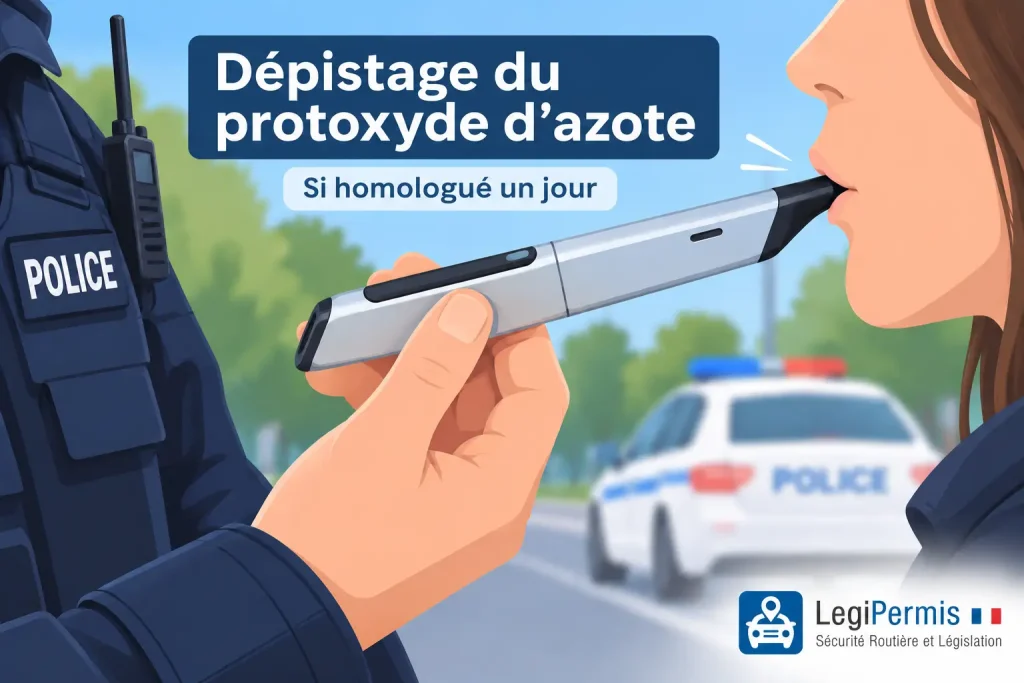
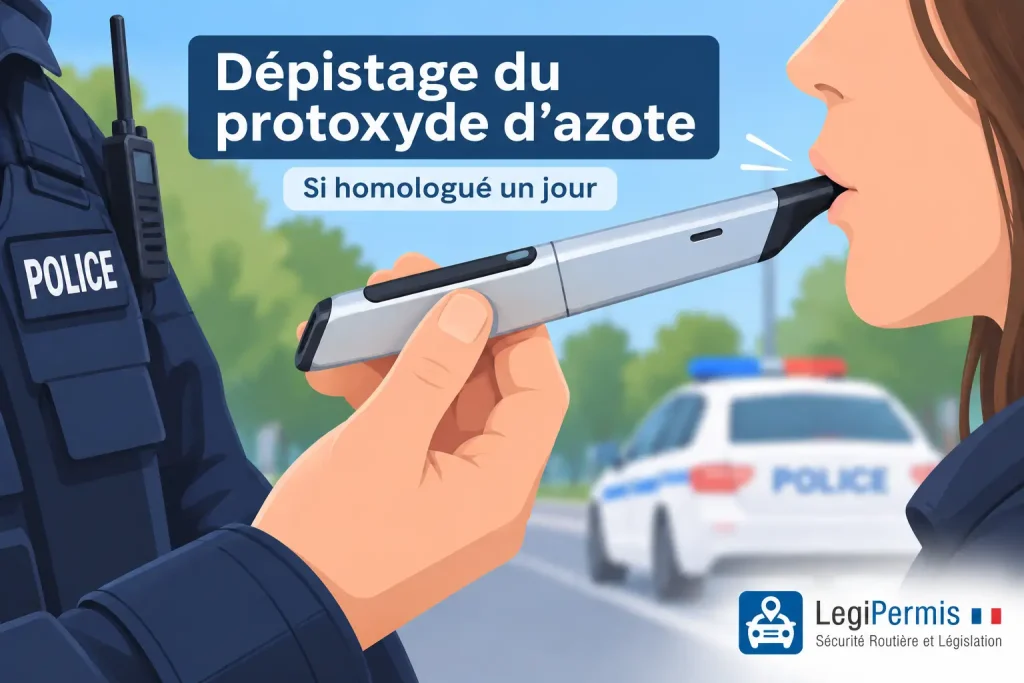
In its September 10, 2026 Senate response, the Ministry of the Interior confirmed that the Road Safety Delegation (DSR) is financially supporting research to scientifically validate the detection of nitrous oxide in exhaled breath. Resembling traditional breathalyzers, these handheld units aim to provide immediate proof of recent consumption.
However, the ministry was careful to manage expectations. This financial backing represents an investment in scientific validation, not an immediate nationwide rollout or generalized screening mandate. The official response omitted details regarding the exact funding amount, testing protocols, or a national procurement calendar for law enforcement agencies.
Local Innovation in Cannes
While national standardization is still underway, local authorities are already taking matters into their own hands. On August 20, 2026, the municipality of Cannes equipped its municipal police force with three specialized nitrous oxide detectors capable of analyzing exhaled air.
While Cannes’ initiative proves that localized screening is technically feasible in France, legal experts emphasize that local deployment does not automatically establish universal device reliability or clear-cut judicial consequences for every positive reading.
Scientific and Association Warnings
The leap from detecting a chemical presence in the breath to proving driver impairment is fraught with complexity. A study published on January 23, 2025, in Scientific Reports demonstrated that $N_2O$ could be detected in breath samples up to an hour post-inhalation among test subjects. However, researchers noted that detection depends heavily on experimental protocols and does not establish a precise threshold below which driving is definitively safe.
In an August 25, 2026 press release, the association PROTOSIDE called for rigorous, independent scientific data to prevent false positives, false negatives, and misinterpretations of breath measurements. For motorists, the distinction is vital: detecting an exposure, assessing actual impairment, and legally establishing a traffic infraction are three entirely different standards.
Implications: The Legal Framework and Penalties
The legal landscape governing nitrous oxide changed dramatically with the enactment of the RIPOST law. To understand the legal risks, motorists and passengers must distinguish between general public health offenses and specific road safety infractions.
1. Inhalation Outside Medical Contexts is a Criminal Offense
Under Article L3611-4 of the Public Health Code (in effect since August 20, 2026), inhaling nitrous oxide outside of a medical setting carries maximum penalties of 1 year of imprisonment and a €3,750 fine.

- Fixed Penalties: The law provides for a standard criminal settlement fine of €500 (reduced to €400 if paid promptly, or increased to €1,000 for late payment).
- Vehicle Occupants: This offense applies to any individual—including passengers—and does not require the offender to be operating a motor vehicle. It carries no mandatory driver’s license point deductions on its own.
- Aggravated Circumstances: If the inhalation occurs during the exercise of public authority, public service missions, or specific sensitive transport functions, penalties skyrocket to 5 years in prison and €75,000 in fines.
2. The Road Safety Offense and the "Substance List" Catch
Article L237-1 of the Highway Code targets motorists who drive after voluntarily, excessively, or divertedly consuming psychoactive substances. However, this specific road traffic offense requires the substance to be officially inscribed on an executive decree list established by the Council of State.
As confirmed by the Ministry of Health on September 10, 2026, the decree listing applicable substances is still being drafted, and nitrous oxide is not yet formally indexed under this specific article. Consequently, police cannot currently prosecute a driver under L237-1 solely on the grounds of nitrous oxide consumption—though they can prosecute general public health inhalation or penalize a failure to maintain control of a vehicle.
Once the decree takes full effect, the statutory maximum penalties for driving under the influence of listed psychoactive substances will include:
| Sanction or Measure | Highway Code Provision |
|---|---|
| Imprisonment | Up to 3 years (higher if aggravated) |
| Criminal Fine | Up to €9,000 |
| License Point Deduction | 6 points (half of a standard 12-point license) |
| Judicial Suspension | Up to 5 years (no partial reprieve allowed) |
| Judicial Cancellation | Permanent ban on reapplication for up to 5 years |
| Immediate Retention | Permitted upon reasonable suspicion of misuse |
| Administrative Suspension | Mandatory prefectural order following retention |
| Vehicle Immobilization | Seizure and temporary impoundment authorized |
For probationary drivers holding a 6-point license, losing 6 points instantly results in license invalidation (invalidation pour solde nul), necessitating a complete retake of the driving examination.
3. General Rules and Upcoming Bans
Even without a dedicated chemical screening test universally deployed, Article R412-6 of the Highway Code requires every driver to remain in a constant state and position to execute all mandatory maneuvers. Operating a vehicle while surrounded by spent gas canisters or displaying clear signs of disorientation exposes the driver to a second-class contravention and immediate vehicle immobilization.
Looking ahead, the calendar points decisively toward total prohibition. Effective February 1, 2027, the French state will implement a comprehensive ban on the possession, transport, sale, and transfer of nitrous oxide for all private individuals. Base penalties for unauthorized possession will double to 2 years in prison and €15,000 in fines, with fixed fines rising to €800.
Conclusion
The mobilization against nitrous oxide at the wheel represents a critical frontier in French road safety policy. While local pioneers like Cannes are deploying early-generation detectors, and national authorities are heavily subsidizing scientific validation, the legal framework remains caught between legislative speed and scientific precision.
Until standardized, homologated breath-testing equipment is universally deployed and the executive decrees finalizing substance listings are published, enforcement relies on a combination of public health bans, general traffic control laws, and strict municipal vigilance. For motorists, the message is unequivocal: whether viewed through the lens of impending 2027 total bans, severe criminal sanctions, or the undeniable physiological perils of laughing gas behind the wheel, consuming nitrous oxide while driving is a dangerous gamble with no legal blind spots left.
