


The air at Silverstone Circuit during the first week of October was thick with the scent of high-octane anticipation. As the new Ford LMDh prototype exited the pit lane for its inaugural shakedown, the sight was more than just a routine test session; it was a symbolic homecoming. Under the watchful eye of Mark Rushbrook, Global Director of Ford Performance, the vehicle completed its maiden laps, signaling the beginning of a rigorous development program aimed at the FIA World Endurance Championship (WEC). With sights set on the 6 Hours of Silverstone in April and the ultimate crucible—the 24 Hours of Le Mans in June—Ford is finally returning to the top tier of prototype racing. This represents the manufacturer’s first official, factory-backed effort in the premier class since the ill-fated C100 project of the early 1980s.
The Ghost of the C100: A Lesson in Ambition
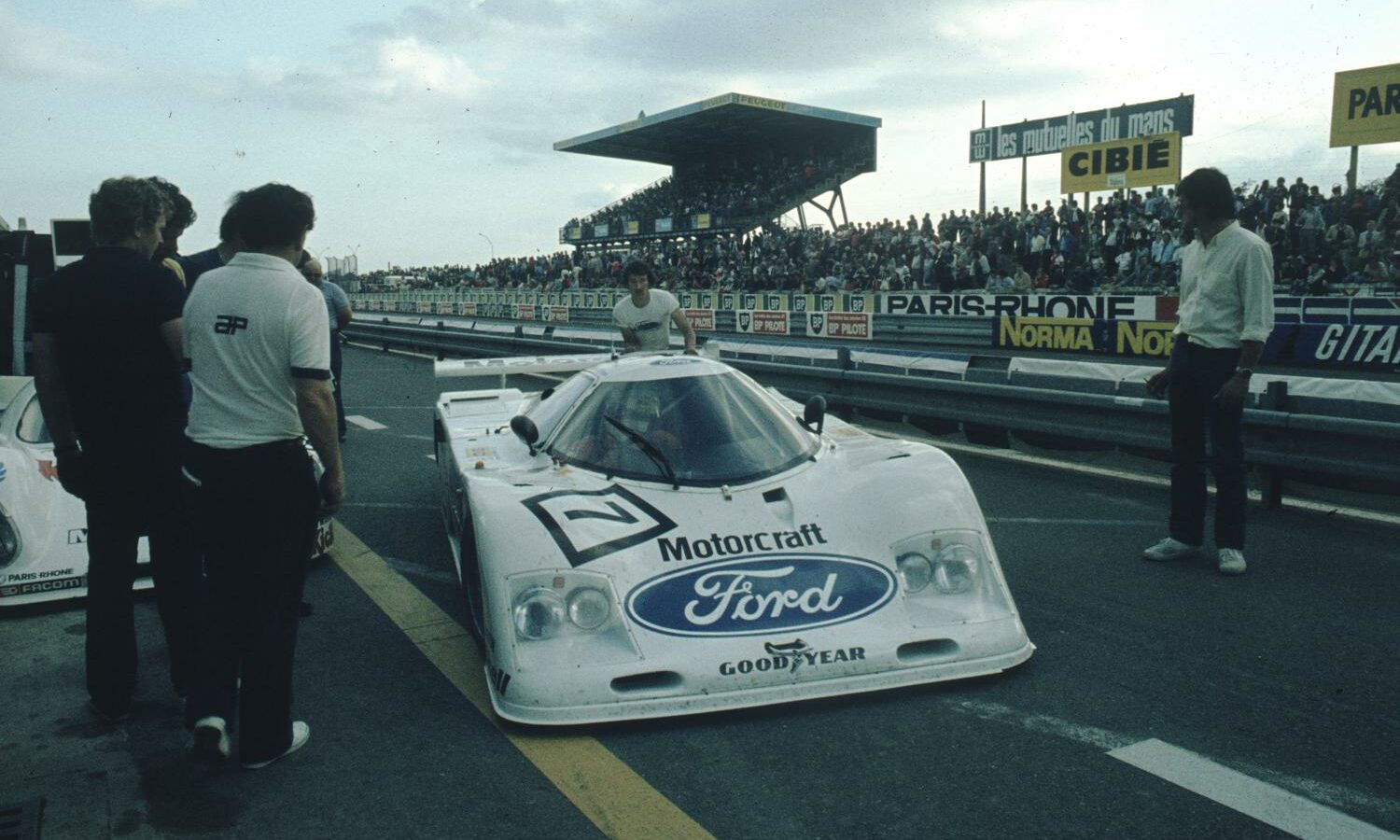
To understand the weight of this moment, one must look back at the post-GT40 era. Following the legendary four-year winning streak in the Sarthe between 1966 and 1969, Ford Europe sought to reclaim its crown with a closed-cockpit prototype. The naming convention of the Ford C100 was a direct departure from the imperial units that defined the brand’s history: where the GT40 took its name from its forty-inch height, the C100 claimed a silhouette capped at exactly 100 centimeters.
However, the project was plagued by a crumbling development timeline. Unable to reach the necessary maturity for a 1981 Le Mans debut, the C100 did not see competitive action until the 1,000 Kilometers of Brands Hatch in September, running under the aging Group 6 regulations. By 1982, as the Group C era dawned, Dearborn shifted technical operations to Zakspeed in Germany. Renowned engineer Tony Southgate was brought in to refine the design, creating the MkIII version for the Gordon Spice Racing team. Yet, in a move that still stings in the annals of motorsport history, Ford abruptly pulled the plug on the program at the end of 1982, leaving the car largely unrefined. Ironically, the underbody aerodynamics developed by Southgate would eventually form the technical foundation for the dominant Jaguar XJR series developed by TWR three years later.
The Reluctant Legend: The Cosworth DFV Era
Between the C100’s failure and the present, Ford’s endurance success was largely driven by privateers utilizing the legendary Ford-Cosworth DFV engine. Despite its monumental success in Formula 1, the engine’s designer, Keith Duckworth, was famously skeptical of using his atmospheric V8 for twenty-four-hour marathons. Duckworth believed the intense torsional vibrations would inevitably shatter the drivetrain over the course of an endurance race. When team manager John Wyer approached him in 1972 with plans to install the DFV in a prototype chassis for Le Mans, Duckworth’s response was characteristically blunt: "I wouldn’t go, my boy."
Despite Duckworth’s reservations, the 3.0-liter V8 proved to be a master of endurance. It powered the Mirage GR8 to a historic victory at Le Mans in 1975, piloted by Jacky Ickx and Derek Bell, and later propelled the Rondeau M379B to the top step of the podium in 1980 with Jean Rondeau and Jean-Pierre Jaussaud. These victories were a testament to the engine’s robustness, even if they were achieved without direct factory involvement. In North America, Ford’s presence in the IMSA GT series—with Mustangs fielded by legends like Jack Roush, Bob Riley, and Zakspeed—remained competitive but ultimately unable to topple the dominant Porsche and March GTP chassis.
Strategic Economics: Why LMDh?
The success of the Ford GT in the GTE Pro category in 2016—fifty years to the day after the 1966 1-2-3 finish—reignited interest within Dearborn’s executive suites. However, the Ford GT was a modified road-going sports car, leaving it without a path to an overall victory at Le Mans. The game-changer for Ford was the regulatory convergence between the Automobile Club de l’Ouest (ACO) and the International Motor Sports Association (IMSA).
The LMDh (Le Mans Daytona h) regulations offer a pragmatic path to global dominance. Unlike the LMH (Le Mans Hypercar) class, which requires manufacturers to build their own chassis from scratch, the LMDh rules allow constructors to purchase a homologated chassis from a licensed partner, integrate a proprietary internal combustion engine, and utilize a standardized Bosch-Williams hybrid rear-axle system. This structure eliminates the need to finance the massive R&D costs of a four-wheel-drive hypercar. By strictly regulating aerodynamic efficiency—specifically drag and downforce—the rules allow Ford to compete on equal footing with titans like Porsche, Ferrari, and Toyota, all for a fraction of the cost that a bespoke program would have required in the 1960s.
Technical Insights: The Southgate Legacy
The engineering lineage of the current program traces back to the discarded notes of the C100 project. After the project’s cancellation in 1982, Tony Southgate found himself without a team, but in possession of a revolutionary set of workshop notes regarding underbody airflow management. When Tom Walkinshaw recruited him in 1984 to spearhead the Jaguar Group C program, Southgate successfully applied the suspension geometry and airflow concepts he had originally designed for the C100 MkIII.
By repositioning the spring-damper units above the gearbox, Southgate created the necessary space for massive venturi channels under the rear of the car. This specific architecture became the cornerstone of the Jaguar XJR-9’s success, ultimately winning the 24 Hours of Le Mans in 1988. Ford’s current engineering team has studied these historical milestones, blending the lessons of the past with the computational fluid dynamics of the present to create a vehicle that is not just a marketing exercise, but a serious contender for the top step of the podium.
Implications for the Future
The decision to re-enter the premier class is a high-stakes gamble that aligns with Ford’s broader electrification and performance strategy. By adopting the LMDh platform, Ford is signaling that it intends to remain relevant in a world where performance is increasingly defined by hybrid efficiency rather than raw displacement alone.
Industry analysts suggest that the impact of this return extends far beyond the racetrack. The data gathered during these endurance races will directly inform Ford’s consumer-facing hybrid and EV powertrain developments. Furthermore, the marketing reach of a successful Le Mans campaign provides an unparalleled global platform, reinforcing Ford’s status as a leader in automotive innovation.
As the program moves into its high-intensity testing phase, the pressure on Mark Rushbrook and his team is immense. The ghosts of the C100 remind them that, in the world of endurance racing, ambition is nothing without reliability. However, with a regulated platform that favors engineering efficiency over brute-force spending, Ford is better positioned today than at any point in the last forty years to conquer the Sarthe once more. The wait for April, and the subsequent return to France, is no longer just about nostalgia—it is about the pursuit of a new era of dominance. As the prototype continues to log miles at Silverstone, the message to the competition is clear: Ford is back, and this time, they are playing the long game.
