The Impossible Triumph of the Antipodean Underdog
On October 22, 1967, the thin, oxygen-starved air of the Autódromo Hermanos Rodríguez in Mexico City bore witness to one of the most improbable coronations in the history of Formula 1. As the legendary Jim Clark piloted his revolutionary, state-of-the-art Lotus 49 to a dominant victory, the eyes of the paddock remained fixed on a stockier, less graceful machine crossing the line in third place.
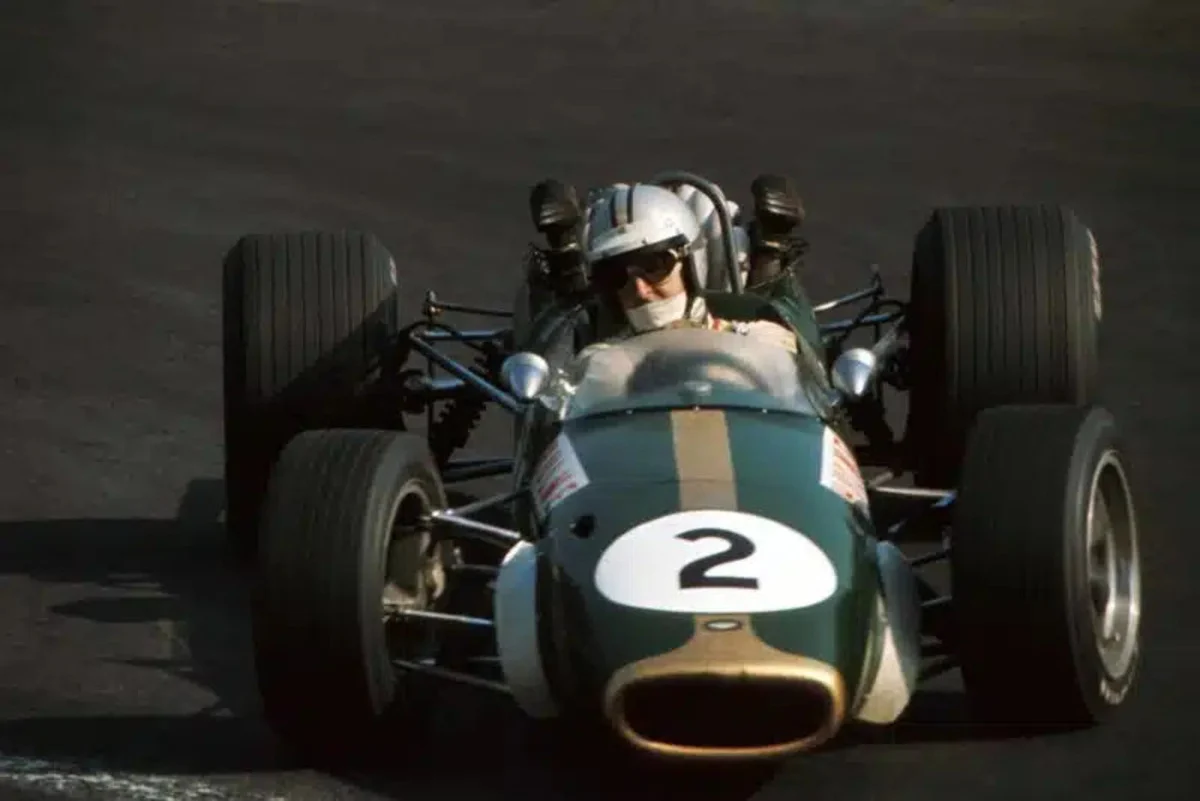
Denny Hulme, a New Zealander whose calm demeanor earned him the nickname "The Bear," coasted over the finish line. He didn’t need to win; he simply needed to finish. With that final lap, he was crowned World Champion of Formula 1. It was a victory of pragmatism over perfection, of the backyard workshop over the aerospace lab, and of a humble Buick-derived V8 over the mighty Ford-Cosworth DFV. Hulme finished the season with 51 points—five more than his own team principal, the formidable Jack Brabham. It was the ultimate "hold-up," a masterclass in reliability that proved that in racing, to finish first, you must first finish.
A Chronology of Ingenuity: From Detroit Scrap to World Title
To understand the magnitude of this upset, one must rewind to the winter of 1965. The Fédération Internationale de l’Automobile (FIA) had decided to double the engine capacity limit, transitioning from 1.5-liter units to 3.0-liter monsters. The move sent shockwaves through the paddock.
Ferrari scrambled to cast a V12 engine that was heavy and cumbersome. British Racing Motors (BRM) attempted the engineering equivalent of a "Hail Mary" pass, designing a complex H16 engine that was as fragile as it was intricate. Meanwhile, Coventry Climax, the industry standard for power, simply threw in the towel.
Jack Brabham, a man who famously despised "fumeous theories" and unnecessary complexity, took a different path. He needed a motor that was lightweight, compact, and affordable. He turned to Phil Irving, a brilliant mechanical wizard at Repco, an Australian company primarily known for aftermarket engine parts.
Irving had a stroke of genius. He recalled a small, all-aluminum 3.5-liter V8 that General Motors had developed in the late 1950s for the Oldsmobile F-85 and the Buick Special. GM had abandoned the project because the aluminum casting process was too expensive compared to traditional cast iron. Irving bought the scrap blocks for a pittance. He sleeved the cylinders, shortened the stroke to fit the 3.0-liter regulations, and bolted on custom single-overhead-cam cylinder heads. By 1967, the Repco "740" engine was born. While it produced a modest 330 horsepower compared to the 400 horsepower of the new Cosworth engines, it weighed less than 150 kilograms and delivered immense torque at low RPMs. It was the perfect weapon for a season defined by attrition.
The Cultural Divide: Steel Tubes vs. The Ballerina
The 1967 season was a clash of two diametrically opposed philosophies. On one side stood Colin Chapman and his Lotus 49—a beautiful, fragile "ballerina" featuring a monocoque chassis made of glued and riveted aluminum. It was a masterpiece of aeronautical engineering, but one that was constantly on the verge of self-destruction.
In the Brabham garage, Ron Tauranac, Jack’s partner, treated such innovation with profound indifference. The BT24 was built on a traditional space-frame of steel tubes brazed with a blowtorch and covered in a lightweight fiberglass skin. It was, by all accounts, archaic. Yet, it possessed a virtue that the Lotus lacked: it was practically indestructible. If a suspension arm bent on a curb, a mechanic could repair it with a torch and a steel rod in under an hour.
This contrast defined the season. While Clark and Graham Hill secured pole positions with ease, they spent their race weekends sidelined by snapped suspensions, seized fuel pumps, or shredded gearbox bearings. Hulme, meanwhile, drove with calculated intelligence. He did not chase the fastest lap on Saturday; he managed his Goodyear tires, protected his Girling brakes, and let the high-strung machines in front of him disintegrate into the gravel traps. With two victories—including a masterful performance on the treacherous Nürburgring—and six podiums, Hulme’s season was a masterclass in metronomic consistency.
Official Responses and the "Black Jack" Spirit
The narrative of the 1967 season is often simplified as a battle between driver and machine, but the role of Jack Brabham—the "Black Jack" of F1—cannot be overstated. In Mexico, Brabham was in a position of total control. He was the founder, the team leader, and the reigning three-time world champion. Had he chosen to impose team orders, he could have easily throttled Hulme’s championship dreams.
Instead, he chose sportsmanship. "Black Jack" finished second in that final race, immediately behind his employee, and was the first to congratulate him in the parc fermé. It was a moment of profound integrity that cemented the legacy of the Brabham-Repco partnership. It was a victory of a small, tight-knit "commando" unit of Australians and New Zealanders against the gargantuan European industrial giants.
However, the camaraderie was short-lived. Hulme, a shrewd tactician both on and off the track, understood the landscape of Formula 1. He knew that Keith Duckworth was working tirelessly to iron out the bugs in the Ford-Cosworth engine. He recognized that the 70-horsepower deficit the Repco faced would eventually become an insurmountable chasm. As soon as the season ended, Hulme departed the Brabham team to join his friend Bruce McLaren. His foresight was impeccable: in 1968, the Cosworth DFV began its era of total dominance, relegating the Repco V8 to the annals of history as one of the most brilliant anomalies in racing.
Implications: The Legacy of the Buick Block
The impact of this "hold-up" resonated far beyond the podiums of 1967. The engine that powered a world champion found a second life that would span decades. After being discarded by General Motors, the design was acquired by Rover. Rebranded as the "Rover V8," this engine became the heart of British motoring.
From the executive luxury of the Rover P5B to the rugged capability of the 1970 Range Rover, the engine proved its versatility. It powered the icons of the British automotive industry—Morgan, TVR, Triumph, and the Land Rover Defender—well into the early 2000s. It is a poetic irony that a design considered "junk" by American accountants became the beating heart of British engineering for nearly forty years.
Supporting Data: 1967 Technical Comparison
| Parameter | Brabham BT24 (Hulme) | Lotus 49 (Clark) |
|---|---|---|
| Chassis | Steel tubular space-frame | Aluminum monocoque |
| Engine | Repco 740 V8 (Buick base) | Ford-Cosworth DFV V8 |
| Power | ~330 hp @ 8,000 rpm | ~400 hp @ 9,000 rpm |
| Weight | 510 kg | 505 kg |
| Mechanical Reliability | Zero race-ending failures | 9 mechanical retirements |
| Final Standing | Champion (51 pts) | 3rd (41 pts) |
Conclusion
The 1967 Formula 1 season remains a testament to the idea that racing is not merely about the highest peak of performance, but about the endurance of the whole. Denny Hulme’s championship was not a fluke; it was the result of a deliberate, well-executed strategy that valued reliability over raw, unrefined speed. While the history books may favor the high-tech innovations of the Lotus, the story of the steel-tubed Brabham and the "scrap" engine from Indiana serves as a timeless reminder: in the brutal theater of motorsport, the most effective tool is often the one that simply refuses to break.