

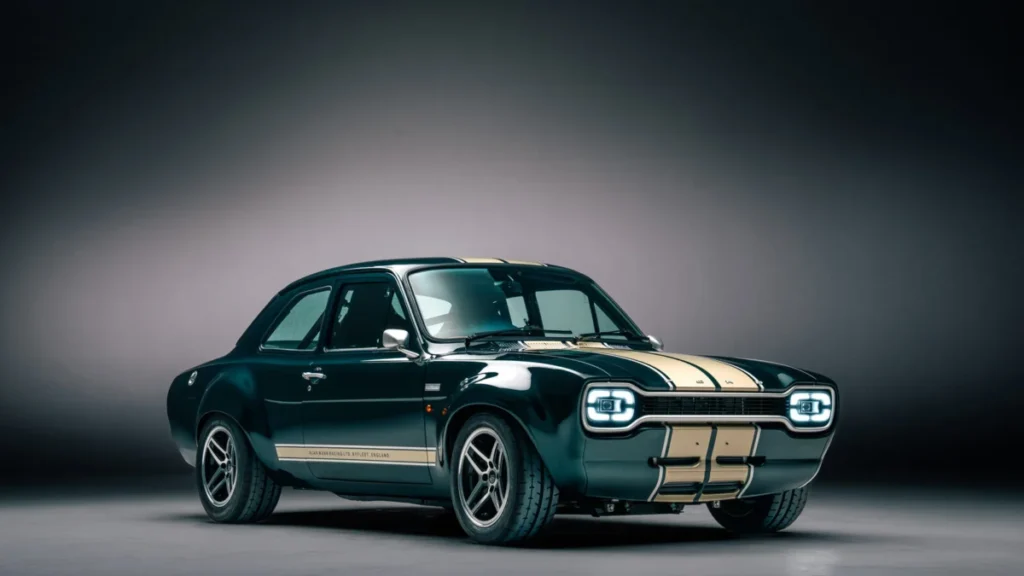
In the quiet industrial landscape of Chelmsford, Essex, a revolution is taking place—not in the world of high-volume mass production, but in the hyper-niche realm of "continuation" vehicles. Boreham Motorworks, the technical powerhouse under the umbrella of the DRVN group, has secured an official licensing agreement with Ford Heritage to manufacture 150 modernized replicas of the legendary Ford Escort Mk1 RS.
The price of admission? £354,000 before taxes, soaring toward half a million euros once import duties and fiscal levies are applied. For this sum, a buyer acquires the silhouette of a humble 1970s family saloon that once carried grocery bags and school runs. Yet, beneath the familiar boxy exterior lies a mechanical masterpiece designed to challenge the performance of modern supercars. This is the autopsy of an automotive icon reimagined for the 21st-century collector.
The Genesis: A License to Thrill
The Ford Escort Mk1 is more than a car; it is a cultural totem of British motorsport. With legendary drivers like Roger Clark and Hannu Mikkola steering the model to victory in the RAC Rally, the Mk1 defined an era of grit, sliding tires, and raw, unfiltered driving pleasure.
Boreham Motorworks’ strategy is twofold. On one hand, it pays homage to the romantic history of the rally stage. On the other, it targets the high-net-worth collector—the denizens of the City of London—who crave an "analog toy" that offers a tactile connection to the machine, far removed from the sterile, software-dominated driving experience of contemporary electric vehicles.
Anatomy of an Improvement: Solving the "Dagenham Offset"
Anyone who has ever squeezed into an authentic Escort RS1600 or a Twin Cam race car is intimately familiar with the ergonomic absurdity imposed by the Dagenham factory in the 1970s. Designed for low-cost, 45-horsepower commuters, the original chassis forced racing engineers to improvise, resulting in a cockpit where the steering column was offset by more than five centimeters to the left relative to the pedal box. The result was a contorted driving position that forced the pilot to sit at an angle, akin to steering a tractor rather than a sports car.
At the Boreham facility, the engineers have taken a scalpel to this legacy. They have entirely redesigned the front bulkhead stamping, effectively "straightening" the driving position so that the steering column perfectly aligns with the driver’s hips.
Furthermore, to address the innate understeer of the short-wheelbase chassis, the front suspension geometry has been shifted. The front axle has been pushed forward by 30 millimeters, lengthening the wheelbase. This modification allows the use of 15-inch wheels wrapped in high-profile tires. These tires serve a dual purpose: they preserve the visual aesthetics of the iconic period-correct "Rostyle" wheels while maintaining the sophisticated suspension geometry derived from the Alan Mann Racing era.
The "Ten-K" Engine: 325 Horses at 10,000 RPM
Perhaps the most significant departure from modern "restomod" trends is the refusal to install a turbocharged EcoBoost engine. While easy to source, a modern turbo unit lacks the soul and response required for a car of this pedigree.
Instead, Boreham Motorworks has commissioned a bespoke, naturally aspirated, 16-valve, 2.0-liter engine internally dubbed the "Ten-K." This power unit is a work of art:
- Weight: Only 85 kilograms (dry).
- Output: 325 horsepower.
- Redline: A screaming 10,000 RPM.
The engine features dry-sump lubrication and individual throttle bodies, all fed by a custom carbon fiber airbox. Power is transferred to the rear wheels via a Holinger five-speed manual transmission, featuring a "dog-leg" pattern—where first gear is located down and to the left. This allows the driver to snap between second and third gear in a straight, linear motion, providing the violent, precise shifts expected of a professional rally machine.
Titanium Engineering: Managing Unsprung Mass
The most complex engineering challenge faced by the team was the rear axle. Simply replacing the original live rear axle with a modern independent multi-link suspension would have stripped the car of its character, turning it into a generic contemporary compact wearing a vintage coat.
The engineers opted to retain the classic live axle design but reimagined it through the lens of modern materials science. The unit is reconstructed entirely from titanium tubes, paired with lightweight half-shafts and a Quaife limited-slip differential. This approach has shaved 40 kilograms of unsprung mass, drastically improving the car’s responsiveness to road imperfections.
Guided by five longitudinal links and a massive, CNC-machined Watt’s linkage, the rear end is now capable of absorbing massive torque and cornering loads without the traditional "hopping" associated with live axles. Weighing in at a total of 895 kilograms, the Escort Continuation boasts a power-to-weight ratio that eclipses even a modern Porsche 911 GT3.
Interior and Build Quality: Where Heritage Meets Luxury
Inside, the transformation is complete. The rear seats have been discarded in favor of a structural tubular roll cage and chassis reinforcements. However, the cabin is not devoid of comfort. Six retro-illuminated Smiths gauges provide the primary data, while a discreetly hidden air conditioning system allows for comfortable touring. A touch of horological luxury is added via two mechanical Breitling rally chronometers mounted on the dashboard, serving as a reminder of the car’s competitive lineage.
The Economic and Social Implications
At a price point exceeding €400,000, these vehicles are unlikely to be seen tearing through the mud of Welsh forests or risking their widened wheel arches against track guardrails. This brings up the inevitable question: Is this a car, or is it an asset class?
The Ford Perspective
For Ford, the deal is a masterstroke of "brand-asset monetization." The company earns substantial royalties for the use of its intellectual property and branding without risking a single cent in manufacturing, warranty, or R&D costs. It is the ultimate low-risk, high-reward strategy.
The Collector’s Market
For the 150 buyers, the purchase is a hedge against the homogenization of the automotive market. As the world transitions toward autonomous electric transport, the value of mechanical, high-revving, tactile machines—what experts call "analog treasures"—is expected to soar. The Escort Mk1 Continuation is not just a car; it is a piece of kinetic art that bridges the gap between the golden age of rallying and the high-tech precision of modern motorsport engineering.
The Future of the Brand
The success of this project has already prompted discussions about the next steps. Rumors from within the DRVN group suggest that Boreham Motorworks is already preparing to apply this same rigorous, high-spec formula to the legendary Ford RS200, the Group B icon that still haunts the dreams of rally fans worldwide.
If the Escort Mk1 is the proof of concept, the future for wealthy enthusiasts looks remarkably bright—and remarkably loud. The "continuation" movement has shifted from simply restoring old metal to re-engineering history, proving that as long as there is an appetite for the analog, the internal combustion engine will continue to find a home in the garages of the ultra-wealthy, no matter the cost of admission.
