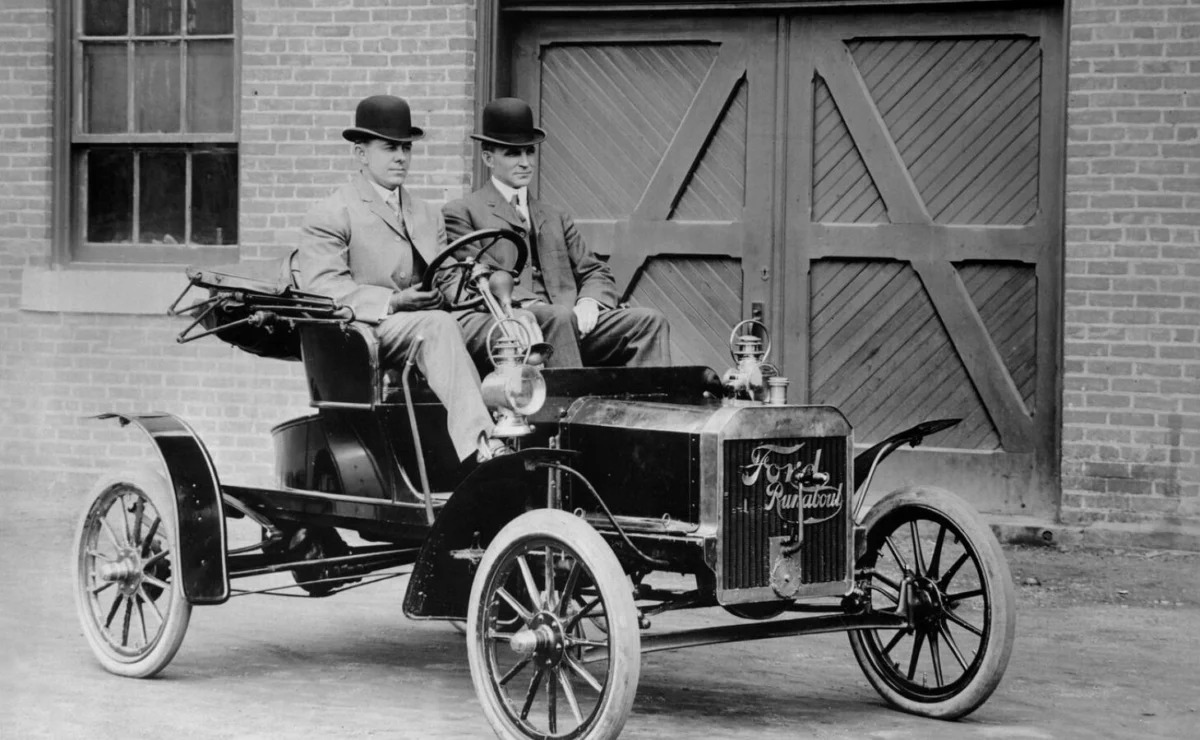
On September 27, 1908, inside the third-floor workshop of the Piquette Avenue plant in Detroit, a group of six mechanics carefully guided a 1,200-pound steel carcass toward a wooden freight elevator. They moved with the quiet focus of men performing a mundane task, avoiding any unnecessary noise that might cause the old floorboards to groan. It was a Sunday morning, and there were no cameras, no ribbons to cut, and no speeches to mark the occasion. The vehicle perched on its hickory-wood wheels was not the iconic black that would eventually define it; instead, it shimmered in a dark, rich carmine red.
This was the first production-run Ford Model T. At the time, the event went entirely unnoticed by the local press. Yet, this modest departure from the assembly floor was the opening salvo of a revolution that would dismantle the old world of horse-drawn carriages and elite motoring, paving the way for the modern industrial age.
The Genesis: A Stove, A Chalkboard, and a Visionary’s Obsession
The Model T was not born on a high-tech assembly line, but rather in a secluded 26-by-30-foot room tucked away from the prying eyes of factory supervisors. Two years prior to that historic Sunday, Henry Ford had effectively locked two young Hungarian-American draftsmen, Childe Harold Wills and Joseph Galamb, into this makeshift design office. Armed with nothing but a chalkboard and a coal-burning stove, they were tasked with a singular mission: to liberate Ford from the failures of the Model K.
The Model K, a cumbersome and expensive six-cylinder vehicle, had been a disaster—a "bourgeois" luxury item that was failing to sell and bleeding the company dry. Ford, however, had a different dream. He envisioned a machine that was lightweight, rugged, and—most importantly—repairable with nothing more than three simple wrenches. It had to be a vehicle calibrated for the modest pocketbooks of the American farmer.
The Vanadium Secret
The technical breakthrough that enabled the Model T’s durability was an accidental discovery. Three years before the car’s launch, while scavenging through the wreckage of a crashed French race car at Daytona Beach, Ford noticed a twisted valve stem that refused to break despite the violent impact. Intrigued, he had his chemists analyze the metal. They identified it as vanadium steel, an alloy then unknown to the Michigan forges.
Because American blast furnaces were not yet equipped to reach the extreme temperatures required to smelt this alloy, Ford took the audacious step of financing the tooling for an Ohio steel mill himself. The result was a chassis three times stronger than his competitors’, yet fifty pounds lighter. It was this metallurgical edge that would allow the Model T to survive the punishing, rutted dirt tracks of rural America.
Engineering for the Wild: Mechanics of the "Tin Lizzie"
In 1908, the United States was a nation of mud tracks and deep ruts. Outside the major urban centers, paved roads were virtually non-existent. To survive, a vehicle needed to be part tractor, part pioneer. The Model T provided exactly that, with a ground clearance of twelve inches and a suspension system utilizing transverse leaf springs that allowed the frame to twist over rocks without fracturing.
A Masterclass in Simplicity
The 2.9-liter, four-cylinder engine was a radical departure from contemporary norms. By utilizing a single-block cast-iron construction and a detachable cylinder head, Ford ensured that even the most inexperienced rural mechanic could clear carbon deposits from the valves in minutes.
The transmission was equally ingenious, if unconventional. It utilized a planetary gear system that eliminated the need for a traditional clutch. Operation was entirely floor-based:
- The Left Pedal: Engaged low or high gear.
- The Middle Pedal: Engaged reverse.
- The Right Pedal: Actuated a fabric-lined band on the transmission drum to serve as the brake.
Speed was controlled via a hand-lever on the steering column. This "do-it-yourself" engineering meant the engine could run on almost anything—gasoline, kerosene, or even homemade corn alcohol. In a pinch, a simple piece of wire could clear a clogged jet, ensuring the car would keep moving long after other, more "refined" vehicles had stalled in the wilderness.
The "Reverse" Workaround
The vehicle’s only major design flaw was the fuel system. The tank was located under the front seat, feeding the carburetor by gravity. On steep inclines of over 15 percent, if the fuel level was low, the gas would stop flowing. The ingenious solution adopted by early owners? They would simply turn the car around and ascend the steepest hills in reverse, ensuring the fuel remained above the carburetor.
The Industrial Bottleneck: From Sawhorses to Mass Production
On that September day in 1908, the "assembly line" did not exist. Components were brought to the workshop floor in wheelbarrows, and teams of mechanics assembled each vehicle from start to finish on stationary wooden sawhorses. It took twelve grueling hours of manual adjustment to complete a single chassis.
Despite the lack of automation, the market reaction was instantaneous. Priced at $850—a substantial sum equivalent to a full year’s wages for a factory worker—the Model T triggered a consumer frenzy. Within weeks, fifteen thousand firm orders had piled up at the Dearborn headquarters. Ford’s bankers were overwhelmed; they couldn’t process the down-payment checks fast enough.
Henry Ford was forced to issue a desperate directive to his dealers: stop taking new orders. The Piquette Avenue facility was at a total standstill, unable to meet the demand. This suffocating bottleneck was the catalyst that pushed Ford to purchase farmland in Highland Park in 1910. It was there, three years later, that the sawhorses would be replaced by mechanical winches and moving conveyors.
Implications: The Democratization of Mobility
The transition from the Piquette Avenue workshops to the Highland Park plant in 1913 resulted in the first true moving assembly line. The time required to assemble a chassis dropped from twelve hours to just ninety-three minutes.
It was during this transition that the Model T turned black. Contrary to popular belief, the choice was not based on aesthetics but on efficiency. "Gilsonite" black paint was the only variety that dried fast enough to keep pace with the accelerating assembly line.
A Societal Shift
The implications of this shift were profound. By 1916, the price of the Model T had dropped to $360. For the first time in history, the automobile was not a toy for the wealthy, but a utility for the masses.
- Urban Migration: The Model T enabled the growth of suburbs, as workers were no longer tethered to proximity to streetcar lines.
- Infrastructure Investment: The sheer volume of Fords on the road forced the U.S. government to finally standardize and pave the nation’s road network.
- The Labor Revolution: By significantly reducing the cost of production, Ford was able to implement the $5-a-day wage, effectively creating the American middle class.
Conclusion: The Legacy of Piquette Avenue
Looking back at that quiet September morning in 1908, it is clear that the "Tin Lizzie" was more than a machine; it was the blueprint for the 20th century. The lessons learned in the cramped, coal-heated room at Piquette Avenue—the necessity of interchangeable parts, the power of vanadium steel, and the efficiency of the assembly line—permanently altered the relationship between man and machine.
Henry Ford did not just build a car; he built a world in which distance was no longer a barrier and where the industrial capacity of a nation could be harnessed to serve the common citizen. While the wooden sawhorses of 1908 are long gone, the echoes of that first Model T rolling out of the factory remain the heartbeat of the global automotive industry today.