

By Editorial Staff | June 30, 2026
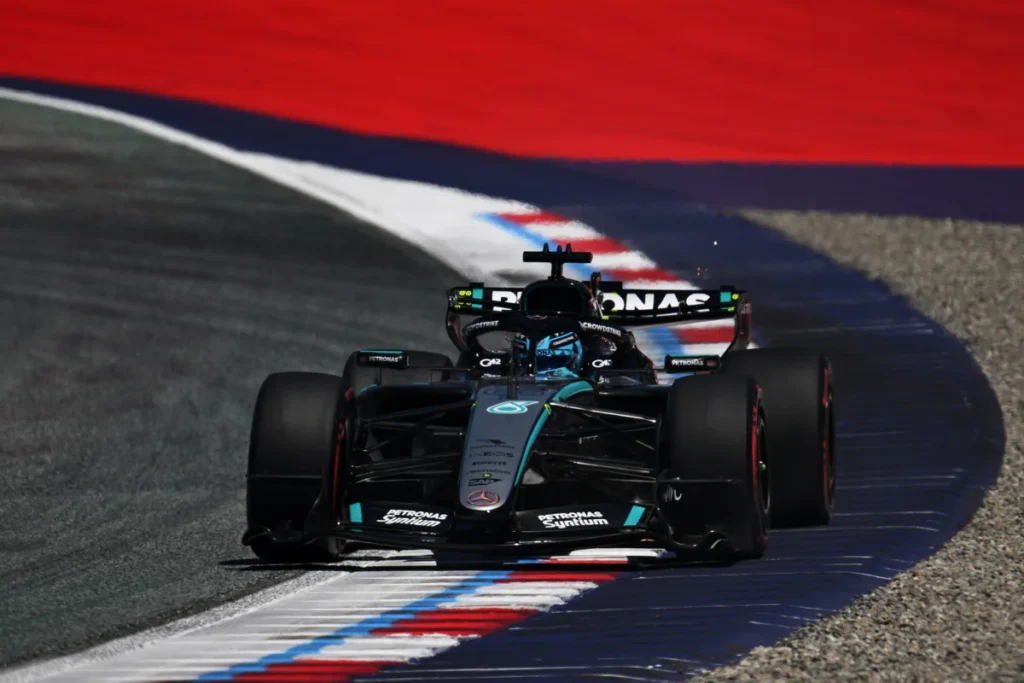
The 2026 Austrian Grand Prix weekend is shaping up to be a masterclass in German engineering as Mercedes-AMG Petronas continues to assert its absolute dominance over the Spielberg circuit. Following a clean sweep of the first two practice sessions by rising star Kimi Antonelli, it was George Russell who took the spotlight in the final practice session (FP3) on Saturday morning.
Under scorching Styrian skies, the Mercedes duo underscored their current momentum, securing a one-two finish that has sent a clear message to their rivals: the Silver Arrows are the team to beat as qualifying approaches.
The Core Narrative: Mercedes in Command
The Red Bull Ring has historically been a demanding circuit, favoring a combination of high-speed stability and mechanical traction. This year, the Mercedes W17 has proven to be the most versatile platform on the grid. While Kimi Antonelli dominated the headlines on Friday, George Russell’s performance in FP3 served as a reminder of the depth and experience within the Brackley-based squad.
Russell’s fastest lap of 1:07.096 was set in the dying embers of the session, just as the track evolution reached its peak. The margin—a mere 0.038 seconds over his young teammate—highlights the incredible synergy currently permeating the Mercedes garage. With Lewis Hamilton—now piloting for Ferrari—securing the third fastest time, the top three positions were occupied by the sport’s most iconic drivers and teams, setting the stage for an explosive qualifying battle.
A Chronological Breakdown of FP3
The session began under intense heat, with ambient temperatures hitting 31°C. This thermal stress posed an immediate challenge for tire management, forcing teams to adopt a cautious approach during the early installation laps.
Early Exchanges and Technical Woes
Sergio Perez was the first to emerge from the pit lane, with his Cadillac team eager to reclaim lost ground after a dismal Friday. However, the early stages were defined by operational challenges rather than pure pace.
Twenty minutes into the hour, Lando Norris moved to the top of the timesheets with a 1:07.832. His session, however, was hampered by a significant hardware failure; the McLaren driver reported over team radio that his left-side mirror was "completely broken," forcing the team to devise a strategy to manage his visibility for the remainder of the session.
As the session progressed, Oscar Piastri initially challenged for the front, but the narrative shifted when Kimi Antonelli began to find his rhythm. The young Italian, fresh off his dominant Friday, shaved nearly three-tenths of a second off the benchmark, signaling that his pace was not a fluke.
The Verstappen Variable
Max Verstappen was the final driver to take to the track, a strategic choice by Red Bull Racing to avoid traffic. While his raw pace remained competitive, the Dutchman was visibly frustrated by persistent technical niggles. He reported a "bizarre, constant interference" through his radio, which was severe enough to warrant an emergency change of his custom-fitted earpieces.

Red Bull’s internal program was notably split. While Verstappen focused on performance runs on the soft compound, Isack Hadjar was tasked with heavy-fuel simulations on the hard tires, suggesting that Red Bull is sacrificing single-lap glory in favor of long-run data to combat the high tire degradation expected for Sunday’s race.
The Final Sprint
The closing fifteen minutes transformed the session into a qualifying simulation. Mercedes remained the benchmark. Antonelli improved his own time to 1:07.134, but Russell, who had spent the earlier half of the session refining his setup, found the necessary extra grip on his final set of soft tires to clinch the P1 spot.
Supporting Data and Performance Analysis
| Position | Driver | Team | Time | Gap |
|---|---|---|---|---|
| 1 | George Russell | Mercedes | 1:07.096 | – |
| 2 | Kimi Antonelli | Mercedes | 1:07.134 | +0.038 |
| 3 | Lewis Hamilton | Ferrari | 1:07.211 | +0.115 |
| 4 | Oscar Piastri | McLaren | 1:07.344 | +0.248 |
| 5 | Lando Norris | McLaren | 1:07.360 | +0.264 |
| 6 | Max Verstappen | Red Bull Racing | 1:07.369 | +0.273 |
| 7 | Charles Leclerc | Ferrari | 1:07.452 | +0.356 |
Ferrari’s Mixed Bag
Lewis Hamilton’s third-place finish provided a much-needed boost for the Scuderia. His ability to extract pace from the Ferrari package demonstrates that the Maranello squad is firmly in the hunt. However, it was not a flawless session for the team. Charles Leclerc struggled with the balance of his car, suffering a significant lock-up at the tight Turn 3. The Monegasque finished seventh, citing a "brouillonne" (messy) session where he failed to find a clean rhythm.
The Midfield and Lower Ranks
Further down the order, the competition remains fierce. Williams faced disciplinary scrutiny after Carlos Sainz was issued a black-and-white warning flag for "unnecessarily slow driving" and running wide at the final corner—a move that likely compromised his focus and rhythm. Meanwhile, the Cadillac pairing of Perez and Bottas languished at the back, suggesting that the team has significant work to do before the start of the qualifying hour.
Official Responses and Team Perspectives
In the aftermath of the session, the paddock buzzed with speculation regarding the Mercedes advantage.
Mercedes Trackside Engineering Director:
"We are pleased with the balance the drivers have found. The heat is a major factor here, and seeing both cars adapt so well to the thermal degradation is a testament to the work done at the factory. However, we expect Ferrari and McLaren to close the gap significantly as temperatures drop for qualifying."
Max Verstappen (Red Bull Racing):
"It was a strange morning. The interference in the radio was a major distraction, and we clearly aren’t where we want to be on the soft compound. We have data to analyze regarding the hard tire runs with Isack. We need to be sharper for the afternoon."
Implications for Qualifying and the Grand Prix
The data from FP3 paints a compelling picture. With the top six drivers separated by less than three-tenths of a second, the margins for error in qualifying will be razor-thin.
- Mercedes’ Pole Position Aspirations: The Brackley squad has clearly unlocked a setup window that provides high peak downforce without compromising tire longevity. If they can replicate this in cooler conditions, they are the clear favorites for the front row.
- The Ferrari/McLaren Threat: Both teams have shown they possess the raw speed to challenge Mercedes. If Leclerc can clean up his driving and Norris can resolve his equipment issues, the gap could vanish in an instant.
- The Tire Factor: The 31°C ambient temperature is expected to persist, making tire management the "X-factor." Teams that prioritized long-run data in FP3, like Red Bull, may have a strategic advantage in the race even if they start further back on the grid.
- Driver Psychology: The battle within Mercedes between the veteran Russell and the prodigy Antonelli is perhaps the most captivating subplot of the 2026 season. Antonelli’s ability to remain within milliseconds of his teammate under high-pressure conditions is a clear sign that he is a future championship contender.
As the sun sets on the Red Bull Ring, the focus shifts to the qualifying session. With the field so tightly packed, the smallest mistake at the exit of Turn 9 or a slight miscalculation in tire temperature will be the difference between a front-row start and the chaos of the midfield. Mercedes holds the edge, but in the volatile world of Formula 1, nothing is guaranteed until the checkered flag falls.
