

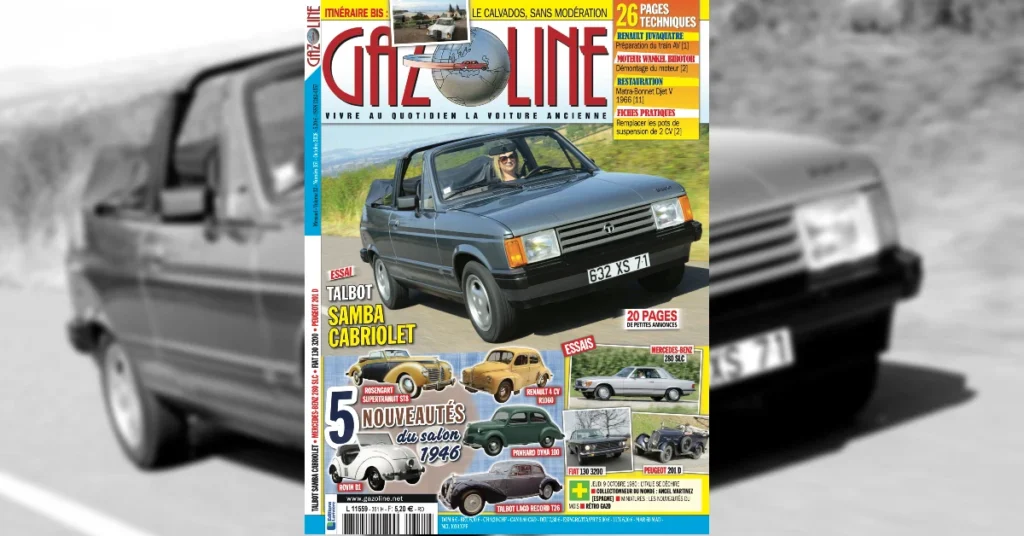
The October 2026 issue of Gazoline (No. 351) has arrived, offering a rich tapestry of automotive heritage that bridges the gap between the affordable open-top fun of the 1980s and the desperate, creative innovation of the post-WWII reconstruction era. From the sun-drenched coastal roads of Calvados to the meticulous mechanical restoration of Wankel engines, this month’s edition provides a comprehensive look at the machines that shaped our roads and our memories.
Main Facts: The Stars of the Show
This month’s cover feature highlights the Talbot Samba Cabriolet, a vehicle that serves as a poignant reminder of France’s attempt to capture the "affordable convertible" market segment, heavily influenced by the German design philosophy seen in the Volkswagen Golf. We have secured a late-production model in pristine, original condition to evaluate whether the Samba still holds the charm it promised decades ago.
Beyond the cover car, this issue features a diverse "garage" of test drives:
- Mercedes-Benz 280 SLC: An exploration of the "stretched" grand tourer, powered by the legendary, velvet-smooth inline-six engine.
- Fiat 130: A rare encounter with a high-end sedan that carried a heavy historical burden, showcasing Italian luxury and engineering ambition.
- Peugeot 201 D Torpedo Commercial: A near-unique piece of pre-war history that represents the grit and utility of early French automotive manufacturing.
Chronology: October 1946 and the Dawn of Recovery
To mark the October season, Gazoline turns its lens toward the monumental 1946 Paris Motor Show. This was the first post-war Salon, a period defined by extreme scarcity, raw ambition, and a country trying to rebuild its identity through mechanical ingenuity.
The Five Icons of 1946
Our feature dissects the divergent destinies of five vehicles that stood on the pedestals in 1946:
- Panhard Dyna 100: Where the aggressive use of aluminum signaled a shift toward lightweight, efficient design.
- Renault 4 CV R1060: The "little car that could," which was quite literally carried to success by the public.
- Rosengart SuperTrahuit ST8: Often dubbed the "other 22," this car remains a fascinating footnote in the luxury segment.
- Rovin D1: A microcar that brings a sense of whimsy and necessity to the post-war landscape.
- Talbot-Lago Record T26: A display of pure mechanical fervor and high-performance design that refused to die in the face of austerity.
Supporting Data: The Full October 2026 Summary
The following index provides a breakdown of the technical and historical content featured in Gazoline No. 351:
| Section | Topic |
|---|---|
| Actualités | October 9, 1980: The political and social fracturing of Italy |
| Redécouverte | Talbot Samba Cabriolet, Mercedes-Benz 280 SLC, Fiat 130 3200 |
| Avant-guerre | Peugeot 201 D Torpedo Commercial |
| Itinéraire Bis | The Calvados: Following the path of the conquerors |
| Collectionneur du Monde | Angel Martinez (Spain): An artist influenced by the "Losange" (Renault) |
| Restauration | Renault Juvaquatre (1951), Wankel Birotor engine, Matra-Bonnet Djet V |
Official Perspectives and Technical Analysis
The Samba and the Art of the Accessible Top
The Talbot Samba Cabriolet remains a divisive but beloved subject. Journalists noted that while it was clearly inspired by the Golf’s footprint, the Samba possessed a uniquely French flair. Its "Samba and sans haut" (Samba without a roof) persona defined the era’s aspirations for a weekend cruiser. Our assessment confirms that for collectors, the late-production models offer the most refined driving experience of the platform, blending nostalgia with surprisingly usable performance.
The Wankel and the Djet: The Restoration Challenge
Technical expertise is at the heart of this issue. We continue our deep dive into the Wankel Birotor engine, focusing on the delicate process of engine disassembly—a task that requires both patience and a deep understanding of rotary dynamics. Simultaneously, our long-term restoration project on the Matra-Bonnet Djet V (1966) hits a major milestone: the vehicle has successfully passed its technical inspection (CT). We walk readers through the final adjustments that allowed this piece of sports-car history to return to the road "with fingers in the nose," or, as the French say, les doigts dans le nez (effortlessly).

Implications: The Legacy of the 1946 Salon
The 1946 Salon was not merely a trade show; it was a psychological turning point for France. By analyzing the Panhard Dyna and the Renault 4 CV, we see how the industry pivoted from luxury craftsmanship to mass-market survival. The implications of these decisions are still felt today in the design language of modern French hatchbacks.
The Gazoline editorial team argues that by looking back at the "uncertain conditions" of 1946, we better understand the resilience of the automotive sector during times of global crisis. Whether it is the bold experimentation of the Rosengart or the sheer elegance of the Talbot-Lago Record, these cars remind us that automotive history is a cycle of innovation, failure, and eventual resurrection.
Travel and Culture: The Calvados Route
As we transition out of summer, our "Itinéraire Bis" takes readers to the Calvados region. This is not just a drive; it is a pilgrimage. By traversing the beaches of the D-Day landings, we explore the juxtaposition of historical gravity and the beauty of the Norman coastline. It serves as a reminder that the cars we drive are not just metallic objects—they are vessels that carry us through the landscapes of our own collective history.
Conclusion: A Must-Have for the Enthusiast
Issue No. 351 is a celebration of the mechanical spirit. From the humble beginnings of a 1951 Renault Juvaquatre being prepped for the road to the high-society presence of the Fiat 130, this edition of Gazoline proves that every car has a story worth telling.
For those looking to deepen their knowledge of the post-war era, the evolution of French design, or the technical hurdles of rotary engines, this issue is an essential addition to any enthusiast’s library.
Ordering Information:
Readers can secure their copy of Gazoline No. 351 by visiting the official Gazoline store. Join us as we continue to champion the preservation of automotive heritage, one restoration, one drive, and one memory at a time.
Gazoline: Celebrating the passion of the past, for the drivers of today.
