In the rarefied world of ultra-luxury grand tourers, few nameplates carry the legendary pedigree of the Aston Martin Vanquish. As the flagship of the Gaydon-based manufacturer’s illustrious lineup, the third-generation Vanquish—launched for the 2024 model year and continuing into 2025—represents the pinnacle of British automotive engineering, bespoke craftsmanship, and brute force.
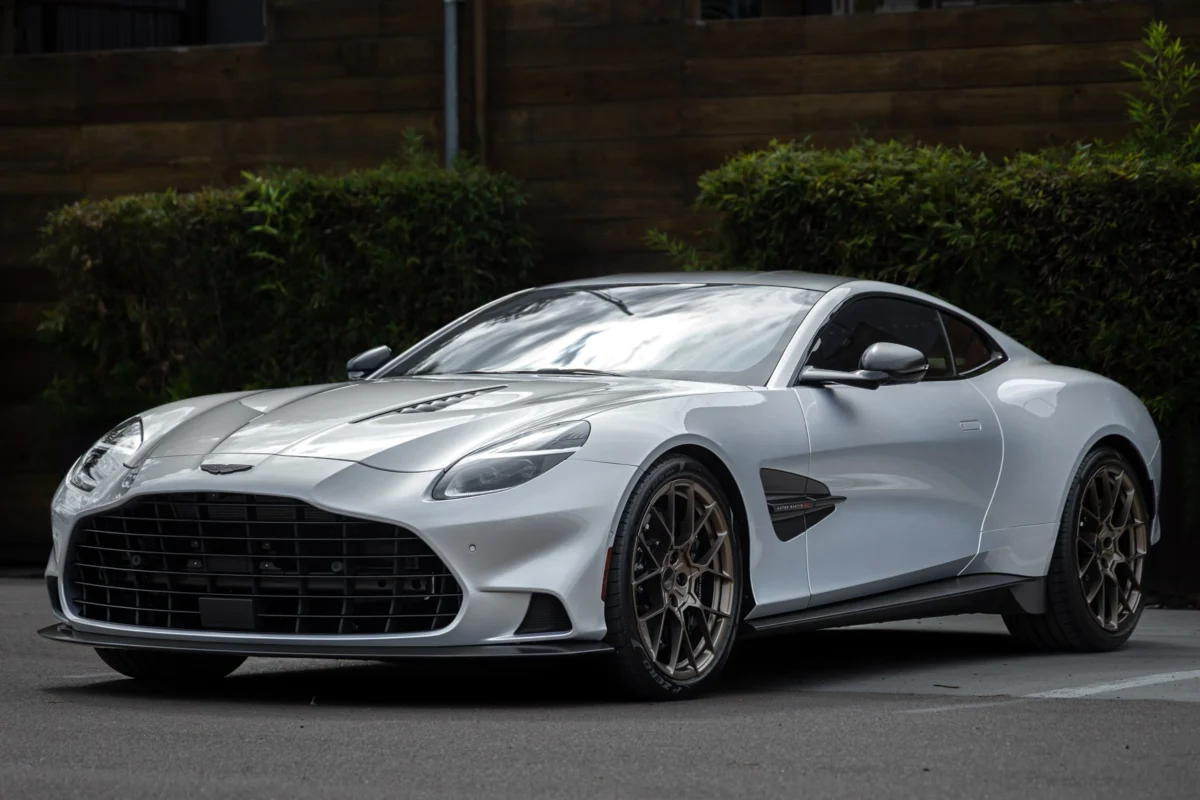
For discerning enthusiasts and collectors, the opportunity to acquire a nearly new, highly optioned example is a rare event. Currently sitting on the market in San Diego, California, with a mere 1,300 miles on the odometer, a meticulously specified 2025 Aston Martin Vanquish finished in sleek silver offers a masterclass in modern supercar performance wrapped in timeless elegance.
Originally acquired new by the current seller, this flagship GT boasts an extensive list of factory options, an accident-free history, and the jaw-dropping performance of a twin-turbocharged V12 engine. As it crosses the auction block, this machine serves as a rolling testament to Aston Martin’s commitment to internal combustion supremacy in an increasingly electrified era.
Main Facts: Anatomy of an Aston Martin Flagship
At the heart of the 2025 Aston Martin Vanquish lies an engineering masterpiece: a monstrous, twin-turbocharged and intercooled 5.2-liter V12 engine featuring an aluminum block and cylinder heads alongside port fuel injection. This powerplant is factory-rated at an astonishing 823 horsepower and 738 lb-ft of torque, figures that instantly cement the Vanquish as a dominant force on both highway and track.
Power is channeled to the rear wheels through an aluminum-alloy torque tube housing a lightweight carbon-fiber driveshaft. This connects to a rear-mounted ZF eight-speed automatic transaxle and an electronic limited-slip differential (e-diff), ensuring lightning-fast gear changes and optimal power distribution. To amplify the acoustic drama of the V12, this particular example was optioned with a sonorous titanium exhaust system.
The vehicle is built upon a dedicated, model-specific bonded-aluminum chassis supplemented by carbon-fiber and composite bodywork. Compared to its stablemates like the DB12, the Vanquish cuts an imposing figure: it measures 6.5 inches longer, boasts a 3.2-inch longer wheelbase, and features a roughly 3-inch greater distance between the front axle and the A-pillar, optimizing both cabin space and high-speed stability.
Key Specifications at a Glance:
Engine: Twin-turbocharged 5.2-liter V12
Horsepower: 823 hp
Torque: 738 lb-ft
Transmission: ZF 8-speed automatic transaxle with paddle shifters
Drivetrain: Front-engine, rear-wheel drive with electronic limited-slip differential
Chassis: Bonded-aluminum structure with carbon-fiber/composite body panels
Suspension: Adaptive Bilstein DTX dampers
Brakes: Carbon-ceramic rotors (16” front, 14” rear) with 6-piston front and 4-piston rear black calipers
Wheels & Tires: 21” forged alloy wheels in bronze, wrapped in Pirelli P Zero tires (275/35 front, 325/30 rear)
Odometer Reading: 1,300 miles
Chronology: The Evolution of the Vanquish Lineage
To understand the magnitude of the 2025 Vanquish, one must look back at the lineage that birthed it. The Vanquish nameplate has long been reserved for Aston Martin’s ultimate production car, serving as a bridge between hand-built British tradition and cutting-edge motorsport technology.
The Genesis and Evolution (1990s–Present)
2001–2007 (First Generation): Designed by Ian Callum and famously featured in the James Bond film Die Another Day, the original V12 Vanquish debuted as Aston Martin’s technological showcase, utilizing a carbon-composite and aluminum structure.
2012–2018 (Second Generation): The Vanquish returned, replacing the DBS. Built on the VH architecture, it utilized a full carbon-fiber body and a naturally aspirated 6.0-liter V12, culminating in the ferocious Vanquish S.
2024 (Third Generation Launch): After a brief hiatus, Aston Martin revived the moniker for a new era. Moving away from naturally aspirated V12s in favor of forced induction, the company positioned the third-generation Vanquish as a direct competitor to ultra-luxury titans from Ferrari, Bentley, and McLaren.
Current Offering (2025 Model Year): This specific silver-over-black example was built during the initial production wave, specified with a suite of bespoke Q-division style carbon-fiber elements, and delivered new to its current owner in Oregon before relocating to Southern California. With only 1,300 miles accumulated, it represents a virtually showroom-fresh iteration of Aston Martin’s latest design language.
Supporting Data: Exterior, Interior, and Dynamic Capabilities
Exterior Design & Aerodynamics
Finished in sophisticated silver paintwork, this Vanquish has been protected from day one by a full layer of paint protection film (PPF) applied to the bodywork. The exterior aesthetics are heavily elevated by an array of exposed carbon-fiber components, including:
Front splitter
Side skirts
Side vents
Mirror caps
Rear diffuser
A striking full carbon-fiber roof panel
Further accentuating its aggressive stance are a black front grille, matching black Aston Martin wing badges, window surrounds, and signature swan doors that elevate gracefully upon entry. The rear profile is dominated by a Kamm tail integrating a carbon-fiber "shield," flanked by matrix LED headlights and front/rear parking sensors. The car rolls on staggered 21-inch multi-spoke forged alloy wheels finished in bronze, framing massive carbon-ceramic brakes.
Cockpit Luxury & Technology
Opening the swan doors reveals a driver-focused cabin trimmed in rich black leather and Alcantara, accented by crisp white contrast piping and stitching. The heated, ventilated, and power-adjustable Sports Plus bucket seats feature three-position memory functionality and embossed Aston Martin wings on the headrests.
The driver interacts with a flat-bottom steering wheel equipped with aluminum paddle shifters, which frames a configurable 10.25-inch TFT instrument cluster displaying a 220-mph speedometer and a tachometer with a thrilling 7,000-rpm redline.
For infotainment and convenience, the cabin incorporates:
Dual 10.25-inch central displays with navigation, Apple CarPlay, and Android Auto (recently updated to support Apple CarPlay Ultra).
A world-class 15-speaker Bowers & Wilkins surround-sound system.
Dual-zone automatic climate control.
A 3D Surround-View camera system alongside a comprehensive suite of active safety aids (adaptive cruise control, blind-spot monitoring, lane centering, and traffic sign recognition).
Dynamics and Handling
Despite its grand touring ethos, the Vanquish is built to handle apexes with sports-car precision. It utilizes adaptive Bilstein DTX dampers, dynamic stability control, Positive Torque Control, multi-level traction control, and a five-mode drive system that allows the driver to tailor the chassis and powertrain response from relaxed highway cruising to full-throttle track attack.
Official Responses and Manufacturer Intentions
When Aston Martin unveiled the latest Vanquish, company executives made it clear that the vehicle was designed to redefine the boundaries of the marque.
"With the Vanquish, we have created a flagship that does not compromise," noted senior Aston Martin engineering representatives during the vehicle’s global rollout. "By pairing an 823-horsepower V12 with an exceptionally rigid bonded-aluminum and carbon architecture, we have ensured that this car delivers uncompromising performance while retaining the peerless elegance expected of an Aston Martin grand tourer."
Engineers emphasized that the decision to stick with a V12 engine—rather than downsizing or adopting hybrid power plants like many competitors—was a deliberate homage to traditional cylinder counts, optimized through modern turbocharging and thermal efficiency techniques to meet stringent performance demands.
Furthermore, automotive critics have universally praised the vehicle’s cabin architecture, noting that Aston Martin has successfully bridged the gap between old-world British craftsmanship and state-of-the-art digital interfaces, moving away from older Mercedes-sourced electronics to a proprietary, high-responsiveness software suite.
Implications: What This Sale Means for the Collectible Car Market
The appearance of a low-mileage, highly optioned 2025 Aston Martin Vanquish on the secondary market carries significant implications for collectors and automotive investors:
The Lasting Appeal of the V12: As strict global emissions regulations force mainstream manufacturers to phase out multi-cylinder internal combustion engines, supercars powered by unadulterated, non-hybridized V12 powerplants are seeing surging demand. The Vanquish’s 823-hp engine places it in an elite, vanishingly small club of pure-ICE ultra-GTs.
Depreciation Curve Defiance: Flagship models from British marques typically experience steep initial depreciation; however, heavily optioned, near-new examples with bespoke carbon-fiber specifications and ultra-low mileage (such as this 1,300-mile specimen) frequently buck this trend, holding their value remarkably well among collectors seeking immediate delivery without waiting for factory waitlists.
The California Connection: Offered out of San Diego, California, with a clean Carfax report (free of accidents or damage), a clean Oregon title in the seller’s name, a custom car cover, and a battery charger, this turnkey package provides peace of mind for buyers looking to drive or display a virtually brand-new piece of automotive royalty.
Ultimately, this 2025 Aston Martin Vanquish is far more than a high-performance machine—it is a rolling sculpture, a technological tour de force, and a celebration of the twelve-cylinder engine at the absolute zenith of its evolution.