

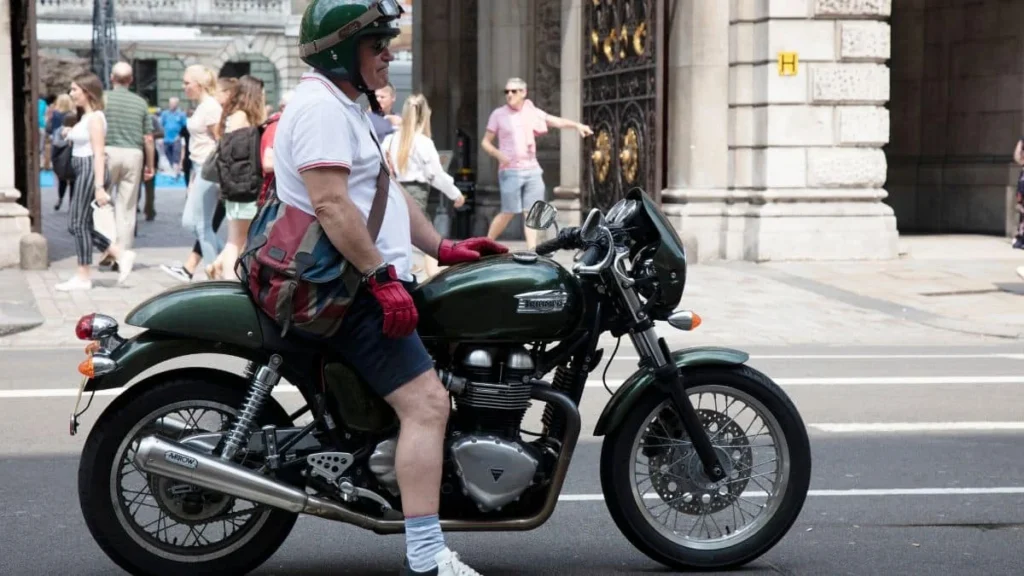
Main Facts: The Essence of Triumph Motorcycles
Founded in 1902, Triumph Motorcycles stands today as one of the oldest and most revered marques in the history of two-wheeled transport. Long before it became synonymous with roaring three-cylinder engines and timeless café racer style, the company humble beginnings lay in the production of bicycles. It was not long, however, before the marque transitioned to motorized propulsion, introducing its very first motorcycle equipped with a Minerva engine.
Throughout the 20th century, Triumph evolved to become the quintessential symbol of the British motorcycle: sober, reliable, rugged, and possessing a discreet yet irresistible charm. It represents a rare and masterful blend of refined class and raw mechanical brutality—a paradoxical balance that is unmistakably English.
Today, the brand operates at the intersection of rich heritage and modern engineering. From its global headquarters and state-of-the-art manufacturing facilities in Hinckley, Leicestershire, to assembly plants in Thailand and India, Triumph produces machines that satisfy both nostalgic purists and performance-hungry modern riders. Key highlights of the brand’s contemporary profile include:
- Global Reach: A widespread network of over 700 dealers across more dimensions of the globe, offering premium customer experiences.
- The Triple Engine Advantage: Mastery of the inline-three cylinder configuration, providing a signature sound and a versatile power band.
- Moto2 Exclusivity: Serving as the exclusive engine supplier to the FIM Moto2 World Championship since 2019, showcasing unmatched reliability and high-performance engineering on the global racing stage.
- The Modern Classic Segment: Dominating the retro-styled market with iconic models like the Bonneville, Thruxton, and Scrambler series, blending vintage aesthetics with cutting-edge electronics and braking systems.
Chronology: A Century of Triumph, Tragedy, and Triumph
1902–1949: Humble Beginnings and Early Innovation
The journey began in Coventry, England, when German immigrant Siegfried Bettmann and his partner Maurice Schulte established Triumph. After starting with bicycles, the company released its first motorcycle in 1902, powered by a 2.2 horsepower Minerva engine imported from Belgium. By 1905, Triumph was producing motorcycles featuring its own proprietary engines.
During the First World War, the brand played a pivotal role by supplying tens of thousands of its Model H motorcycles to the Allied forces, proving their rugged dependability on the muddy battlefields of Europe. In the interwar years, legendary designer Val Page joined the company, ushering in an era of high-performance parallel-twins that would define British motorcycling for decades to come.
1950–1979: The Golden Age of Rockers and the Looming Storm
The post-war decades marked the golden age of Triumph. The introduction of the iconic Speed Twin and later the Bonneville T120 (named after the famous Bonneville Salt Flats where records were shattered) turned the brand into a global cultural phenomenon.
During the 1950s and 1960s, Triumph embodied youth rebellion. The machines became cult objects for rockers, café racers, daredevil stunt performers, and Hollywood icons. Most famously, screen legend Steve McQueen attempted to leap a barbed-wire fence on a modified Triumph TR6 Trophy in the 1963 cinematic masterpiece The Great Escape.
However, paradise was short-lived. By the 1970s, Triumph, alongside the broader British motorcycle industry, faced an existential threat: the unstoppable rise of Japanese manufacturers such as Honda, Yamaha, Suzuki, and Kawasaki. Offering superior manufacturing quality, electric starts, oil-tight engines, and aggressive pricing, the Japanese brands systematically chipped away at Triumph’s market share. Industrial strikes, outdated factory equipment, and financial mismanagement pushed the once-proud company to the brink.
1980–1990: Bankruptcy and the Visionary Rescue
The inevitable collapse arrived in 1983 when the original Triumph company went into receivership and bankruptcy. It seemed like the end of an era for the legendary British marque.
However, the story took a miraculous turn thanks to John Bloor, a British multi-millionaire property entrepreneur. Bloor purchased the rights to the Triumph name and assets in 1983. Rather than rushing back into production, Bloor played the long game. He funded a quiet, methodical rebuilding process, investing heavily in a brand-new, cutting-edge manufacturing facility in Hinckley. In 1991, a revitalized Triumph triumphantly returned to the market with a completely new generation of modular, three- and four-cylinder motorcycles, proving that the legendary nameplate still had a pulse.
1991–Present: The Modern Era and Global Expansion
The post-Hinckley era has been characterized by consistent growth, technical innovation, and strategic market expansion. Triumph successfully carved out a unique space in the industry by inventing and dominating the "modern classic" motorcycle market, while simultaneously building world-class naked sports bikes and adventure tourers.
The acquisition of production facilities in Thailand allowed the company to scale efficiently while maintaining strict quality control overseen by British engineers. Today, Triumph stands stronger than ever, celebrating record sales milestones and a deeply loyal global community of riders.
Supporting Data: Sales, Racing, and Production Metrics
To understand the scale and health of Triumph Motorcycles today, one must look beyond the gleaming chrome and listen to the hard numbers that define the company’s current operations.
- Annual Production & Sales: In recent fiscal years, Triumph has consistently pushed past the threshold of 75,000 to 80,000 motorcycles sold globally per year. This demonstrates remarkable resilience and growth in a competitive post-pandemic global economy.
- The Hinckley Workforce: The company employs over 2,000 people worldwide, with a significant concentration of engineers, designers, and assembly workers stationed at its primary research, development, and manufacturing hub in Hinckley, UK.
- Moto2 Engine Milestones: Since taking over as the exclusive engine supplier for the intermediate MotoGP class in 2019, the Triumph-derived 765cc triple engine has broken numerous all-time lap records across virtually every circuit on the Grand Prix calendar. By the end of the 2023 season, the Hinckley powerplant had reliably accumulated hundreds of thousands of competitive racing kilometers with virtually zero mechanical failures—a testament to exceptional build quality.
- Global Dealer Network: Triumph’s market footprint spans over 700 authorized dealerships in more than 60 countries, ensuring that enthusiasts from North America to Japan have access to premier sales, servicing, and official apparel lines.
Official Responses: Insights from Triumph’s Leadership
The preservation of a century-old brand while aggressively pushing into the future requires delicate leadership. Executives at Triumph have frequently articulated a philosophy centered on authenticity, uncompromised quality, and emotional connection.
Nick Bloor, CEO of Triumph Motorcycles (and son of savior John Bloor), has often emphasized the importance of heritage balanced with cutting-edge technology:
"When my father acquired Triumph in 1983, he did so not just as a business investment, but out of a profound respect for British engineering heritage. Our mission ever since has never been to live in the past, but to honor it by building motorcycles that are relevant, technologically advanced, and emotionally stirring for today’s rider. We do not build appliances on two wheels; we build passions."
Regarding the brand’s quiet yet devastatingly effective entry into premier-class motorcycle racing, Chief Product Officer Steve Sargent noted the strategic value of the Moto2 engine supply program:
"Entering Moto2 was a massive statement of intent for us. People knew us for our road manners and our classic lines, but we wanted to prove the raw capability and durability of our triple architecture under the most brutal conditions imaginable. The success of the 765cc platform on the Grand Prix stage directly translates to the performance our customers experience every day on models like the Street Triple and Daytona."
Implications: The Future of British Motorcycling in a Changing World
As the global automotive and motorcycle industries face massive regulatory shifts, environmental pressures, and the looming transition toward electrification, Triumph Motorcycles finds itself at a fascinating crossroads.
Navigating the Electric Frontier
Like all major legacy manufacturers, Triumph has had to confront the realities of zero-emission mobility. Through its ambitious TE-1 electric motorcycle project—developed in partnership with Williams Advanced Engineering, Drivetran, and the University of Warwick—Triumph has successfully engineered and tested a high-performance electric prototype. The project demonstrated that future electric Triumphs will retain the brand’s core DNA: sharp handling, visceral acceleration, and unmistakable aesthetic aggression. The implications suggest that when the market is ready, Triumph will transition smoothly into the electric age without losing its soul.
The Power of the Modern Classic Niche
While rivals chase hyper-specialized niches, Triumph’s mastery of the modern classic segment has insulated it against changing consumer trends. Riders today increasingly crave analog experiences in an increasingly digital world. The tactile feedback of a metal tank, the mechanical thrum of a parallel twin, and the ability to customize one’s machine have made Triumph a lifestyle brand rather than a mere transit provider. This cultural capital carries immense financial value, ensuring strong resale values and fierce brand loyalty.
Conclusion: Class, Character, and Progress
Ultimately, Triumph represents the pinnacle of British class applied to mechanics. By surviving near-death experiences, economic turmoil, and fierce international competition, the brand has emerged stronger, wiser, and more focused than ever before. It remains faithfully anchored to its rich history, yet it refuses to shy away from progress or compromise on its unique character. Whether carving through a alpine pass on a Speed Triple, touring continents on a Tiger, or cruising city streets on a Bonneville, the rider of a Triumph is part of a century-old lineage that values substance just as much as style.
