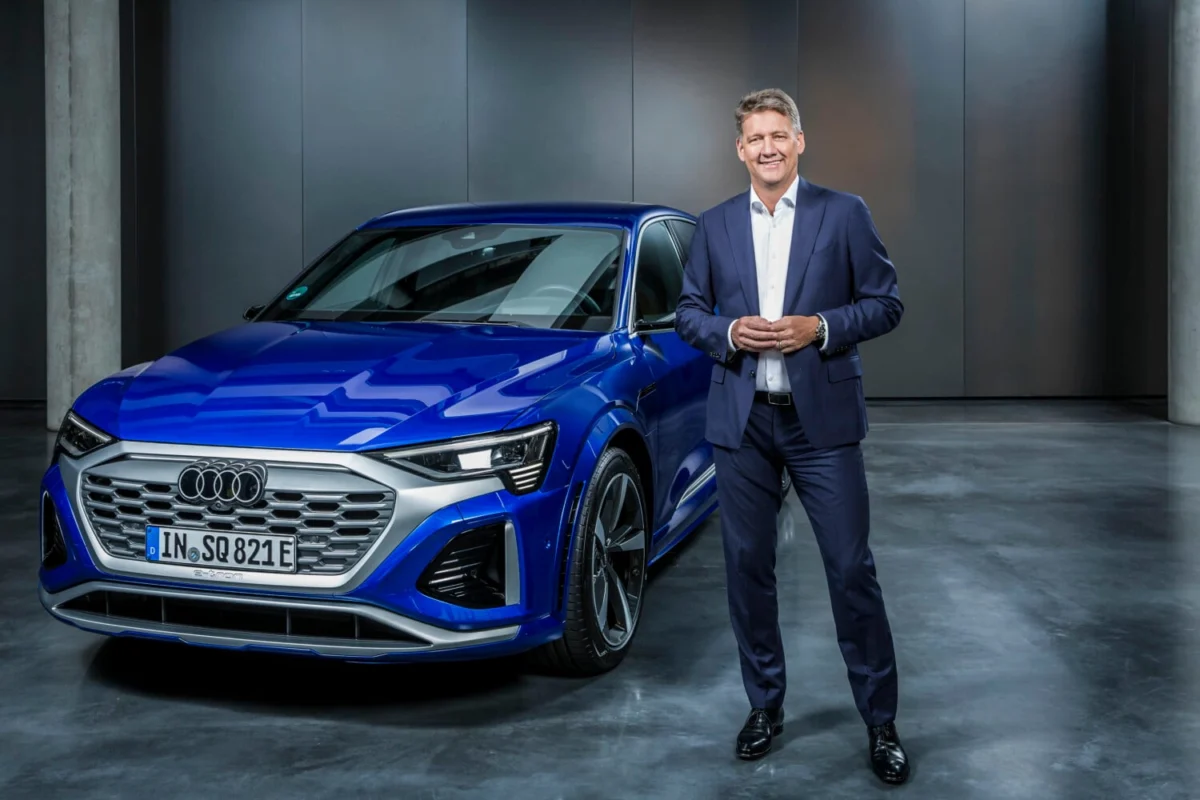
In a move that promises to reshape its North American footprint, Audi has officially announced the construction of its first-ever manufacturing facility in the United States. The site, to be located in Macon, Georgia, represents a massive $4.4 billion investment aimed at securing the brand’s future in its most critical luxury market. However, what should have been a triumphant industrial milestone has spiraled into a corporate governance crisis. The announcement, staged in tandem with a campaign rally for Donald Trump just days before the U.S. midterm elections, has ignited a firestorm of controversy in Germany, leaving Audi CEO Gernot Döllner at the center of a heated debate regarding corporate neutrality and the delicate balance between global expansion and domestic stability.
The Industrial Logic: Why Georgia?
From a purely economic and logistical standpoint, Audi’s decision to build in the United States is not merely logical; it is a long-overdue strategic correction. As one of the last remaining German premium manufacturers without a domestic production base in the U.S., Audi has been uniquely vulnerable to market fluctuations and trade volatility.
For years, the brand has been forced to import its entire American portfolio from Europe. This strategy has proven increasingly costly. Industry analysts estimate that cumulative import tariffs and fluctuating shipping costs have drained approximately €1.2 billion from Audi’s coffers—capital that the company now aims to preserve by localizing production.
The Georgia facility is slated to break ground in 2027, with production expected to commence at the beginning of the next decade. The plant is designed as a high-capacity hub, with an output target of 200,000 vehicles per year. This massive operation is expected to generate roughly 4,500 jobs, providing a significant boost to the local economy. The production focus will be on the company’s high-margin, large-scale SUVs—most notably the upcoming Audi Q9, a flagship vehicle designed specifically to appeal to the tastes and needs of the North American luxury consumer.
By choosing Georgia, Audi is planting its flag in a region that has become a burgeoning powerhouse for automotive manufacturing. The state joins neighboring South Carolina, which already hosts production facilities for BMW, Mercedes-Benz, Volvo, and, notably, Scout—a sister brand under the Volkswagen Group umbrella. This clustering of automotive expertise and supply chain logistics makes the Southeast an ideal theater for Audi’s expansion.
Chronology of the Controversy
The fallout stems less from the investment itself and more from the theatrical context in which it was unveiled. The timeline of the events reveals a strategic miscalculation that has left stakeholders reeling:
- Pre-Election Week: In the final stretch of the U.S. midterm election campaign, Audi’s leadership opted for a high-profile announcement at a campaign event for Donald Trump. The imagery of CEO Gernot Döllner speaking amidst a backdrop of campaign flags and partisan branding created an immediate visual association between the German luxury brand and a specific American political faction.
- The Immediate Backlash: Within hours of the event, the images circulated globally. By the following day, trade unions and corporate governance experts in Germany were expressing open shock at the proximity between the CEO and a polarizing political figure.
- The "Corrective" Release: Recognizing the severity of the optics, Audi issued an official, more neutral press release on the following Sunday. However, for many observers, this felt less like a strategic communication and more like an attempt at damage control—a "rattrapage" that failed to undo the impression created at the rally.
The Code of Conduct: A Breach of Neutrality?
At the heart of the corporate scandal is a fundamental question of ethics and internal policy. Christiane Benner, the powerful head of the IG Metall union and a pivotal member of the Volkswagen supervisory board, has been among the most vocal critics. In statements to Reuters, Benner described Döllner’s appearance as "deeply embarrassing" and a "manifest violation" of internal corporate rules.
Audi’s own Code of Conduct, specifically outlined on page 43, contains explicit provisions regarding political activity. The policy mandates that the company and its high-ranking executives must maintain strict political neutrality, particularly in the three months leading up to a major election. Participation in, or the sponsoring of, partisan events is strictly prohibited to ensure that the brand remains an impartial global actor.
Döllner’s defense—that the investment is an objective business decision intended to secure jobs and profitability—has done little to quell the outrage. While the investment itself may be "neutral" in its intent, the staging of the announcement effectively transformed a business venture into a political endorsement. By appearing on a platform that was actively campaigning on the promise of aggressive protectionist tariffs—tariffs that could fundamentally alter the global automotive trade—Döllner inadvertently placed Audi in the middle of a heated partisan debate.
The Domestic Context: A Fragile Backdrop
The timing of this announcement is particularly sensitive given the climate in Germany. Volkswagen, Audi’s parent company, is currently navigating a period of profound restructuring. The German automotive industry is facing a "perfect storm": the transition to electric vehicles, stagnant growth, and the burden of high domestic energy and production costs.
Several major German manufacturing sites, including Audi’s central hub in Neckarsulm, are currently considered vulnerable. Speculation regarding the future of these plants has been rampant, with some estimates suggesting that up to 100,000 jobs could be at risk across the group in the coming years. In this atmosphere of existential anxiety, announcing the creation of 4,500 jobs in the United States is viewed by many German employees as a betrayal. To the workers in Wolfsburg and Neckarsulm, the expansion in Georgia feels less like a strategic hedge and more like a migration of opportunity away from Germany.
Furthermore, the regional political landscape of Lower Saxony adds another layer of complexity. The state holds a 20% stake in Volkswagen and maintains two seats on the supervisory board. The state government, led by a coalition of the SPD and the Greens, has been under consistent political pressure from the AfD (Alternative for Germany). Because Donald Trump’s rhetoric has, at various times, been perceived as ideologically aligned with right-wing populist movements globally, the optics of the CEO of a company with significant state-owned capital appearing at a Trump rally have caused deep unease within the German political establishment.
Implications for the Future
Audi now finds itself in a precarious position. The company must balance its urgent need for a competitive, localized U.S. production base with the necessity of maintaining its corporate integrity and the support of its European workforce.
- Governance Reform: The incident will likely trigger an internal review of how Audi manages its executive appearances and communications. Expect tighter controls on public-facing events involving leadership, particularly during election cycles.
- Labor Relations: The relationship between the board and IG Metall will require significant mending. Management will need to demonstrate that the U.S. investment is a component of a larger strategy to keep the overall group competitive, rather than a sign of abandonment for the German workforce.
- Market Strategy: As Audi moves forward with the Georgia plant, it will be under intense scrutiny. Every milestone—from hiring practices to the Q9 production rollout—will be measured against the political controversy of its origin. The brand will need to prove that its U.S. expansion provides a net benefit to its global ecosystem, rather than serving as a political talking point.
In conclusion, while the Georgia factory is a necessary evolution for a global premium brand, the "Macon Incident" serves as a cautionary tale for multinational corporations in an era of heightened political polarization. In the modern global economy, where every corporate move is subject to instantaneous scrutiny, the line between strategic pragmatism and political optics has never been thinner. For Audi, the challenge will be to ensure that the Q9s rolling off the line in Georgia eventually represent a success for the entire company, rather than a symbol of a leadership misstep that shook the foundations of one of Germany’s most iconic industrial giants.