

The Red Bull Ring in Spielberg, Austria, served as the theater for a compelling and chaotic start to the 2026 Austrian Grand Prix weekend. Under the blistering Styrian sun, with track temperatures soaring toward 50°C, the opening Free Practice session (FP1) proved to be a stark reality check for several title contenders. While Mercedes asserted a commanding pace, the session was defined by technical gremlins, rookie evaluations, and a late-session stoppage that left the paddock with more questions than answers.
The Mercedes Masterclass: Antonelli and Russell Set the Pace
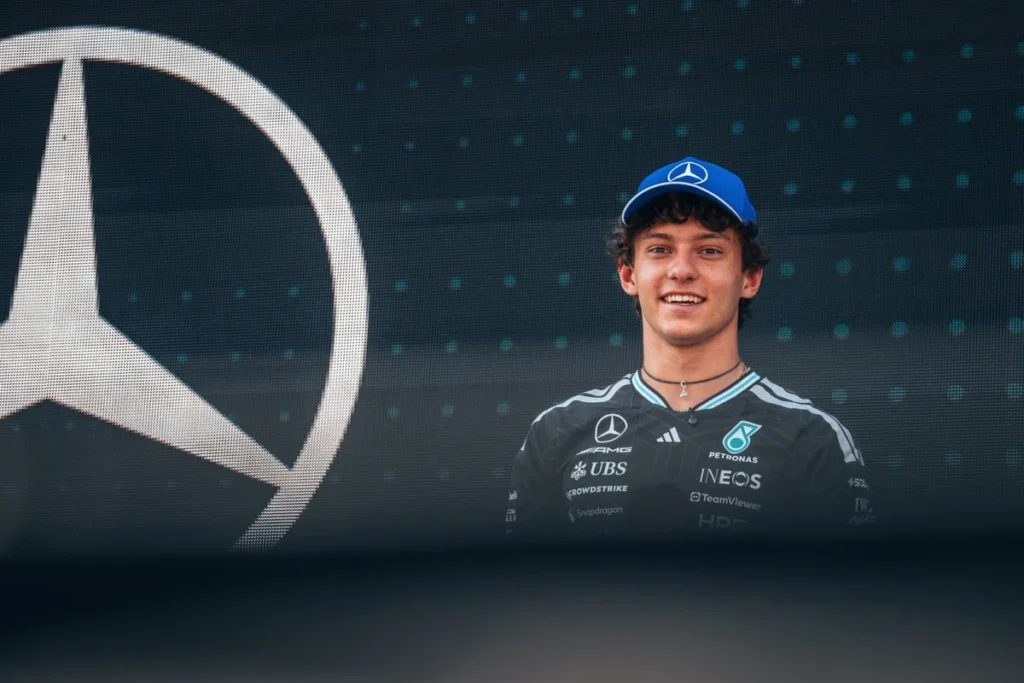
Mercedes-AMG PETRONAS F1 Team emerged as the clear benchmark for the weekend. Kimi Antonelli, continuing his impressive trajectory in the 2026 campaign, secured the top spot on the timesheets with a blistering lap of 1:07.796. His teammate, George Russell, followed closely behind, trailing by a mere 0.040 seconds.
The W16 proved remarkably well-suited to the fast, flowing nature of the Spielberg circuit. From the outset, the Silver Arrows displayed superior mechanical grip and thermal management, qualities that were essential given the stifling track conditions. While Antonelli did suffer a minor off-track excursion at Turn 1—locking his front tires and taking an unplanned detour through the escape road—his ability to reset and set the pace on soft compound tires underscored the raw speed of the car. Russell, despite complaining of a peculiar pedal feel, remained a model of consistency, suggesting that Mercedes has found an ideal setup window for both drivers.
A Session of Mechanical Mayhem
While Mercedes enjoyed a seamless morning, the rest of the pit lane faced a series of technical hurdles that disrupted their planned programs. The session was effectively a "lost hour" for several key protagonists, as reliability issues plagued the top teams.
The Red Bull Racing Struggle
Max Verstappen, the quadruple world champion, endured a frustrating start. His Red Bull RB22 appeared to be suffering from an aggressive anti-stall system that triggered repeatedly, forcing the car into a "safe mode" repeatedly. The mechanics were forced to push the car back into the garage on two separate occasions during the first twenty minutes. When the Dutchman finally emerged, he struggled to find rhythm, complaining of poor tire sensitivity and excessive heat.
His woes were shared by teammate Isack Hadjar—filling in for a rookie slot—who was also confined to the garage for the first half of the session due to persistent technical gremlins. The limited track time meant that Red Bull enters the afternoon sessions with a significant data deficit, having been unable to conduct their planned long-run simulations.
The McLaren Hydraulic Headache
Lando Norris, the reigning world champion, faced a similarly disjointed session. A hydraulic leak kept the Briton sidelined for the majority of the hour. By the time the leak was patched and the MCL36 was cleared for track duty, only fourteen minutes remained. Despite the limited window, Norris managed to clock the seventh-fastest time, a testament to his adaptability, but the lack of meaningful mileage leaves McLaren guessing regarding their true race-trim performance.
The Cadillac Collapse
The session concluded in a premature manner, with a red flag triggered by Sergio Perez. The Mexican driver’s Cadillac ground to a halt on the circuit in the final minutes, citing a catastrophic mechanical failure. The incident not only cut short the development programs of the entire field but also served as a grim exclamation point on a day where several teams struggled to keep their machinery running reliably under the Austrian sun.
Chronology of the Session: From Installation Laps to Red Flags
The session began with a flurry of activity as teams scrambled to collect aerodynamic data. With six rookie drivers participating in the session—fulfilling the FIA’s mandatory young-driver requirements—the track was congested from the moment the lights turned green.

- 0-20 Minutes: Initial installation laps dominated the early stages. Mercedes immediately signaled their intent, with Russell setting an early 1:10.407. Simultaneously, the garage doors at Red Bull remained stubbornly shut as engineers worked on the anti-stall calibration for Verstappen.
- 20-40 Minutes: The "medium-tire phase." Antonelli began to stretch the legs of his W16, dropping the benchmark to 1:09.119. A friendly, high-speed duel ensued between the two Mercedes drivers, with Russell briefly reclaiming the top spot before Antonelli fired back with a 1:08.448.
- 40-55 Minutes: The "soft-tire push." As the session moved into its final third, teams switched to the softest compound. This was when the true pace of the field became apparent, with Oscar Piastri jumping to third, splitting the Mercedes and the recovering Verstappen.
- 55-60 Minutes: The final dash was cut short. Perez’s stoppage triggered a red flag, effectively ending the session. The field was unable to complete their final performance runs, leaving the classification somewhat skewed by the lack of representative laps for the frontrunners.
Supporting Data: The Hierarchy at a Glance
The final classification table, while influenced by the red flag, highlights the current pecking order:
| Pos. | Driver | Team | Gap to Leader |
|---|---|---|---|
| 1 | Kimi Antonelli | Mercedes | – |
| 2 | George Russell | Mercedes | +0.040s |
| 3 | Oscar Piastri | McLaren | +0.117s |
| 4 | Max Verstappen | Red Bull Racing | +0.281s |
| 5 | Lewis Hamilton | Ferrari | +0.665s |
| 7 | Lando Norris | McLaren | +1.077s |
The mid-field remains incredibly tight, with the gap between 6th and 15th position measuring less than a second. Rookies such as Arvid Lindblad (6th) and Franco Colapinto (8th) showed remarkable maturity, capitalizing on the chaos to secure top-ten positions for their respective teams.
Implications for the Weekend
The implications of FP1 for the remainder of the weekend are profound. Mercedes has established a clear psychological advantage, demonstrating both one-lap pace and relative reliability. For Red Bull and McLaren, the focus shifts immediately to damage control.
The Reliability Factor
The issues experienced by Red Bull and McLaren are not merely inconveniences; they suggest a struggle to manage the extreme temperatures of the Spielberg circuit. If these teams cannot find a solution to the cooling and hydraulic pressures by the start of FP2, they risk compromising their entire qualifying setup.
The "Rookie" Influence
With teams utilizing their mandatory young-driver sessions, the data collected was perhaps less representative than in a standard session. However, the performance of the rookies provided a fascinating subplot. Seeing drivers like Dino Beganovic in the Ferrari and Paul Aron in the Audi performing within a second of the leaders suggests that the talent pipeline in Formula 1 is deeper than ever.
Looking Ahead: The Pressure Mounts
As the paddock prepares for FP2 and the sprint qualifying sessions, the narrative is clear: Mercedes is the team to beat, but the margin for error is razor-thin. The track surface is expected to evolve rapidly, and the forecast suggests that the heat will continue to play a factor.
For Max Verstappen, the task is to regain lost ground and find a balanced setup that doesn’t trigger the car’s safety protocols. For Lando Norris, the mission is to recover the lost time on long-run data to ensure McLaren can fight for the front row.
The 2026 Austrian Grand Prix is shaping up to be a tactical battle of attrition. While Mercedes has drawn first blood, the volatility of this session proves that in the current era of high-stakes, high-tech F1, even the smallest technical glitch can turn a championship contender into a mid-field struggler. The fans in Spielberg are in for a weekend where engineering resilience will be just as important as driver skill.
