By Global Automotive Desk
Updated: October 2026
Main Facts: A Technical Juggernaut Sets Its Sights on Europe
The automotive landscape in Europe is undergoing its most radical transformation in a century, driven largely by an unprecedented wave of advanced, high-performance electric vehicles from China. At the vanguard of this movement is BYD (Build Your Dreams), the world’s leading new-energy vehicle manufacturer. Through its newly established luxury offshoot, Denza, BYD is aggressively challenging the old guard of European and American luxury brands.
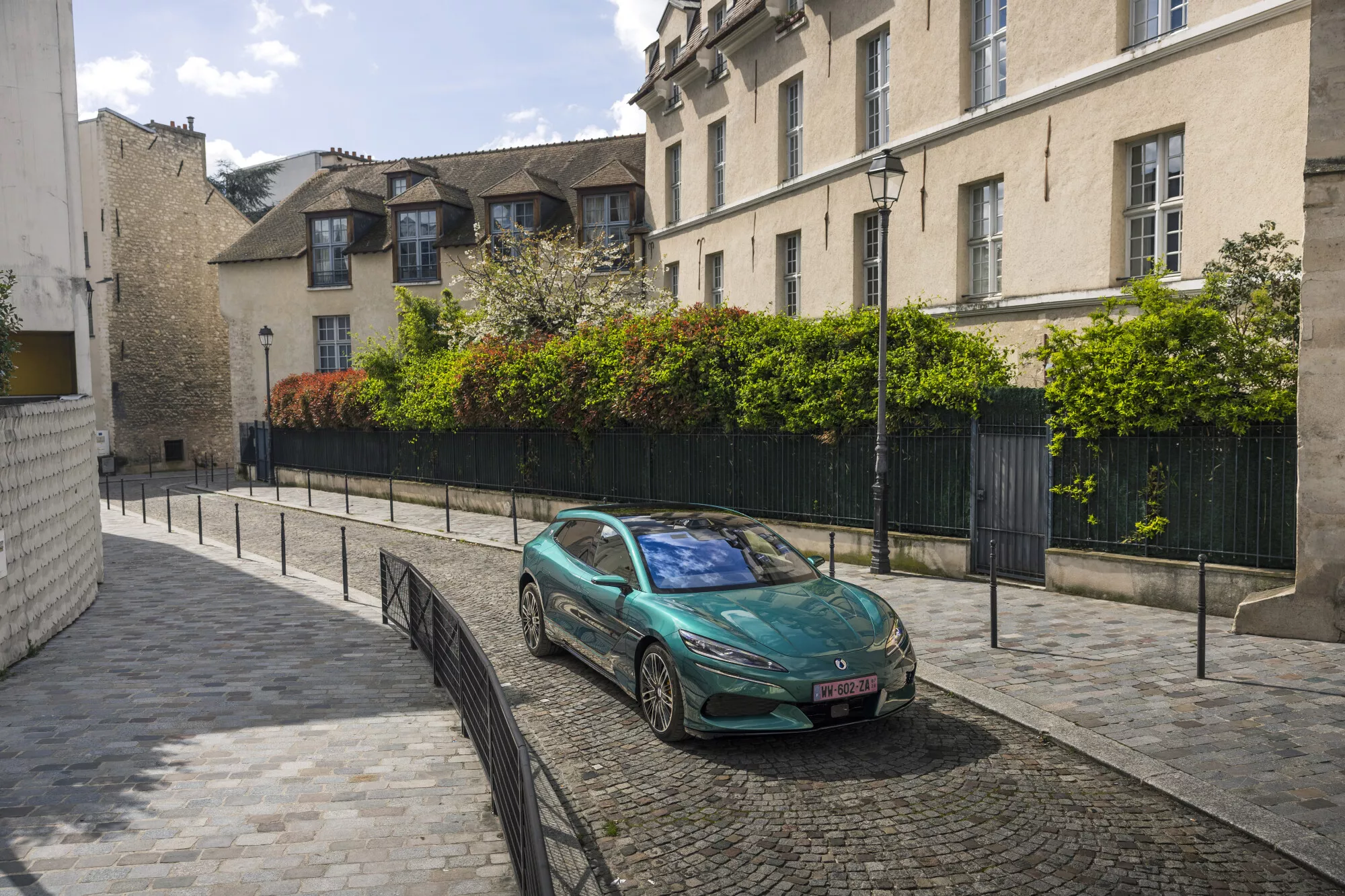
The crown jewel of this European expansion is the Denza Z9 GT—a striking, ultra-technological shooting brake that boasts a mind-boggling 1,300 horsepower. Designed explicitly to hunt down elite performance models like Porsche on both the track and the open road, the Z9 GT lacks very little in terms of raw physical capability. However, hardware is only half the battle in the modern era of software-defined vehicles.
During the bustling halls of the Paris Motor Show 2026, corporate leadership confirmed a major strategic milestone: the Denza Z9 GT will officially become the very first BYD-family vehicle to integrate the company’s flagship autonomous navigation suite, God’s Eye (known specifically as God’s Eye CNOA), into the European market. Slated for a commercial rollout in 2027, this intelligent driving system aims to fundamentally alter how drivers interact with dense European cityscapes, bridging the gap between futuristic Chinese EV engineering and strict European regulatory frameworks.
Chronology of an Expansion: From Shenzhen to the Streets of Paris
To understand the weight of this announcement, one must trace the rapid, calculated trajectory of BYD and its luxury subsidiaries over recent years.
- Late 2024 – 2025 (Domestic Domination): Denza rolls out the Z9 GT in the Chinese domestic market. Out of the gate, the vehicle features state-of-the-art autonomous driving infrastructure, notably powered by the God’s Eye 5.0 ecosystem. This domestic version relies on the advanced Xuanji A3 architecture—touted as China’s premier 4-nanometer automotive system-on-chip (SoC)—delivering an astonishing computing power of roughly 700 TOPS (Tera Operations Per Second).
- Early 2026 (The European Incursion): BYD officially initiates the export and launch strategy for the Denza Z9 GT across select European territories, positioning the 1,300-hp shooting brake as a direct technological showcase for what the brand can achieve.
- October 2026 (The Paris Motor Show Reveal): During the Paris Motor Show, a high-level corporate spokesperson, backed by executive commentary, formally confirms that the European-spec Z9 GT will receive the God’s Eye autonomous navigation package.
- 2027 (Scheduled European Launch): The God’s Eye CNOA system is slated to go live for European consumers, marking the true beginning of BYD’s intelligent driving software deployment outside of Asia.
Supporting Data: Under the Hood and Inside the Neural Network
The technical specifications underpinning the Denza Z9 GT and its God’s Eye software ecosystem highlight a massive leap in mobile computing and mechanical engineering.
Performance and Powertrain
- Output: Approximately 1,300 horsepower, delivered via a multi-motor configuration.
- Body Style: High-performance luxury shooting brake (GT).
- Market Positioning: Direct competitor to high-end European electric and internal combustion tourers, aiming squarely at brands like Porsche and Audi.
Computing and Sensor Architecture (God’s Eye 5.0 / Xuanji A3)
- Processor Chipset: Xuanji A3, built on a cutting-edge 4-nanometer manufacturing process.
- Processing Power: Peak performance rated at approximately 700 TOPS, allowing real-time processing of high-density sensor data, high-definition mapping, and dynamic path planning.
- System Classification: Operates strictly under SAE Level 2 automation protocols.
Despite the staggering computational power running through the vehicle’s neural network, industry analysts emphasize that God’s Eye CNOA is a sophisticated driver assistance tool rather than a fully driverless system. Drivers must remain actively engaged, keep their eyes on the road, and be prepared to take over the steering wheel at a split second’s notice.
Official Responses: What the Leadership is Saying
The introduction of advanced artificial intelligence and sensor suites into European luxury cars brings significant corporate strategy into focus. Executives from BYD have been vocal about the vision behind bringing God’s Eye to foreign soil.
During the Paris Motor Show reveal, Stella Li, Executive Vice President of BYD, addressed the media regarding the upcoming software integration:
"We are thrilled to deliver on our promise by integrating the advantages of God’s Eye into the Z9 GT, particularly urban navigated driving. This technology will help make driving in the city much less stressful."
Li’s comments underscore a key consumer pain point in Europe: the congested, narrow, and often chaotic layout of historic European metropolitan areas. By easing the cognitive load of stop-and-go traffic, complex roundabouts, and tight parallel parking, BYD hopes to win over discerning European buyers who might otherwise remain loyal to legacy domestic brands.
At the same time, company representatives have been careful to manage expectations regarding legal boundaries. In tandem with the official statements, a corporate spokesperson emphasized the strict parameters of the Level 2 classification:
"While the computing architecture behind God’s Eye is capable of processing complex spatial data akin to higher automation tiers, our European deployment adheres rigorously to regional safety standards. The human driver remains the ultimate pilot of the vehicle at all times."
Market Implications: The New Battleground for Intelligent Mobility
The arrival of God’s Eye in Europe is far more than just a software update for a single model; it represents a major escalation in the global automotive tech race.
1. Direct Confrontation with Emerging Rivals
BYD is not the only Chinese manufacturer making aggressive moves into Europe’s smart-driving space. The competition is fierce and accelerating. For instance, rival Chinese automaker Xpeng has slated the European rollout of its own advanced assisted navigation system—Navigation Guided Pilot (NGP)—for the first quarter of 2027. By confirming the Z9 GT’s God’s Eye rollout for 2027, BYD ensures that Xpeng will not be allowed to capture an uncontested monopoly on high-end Chinese autonomous features in Europe.
2. Pressuring Tesla and Legacy European Brands
For years, Tesla’s Full Self-Driving (FSD) beta aspirations and Autopilot systems have served as the benchmark—and lightning rod—for automated driving discourse in the West. Simultaneously, legacy German automakers like BMW, Mercedes-Benz, and the Volkswagen Group have rolled out their own Level 2+ systems (such as Mercedes’ Drive Pilot, though largely operating at higher certification levels in specific regions).
The introduction of a 700-TOPS processing suite packaged inside a 1,300-horsepower luxury import fundamentally shifts the competitive pressure. European buyers are no longer looking at Chinese brands as strictly budget-friendly alternatives; they are now confronting luxury alternatives that occasionally out-tech and out-muscle native offerings.
3. Future Scalability Across the Lineup
While the Denza Z9 GT serves as the technological trailblazer and flagship for this software rollout in Europe, industry insiders anticipate a wider deployment strategy. If God’s Eye proves successful—and regulatory hurdles are cleared smoothly across diverse European Union member states—BYD is expected to trickle down these intelligent driving features to higher-volume models within the broader BYD brand portfolio.
However, corporate representatives have remained tight-lipped regarding specific timelines for smaller or more affordable vehicles. For now, all eyes remain fixed on the Z9 GT as it prepares to hit European asphalt in 2027.
Conclusion
The automotive world is witnessing a historical paradigm shift. With the Denza Z9 GT, BYD is combining sheer hypercar performance with heavy-duty neural computing via the God’s Eye system. As European consumers grow increasingly receptive to software-defined mobility, the 2027 launch of this technology will serve as a crucial litmus test. Can a Chinese luxury shooting brake armed with 700 TOPS of processing power successfully charm the discerning, regulation-heavy European market? If the ambition displayed at the Paris Motor Show is any indication, the race for the future of European roads has only just begun.