

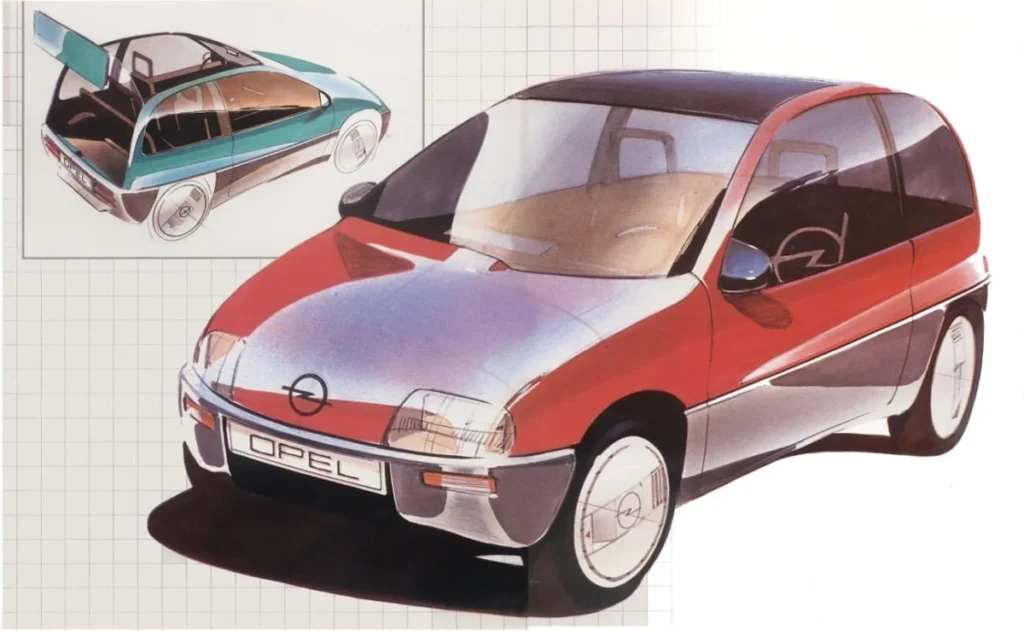
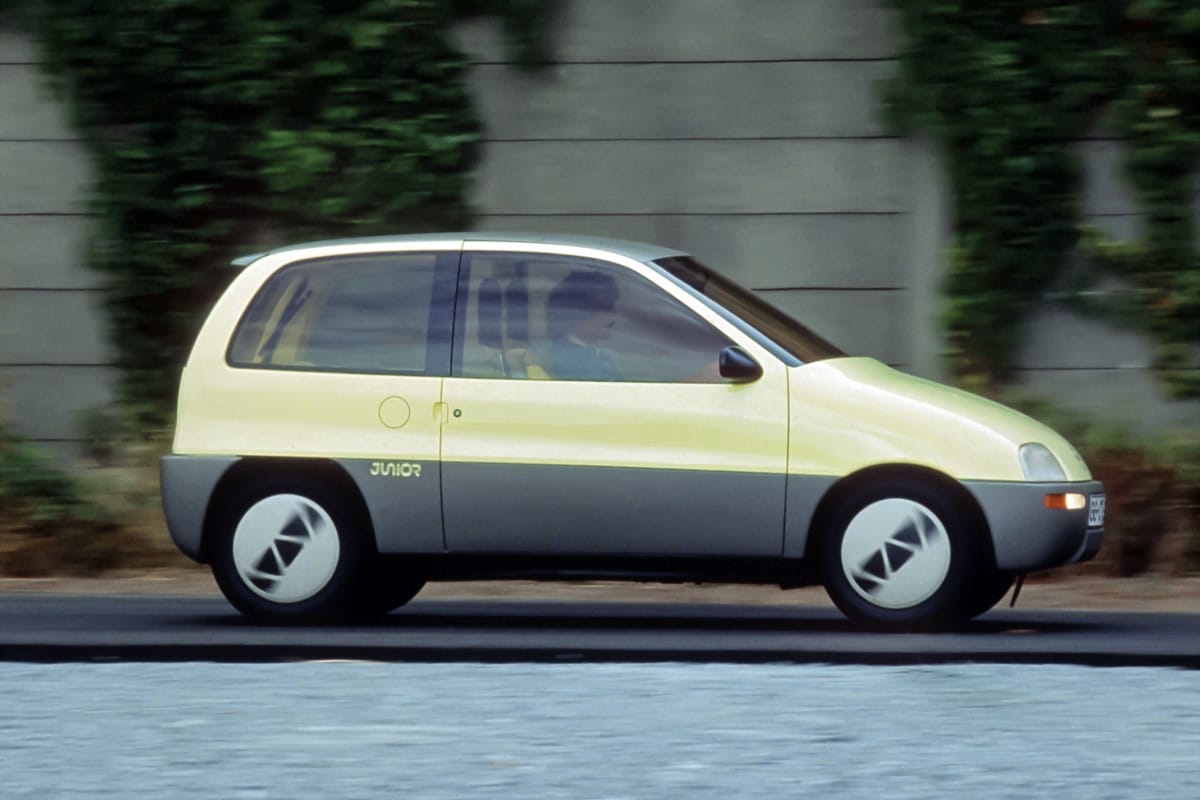
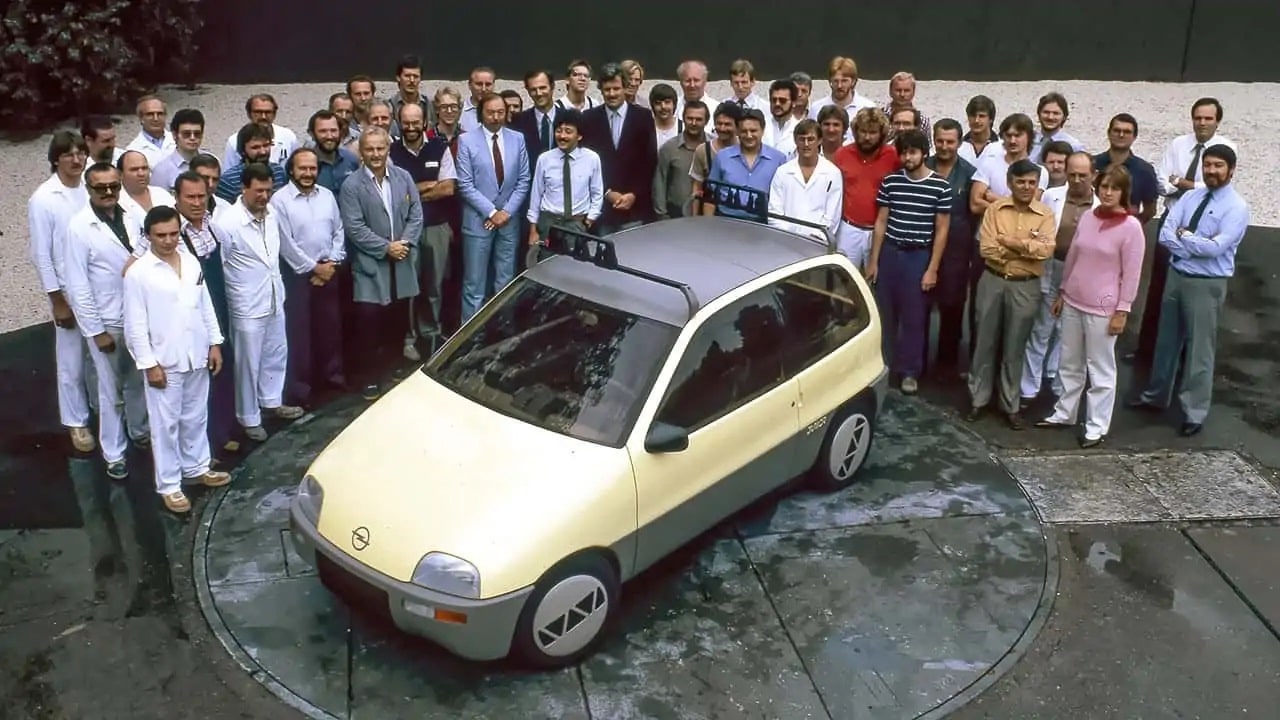
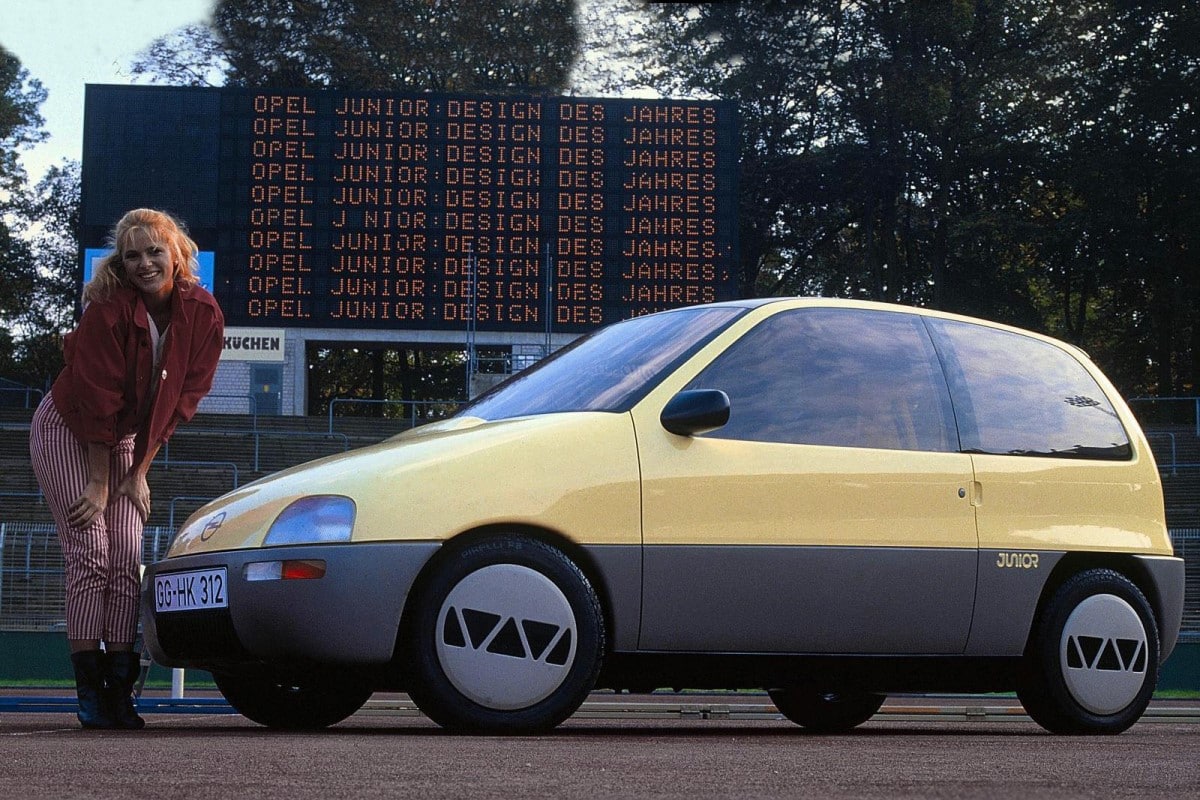
Frankfurt, September 1983. Amidst a sea of automotive stands dominated by high-performance GTIs, advanced engine aerodynamics, and early digital electronics, German manufacturer Opel unveiled a surprisingly cheerful, diminutive creation. Dubbed the “Junior,” this rounded, 3.41-meter three-door hatchback was powered by a modest 1.2-liter, 55-horsepower gasoline engine.
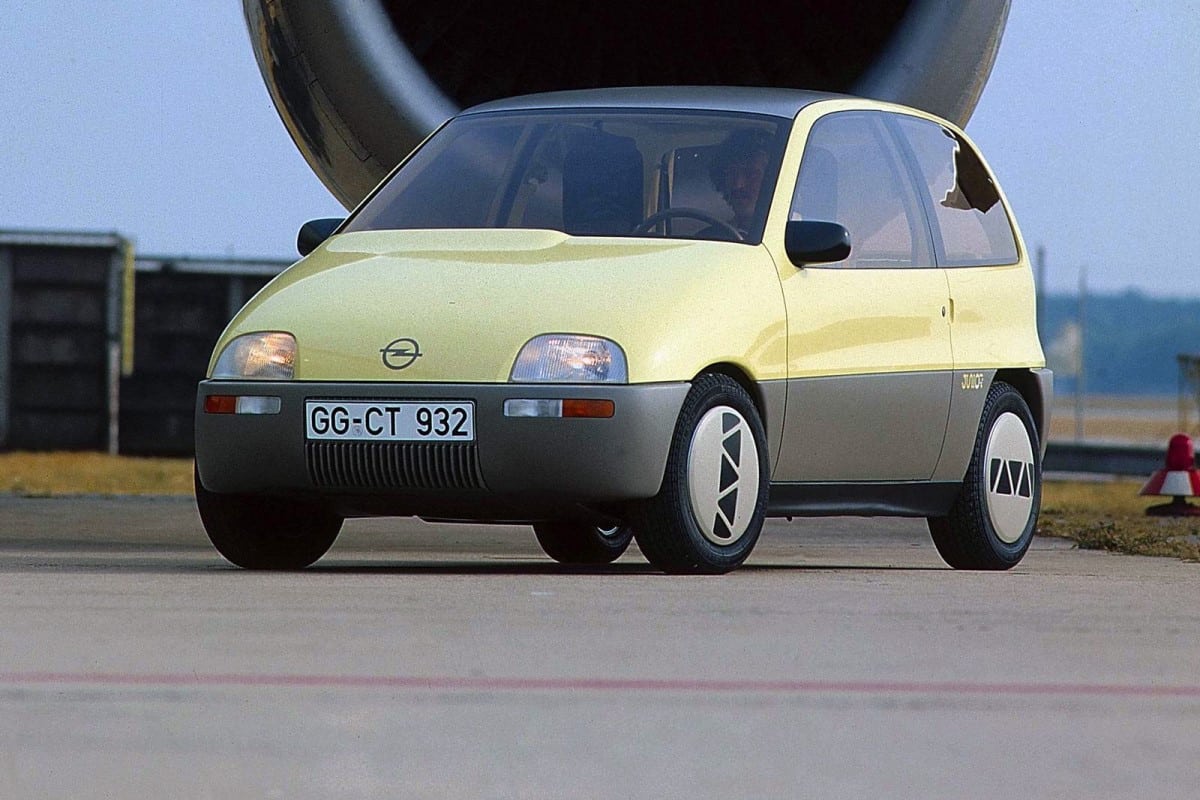
On paper, its specifications appeared thoroughly ordinary. Yet, the Junior’s infectious, friendly design language carried more long-term influence than many 300-horsepower concept cars of the era. It successfully mapped out the design DNA, functional modularity, and packaging philosophy for Opel’s future city cars for decades to come.
Main Facts: The Anatomy of a Micro-Revolution
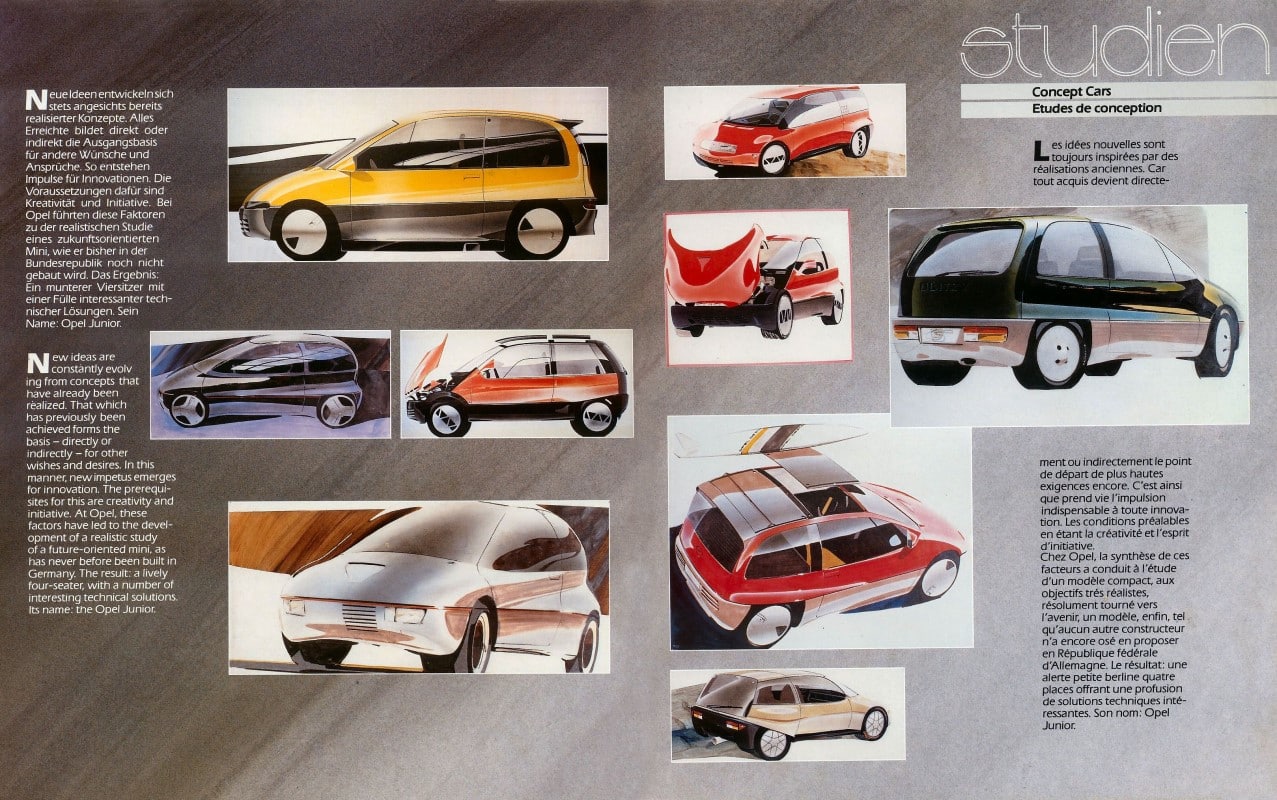
The Opel Junior was conceived as a "thought experiment" rather than a definitive production preview. It explored how a vehicle could be positioned beneath the newly launched Corsa, investigating whether the market had an appetite for an even smaller, highly optimized urban runabout.
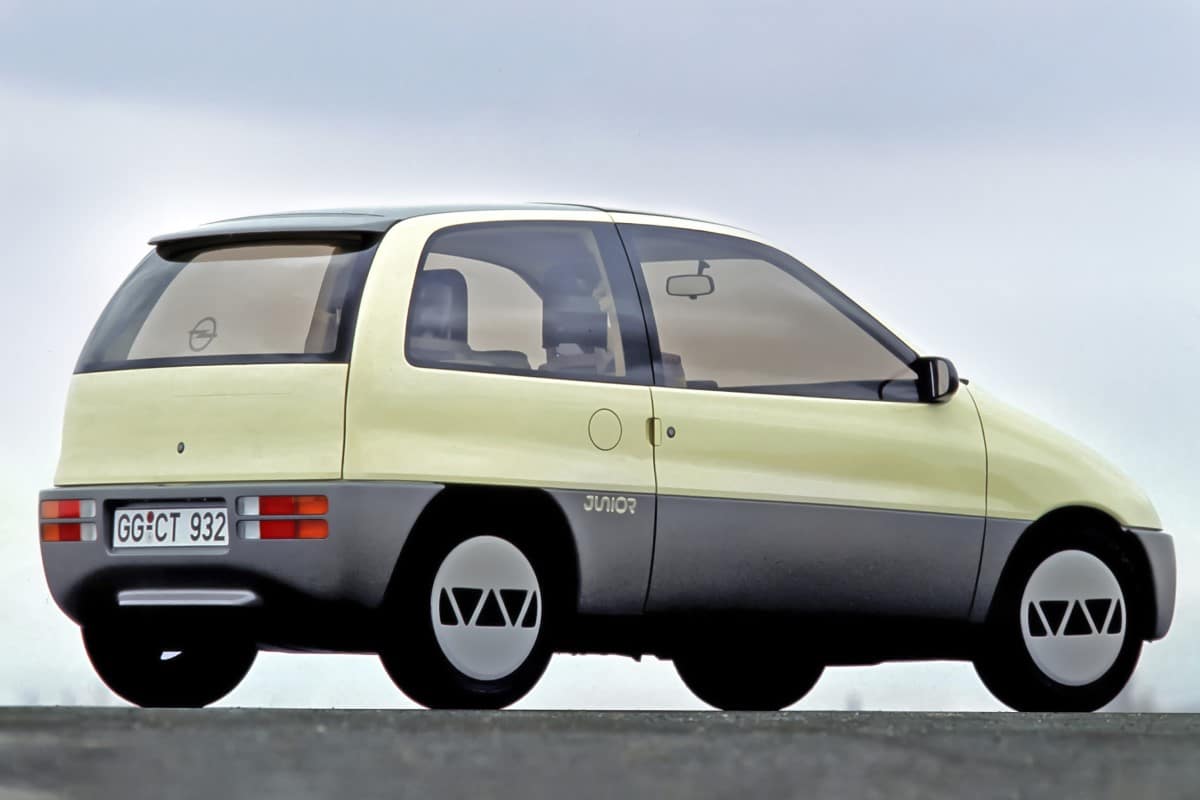
- Dimensions: Measuring just 3,410 mm in length, the Junior was 210 mm shorter than the Corsa, yet it was 90 mm taller and 40 mm wider.
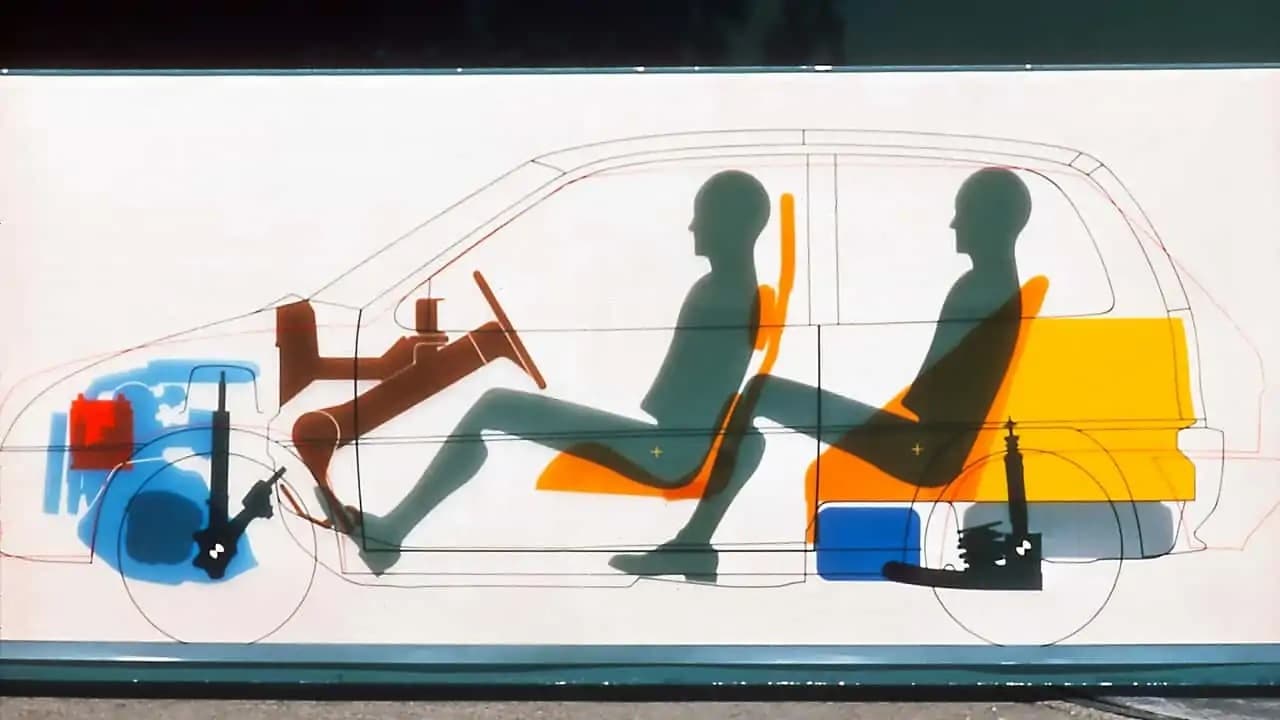
- Packaging: By pushing the wheels to the absolute corners and elevating the roofline, Opel dedicated two-thirds of the total footprint entirely to passenger space. This clever space-efficiency directly anticipated the compact monospace boom of the 1990s.
- Powertrain & Performance: Underneath the skin, the Junior utilized proven Corsa architecture: a transversally mounted 1.2-liter engine driving the front wheels. Thanks to an ultra-light curb weight of just 650 kg, the car achieved a 0 to 100 km/h time of 15 seconds, a top speed of roughly 150 km/h, and an astonishing fuel economy of around 4 liters per 100 km.
- Aerodynamics: Despite its tall, boxy proportions, the Junior achieved an exceptional drag coefficient ($C_x$) of 0.31. This was accomplished through flush-mounted elements, including integrated bumpers, glass panes, light clusters, and flush door handles. A rugged grey plastic underbody protection scheme also anticipated similar protective styling cues later popularized by vehicles like the Ford Ka.
Chronology: Opel’s Delayed Entry into the City Car Segment
To fully contextualize the significance of the 1983 Junior concept, one must examine Opel’s strategic position at the dawn of the 1980s.
The Rise of the European City Car
During the late 1970s and early 1980s, the European automotive market experienced a structural shift. Affordable, practical city cars dominated sales charts across the continent. Competitors had firmly established themselves in the segment with vehicles like the Fiat 127, Renault 5, Peugeot 104, and Ford Fiesta.
For a long time, General Motors’ German subsidiary, Opel, lagged behind. It attempted to plug the gap merely with a rudimentary "City" trim level of the larger Kadett.
The Birth of the Corsa
Opel’s belated yet colossal riposte arrived in the form of the Corsa. Developed as a massive undertaking for a brand historically accustomed to rear-wheel-drive configurations, the Corsa project required:
- The construction of an entirely new, highly automated manufacturing plant in Zaragoza, Spain (featuring 90% production line automation).
- The transition to front-wheel drive.
- Extensive computer-aided body engineering.
Unveiled at the Paris Motor Show in 1982, the Corsa debuted with two basic engine choices (a 1.0-liter producing 45 hp and a 1.2-liter producing 54 hp). It quickly captured market share by offering an exceptional price-to-performance ratio.
The Junior Experiment (1983)
Astonishingly, just one year after the Corsa’s commercial rollout, Opel exhibited the Junior in Frankfurt. Rather than a redundant duplicate, the Junior served as an advanced technological and sociological laboratory. It tested public and media reception regarding a micro-city car segment situated strictly beneath the Corsa.
Although the Junior never transitioned directly into a mass-production assembly line, its stylistic and engineering breakthroughs rippled through Rüsselsheim for the next ten years.
Supporting Data: Modular Ingenuity and Design Philosophy
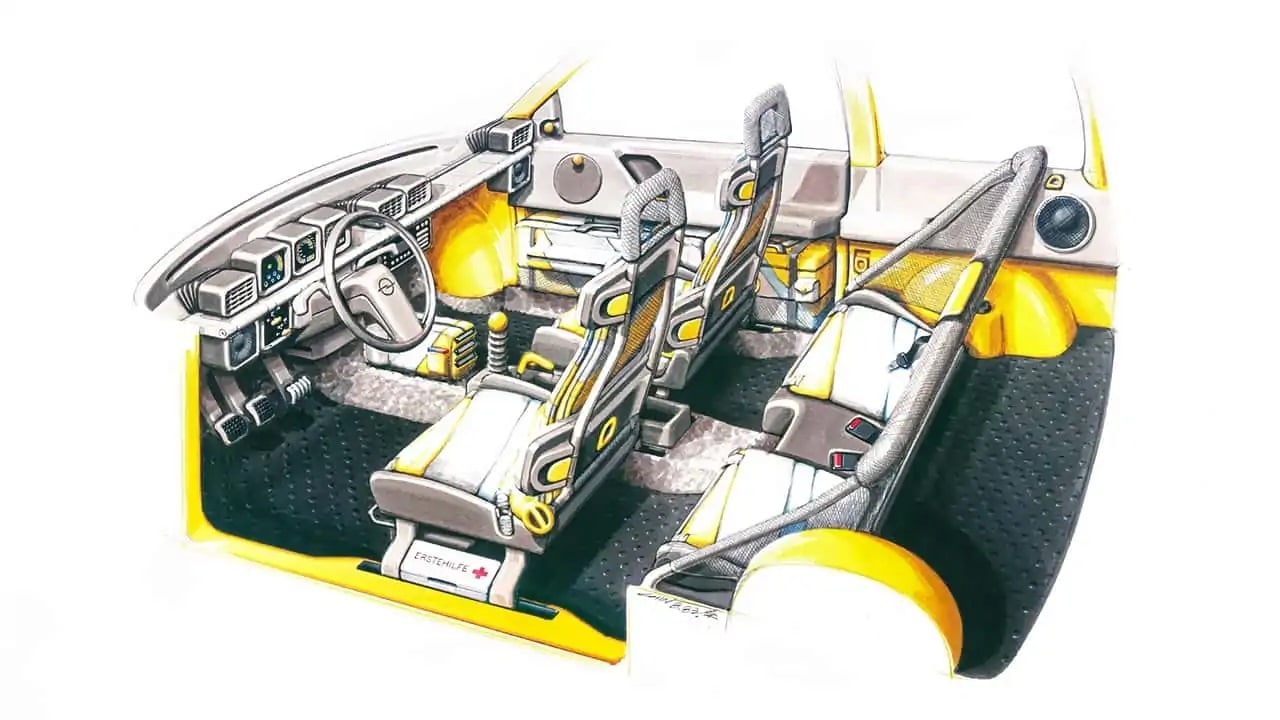
While the exterior dimensions and aerodynamics turned heads, the interior of the Junior represented a genuine masterclass in industrial design and modular flexibility.
A Pioneering Interior and the Touch of Chris Bangle
Legend attributes the revolutionary interior packaging and modular dashboard layout of the Junior to a young, then-unknown designer named Chris Bangle, working alongside Hideo Kodama and Gert Hildebrand under the direction of Opel’s design studio.
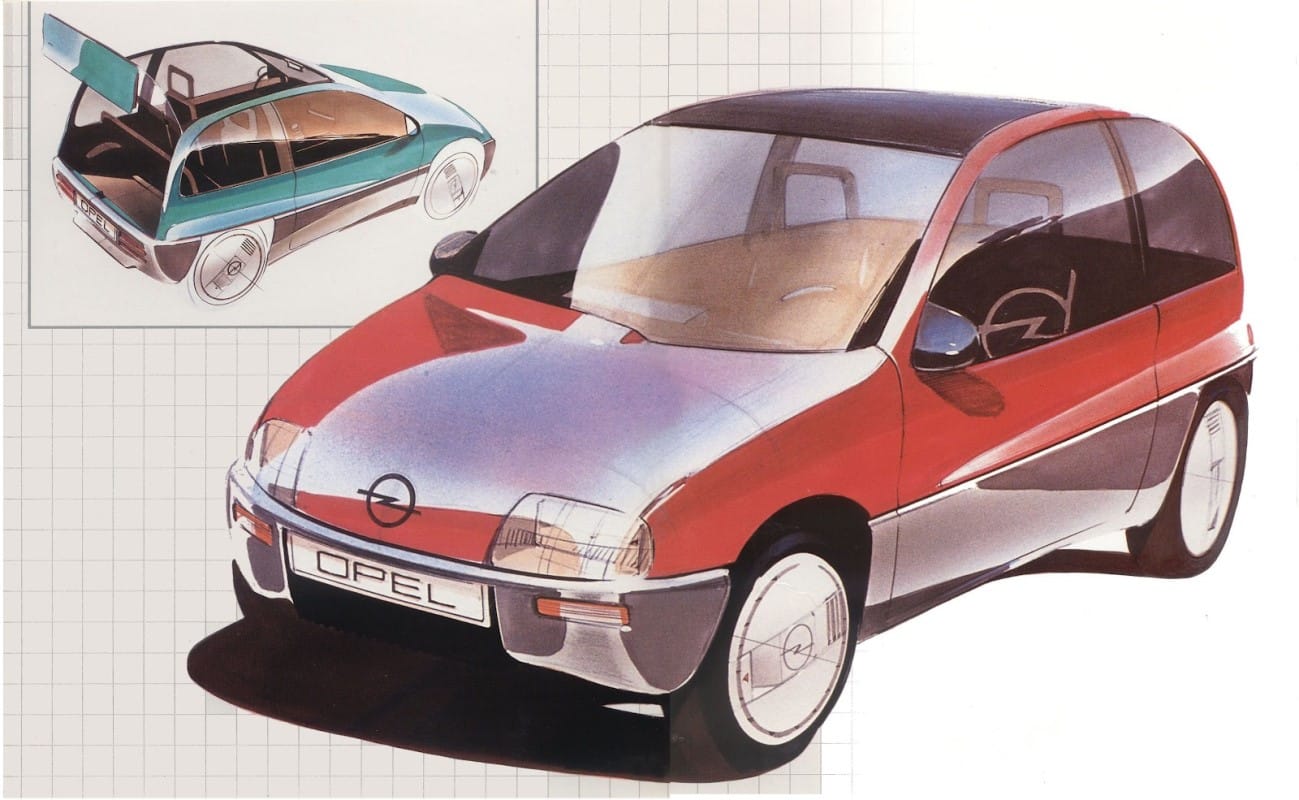
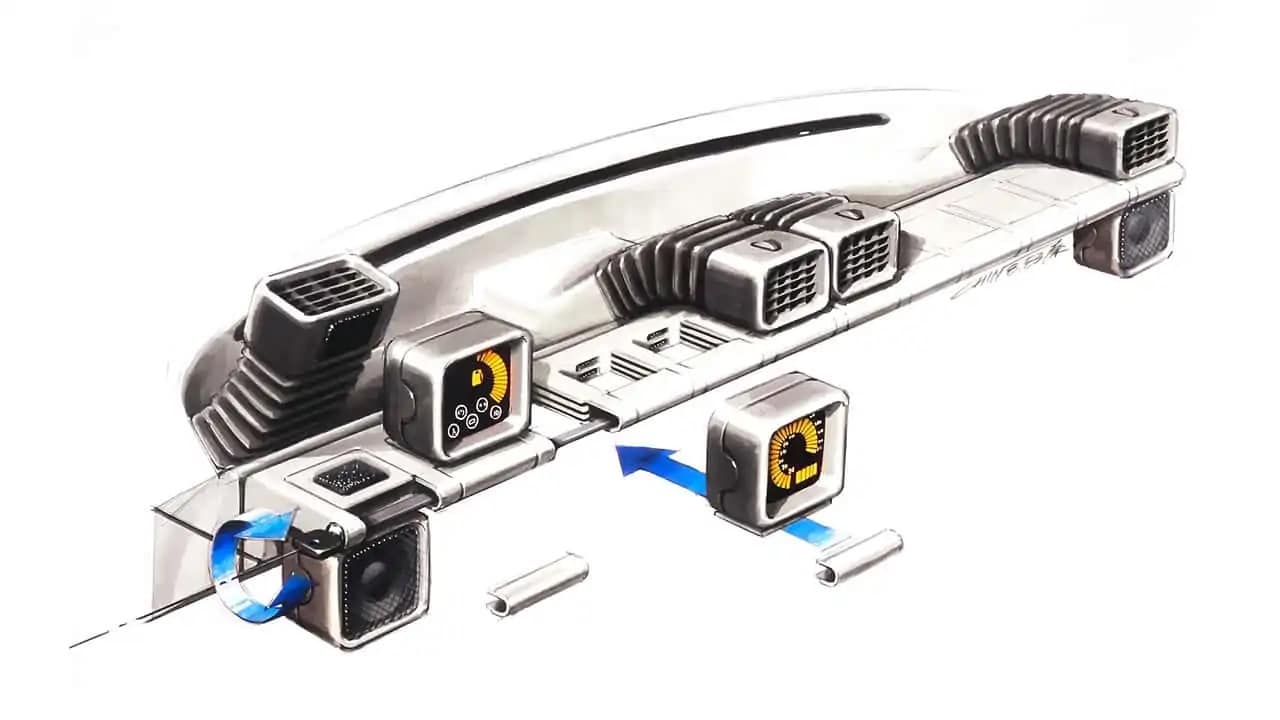
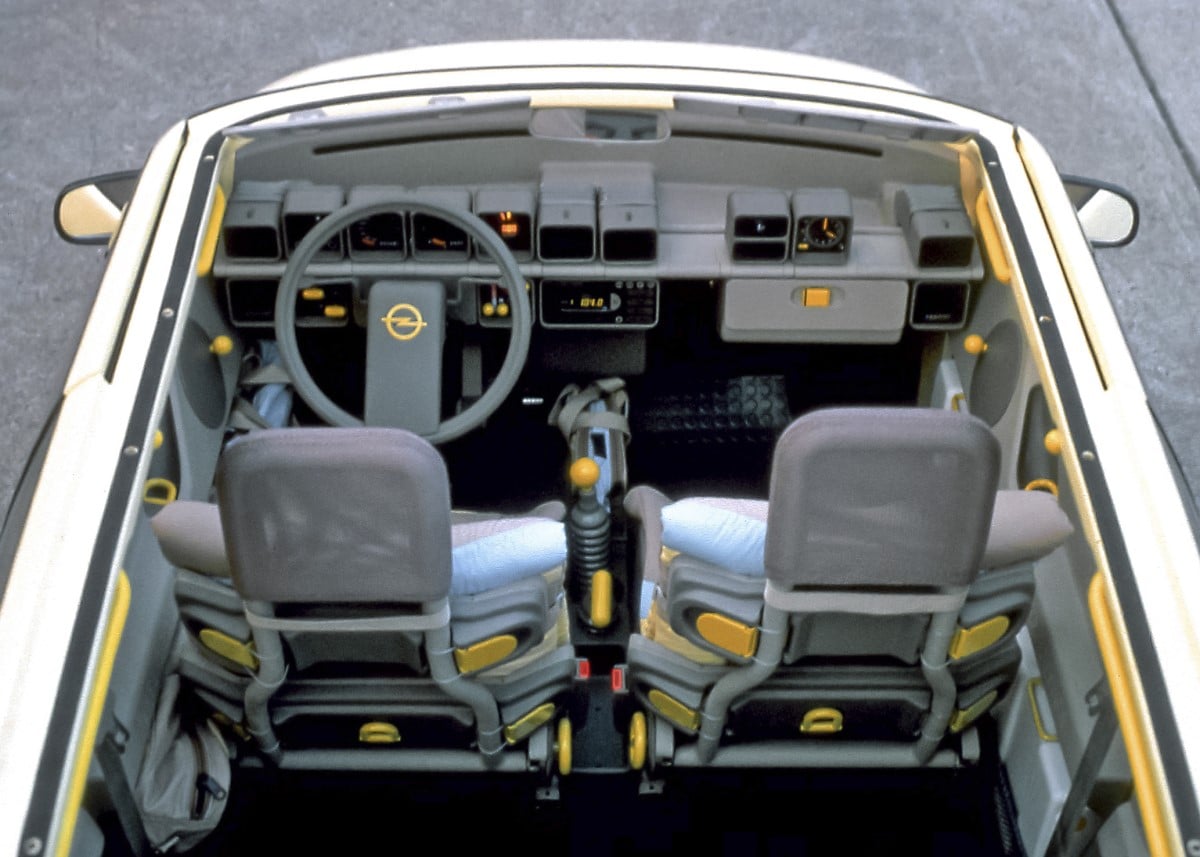
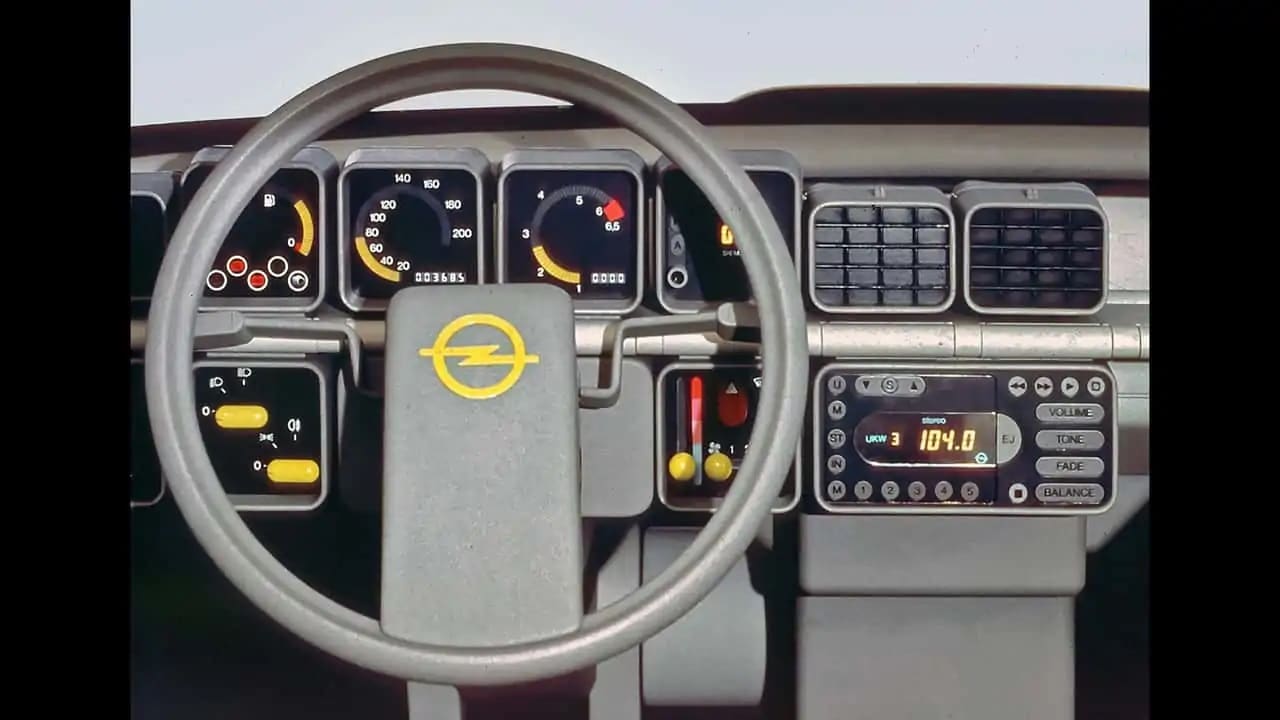
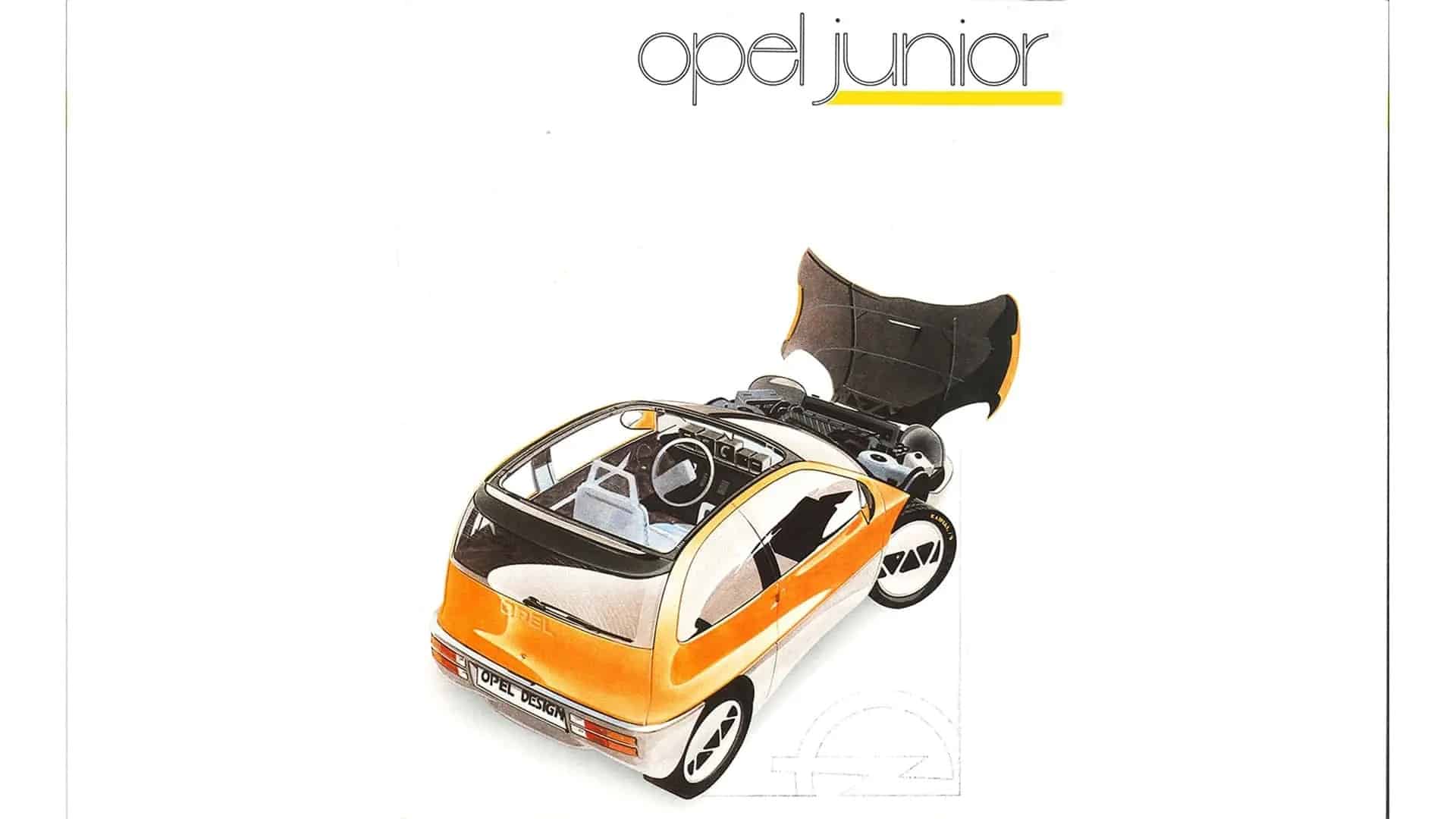
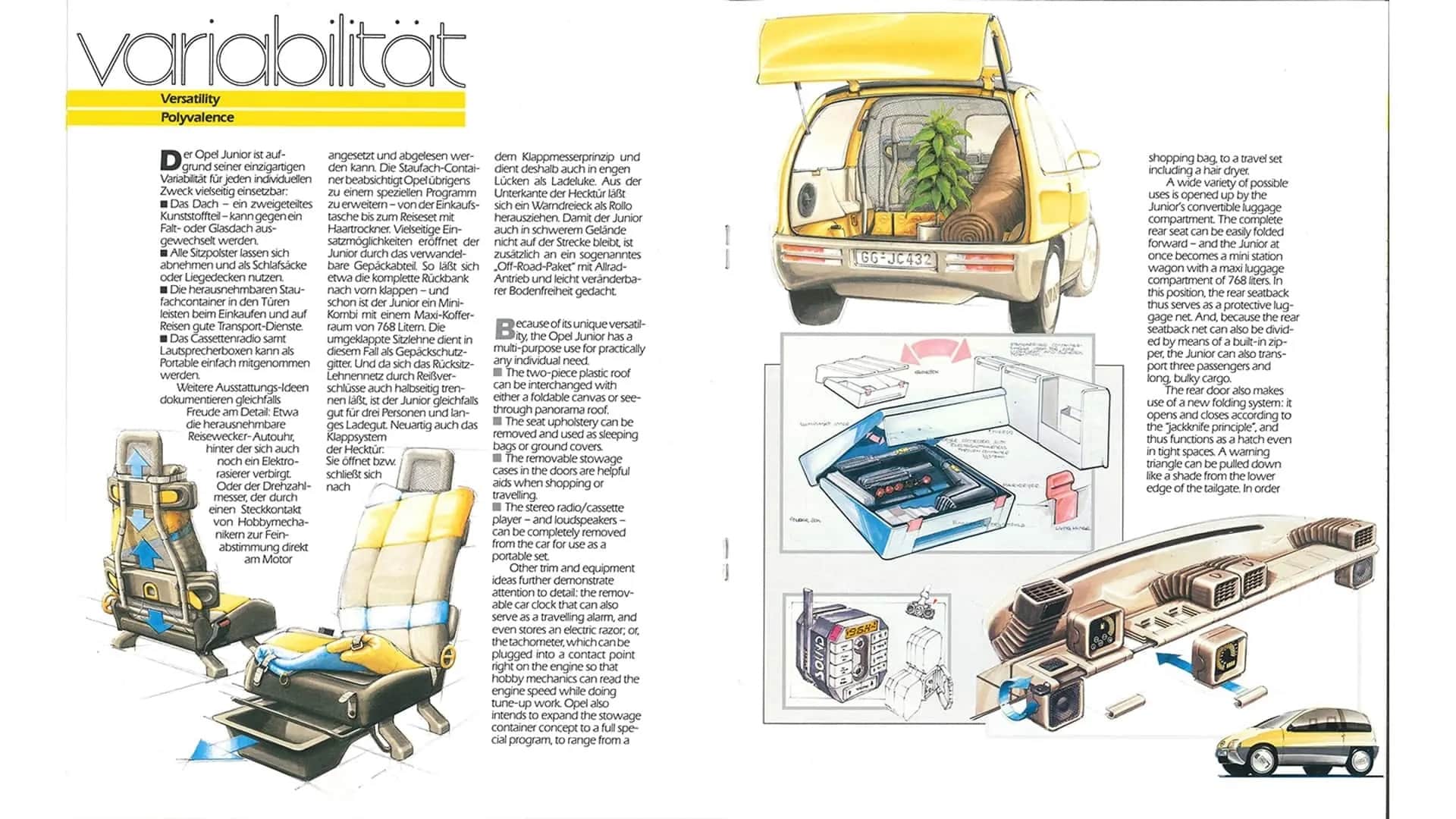
- Plug-and-Play Dashboard: The Junior featured a pre-wired dashboard housing interchangeable, cubic instrument pods that could be "plugged in" without requiring additional factory wiring harnesses.
- Symmetrical Assembly: The pedal box, steering column, and heating apparatus were designed as a symmetrical, unified module. This drastically simplified manufacturing and lowered costs for both left-hand-drive and right-hand-drive markets.
The Ultimate Lifestyle Accessory
Long before the term "lifestyle vehicle" became industry standard, the Junior packed an inventory of clever interior features:
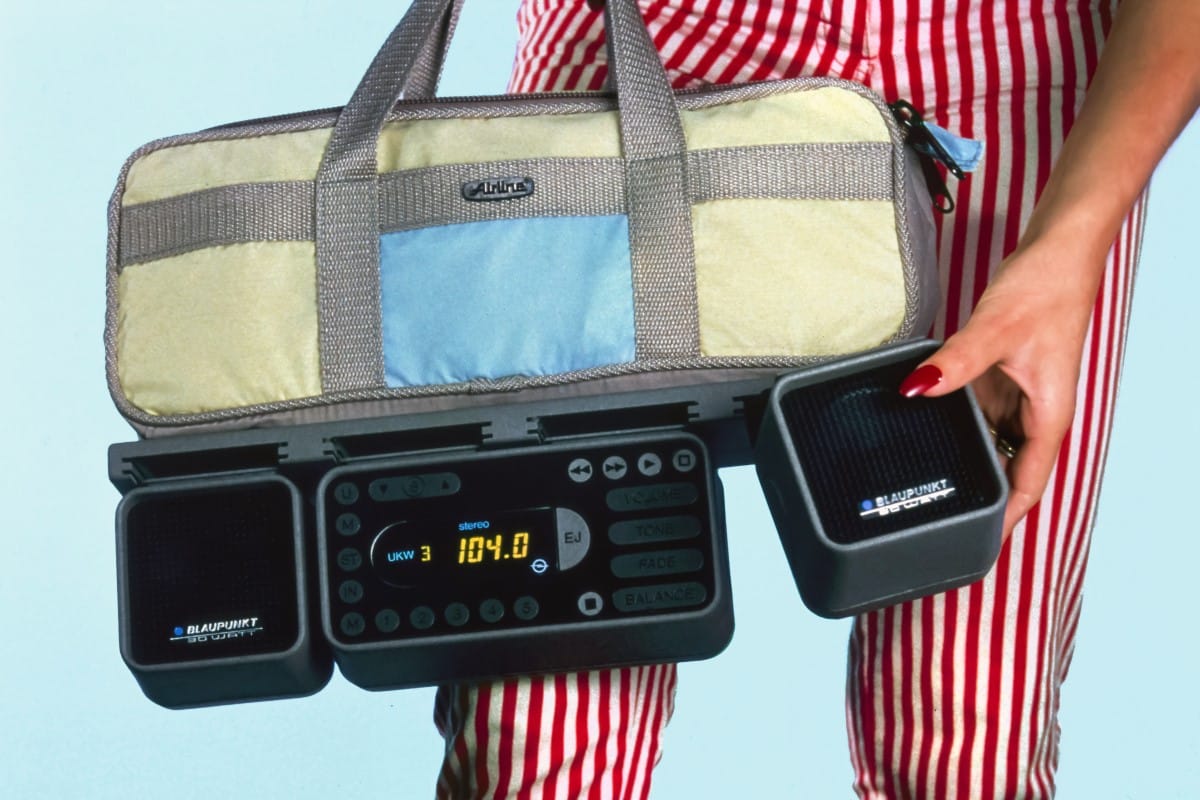
- A detachable car radio that doubled as a portable stereo system.
- A dashboard clock that doubled as a portable alarm clock.
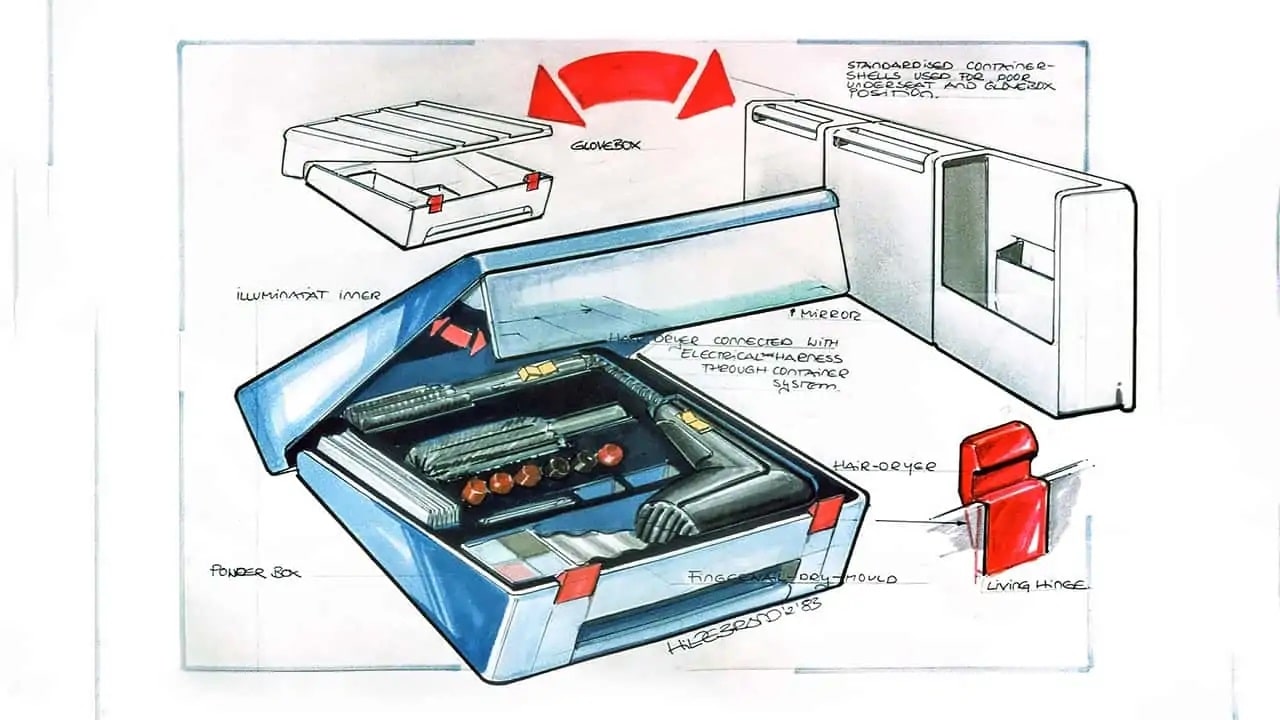
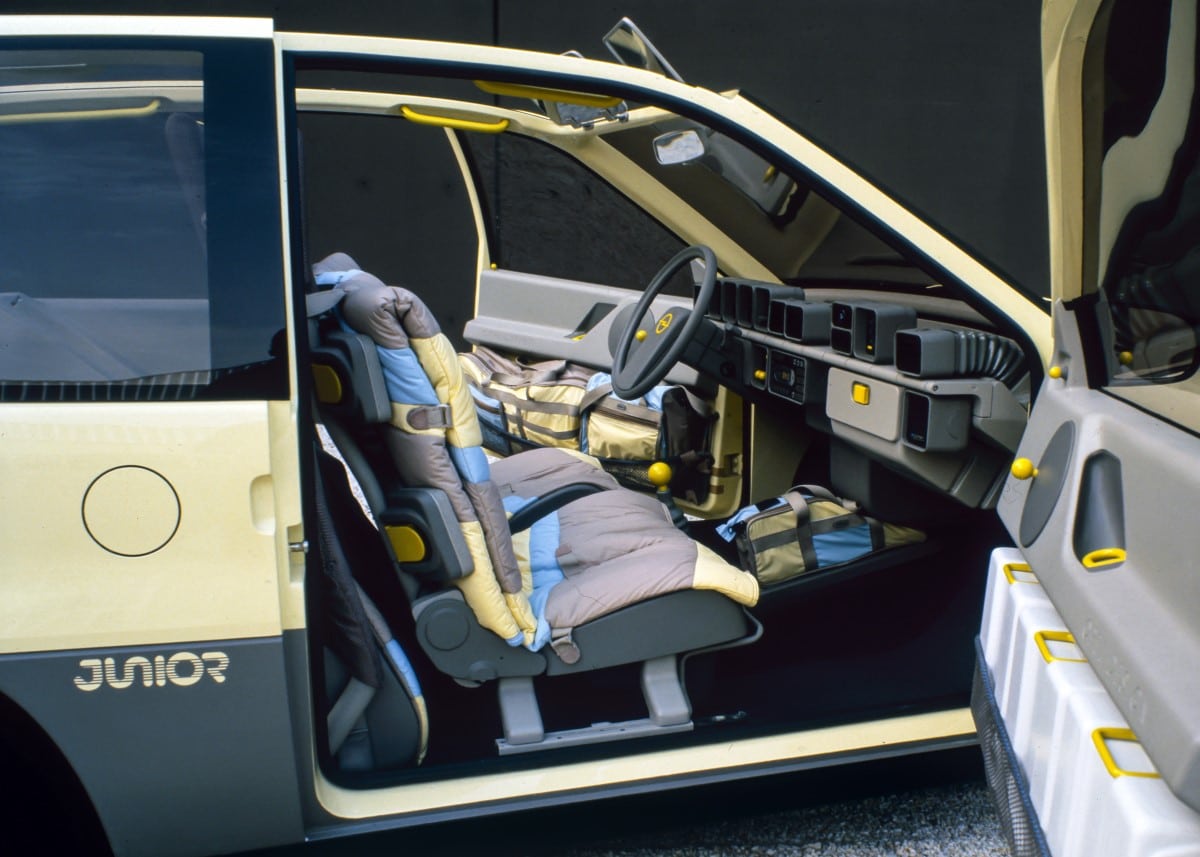
- Door storage bins that seamlessly transformed into detachable shopping bags.
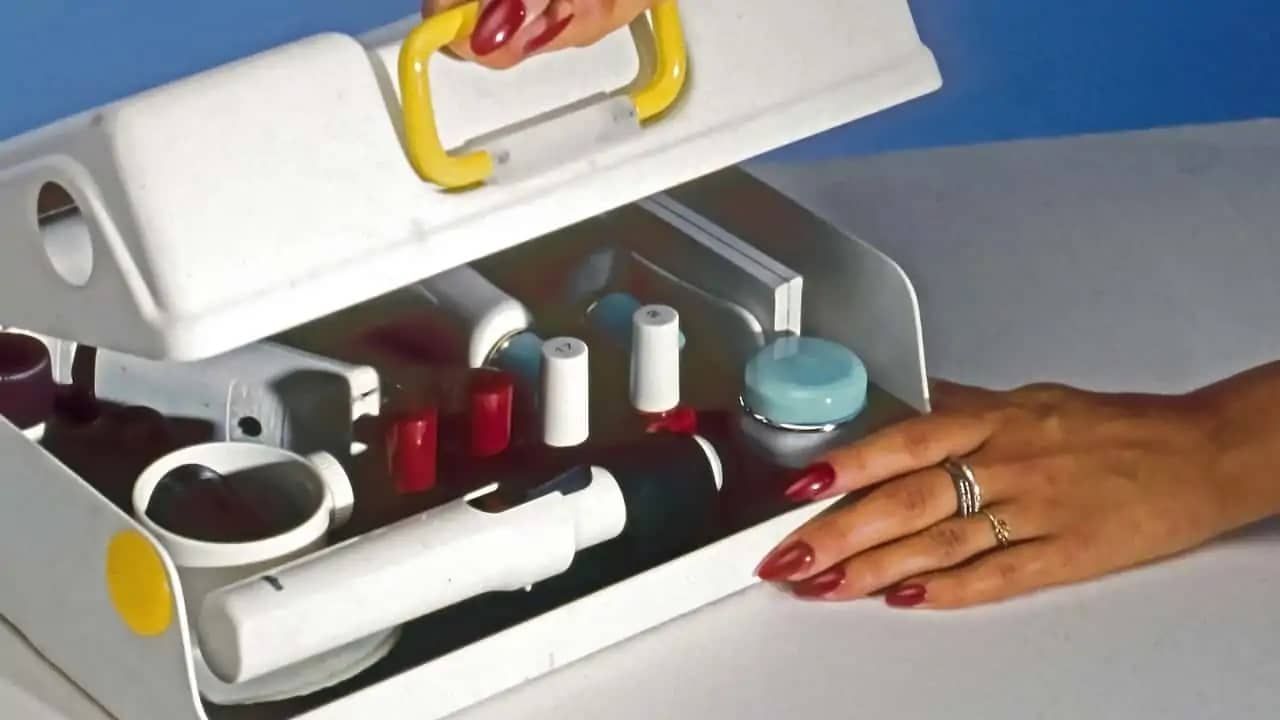
- Integrated travel kits featuring accessories like a razor and hair dryer.
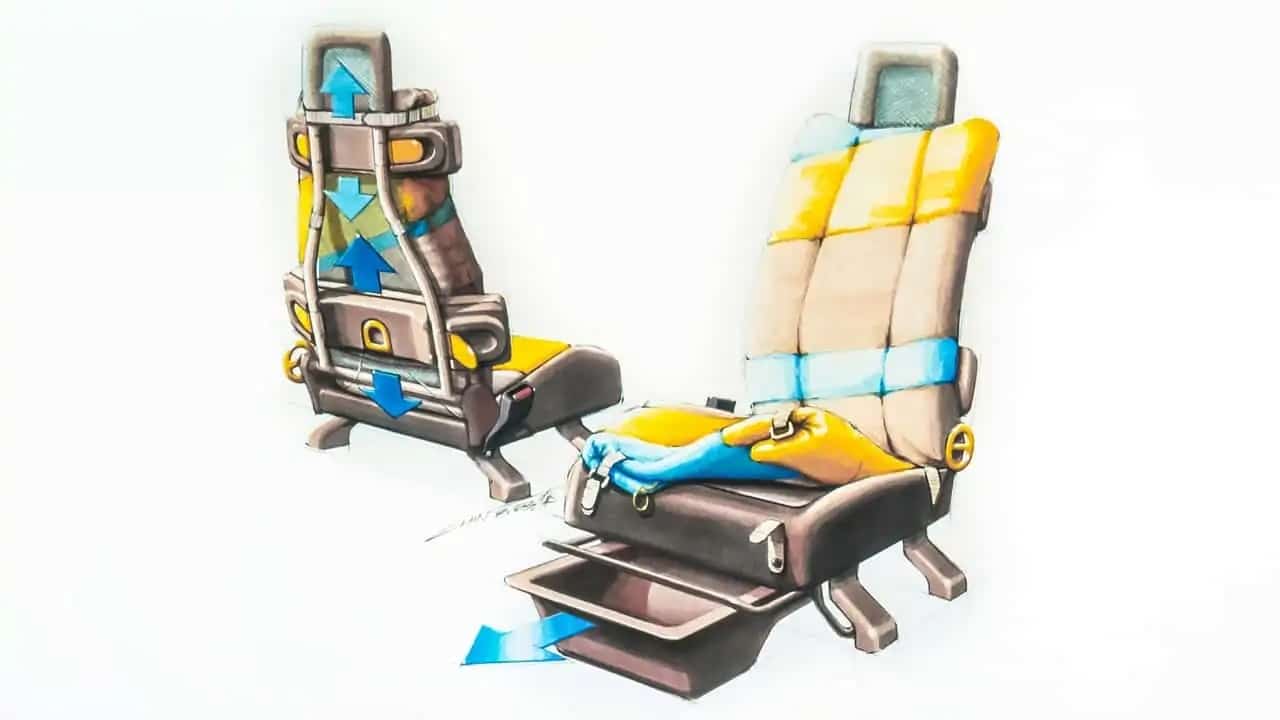
- Modular seat covers that could double as functional sleeping bags.
- A convertible plastic roof system that could be easily swapped for a glass panel or a soft top.
This conceptual focus on portable electronics and multi-use accessories anticipated concepts later explored by Japanese micro-cars, such as the 1989 Nissan Pao.
The "Huggable" Aesthetic
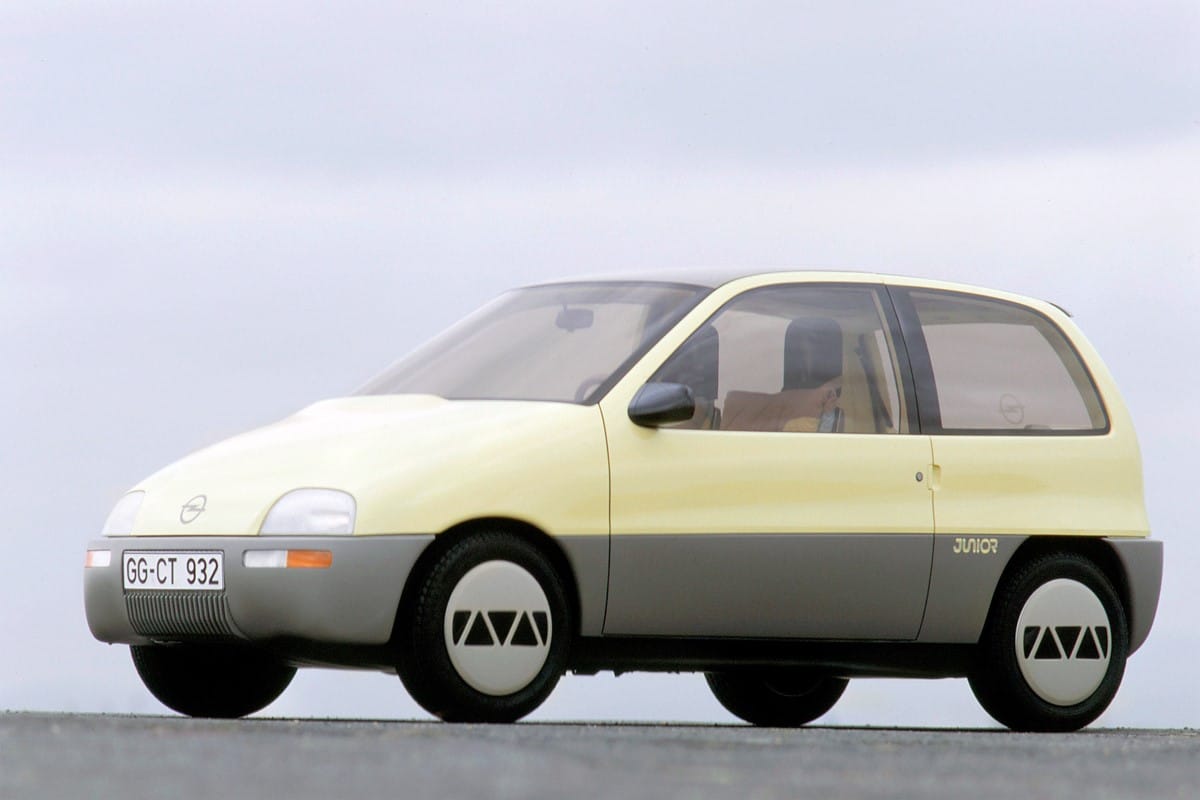
In an era defined by wedge-shaped designs and sharp angles—exemplified by Giorgetto Giugiaro’s work on the Fiat Uno and Fiat Panda—the Opel Junior broke the mold with soft, friendly surfacing. Hideo Kodama famously summarized the design philosophy by stating they wanted to create a car that was "huggable"—an automobile that evoked an emotional, affectionate response from onlookers.
Official Responses and Strategic Implications
Why Was the Junior Never Produced?
For decades, automotive historians debated why the Junior never reached showrooms. The official press kits distributed at the 1983 Frankfurt Motor Show read precisely like pre-production brochures, complete with comprehensive technical specifications, performance metrics, and even studies detailing a proposed four-wheel-drive variant.
However, the reality of corporate finance prevailed:
- Financial Exposure: Opel had recently poured astronomical sums into establishing the Zaragoza plant for the Corsa.
- Internal Cannibalization: Launching a second, even smaller city car immediately afterward risked cannibalizing the Corsa’s nascent market share.
While official corporate archives lack a single definitive document declaring the project’s cancellation, industry consensus points to strategic prioritization. The production green light was withheld, but the project’s DNA was safely preserved.
The Direct Descendants: Corsa B and Beyond
The aesthetic and technical lessons learned from the Junior did not vanish; they formed the cornerstone of Opel’s design language for the remainder of the 1980s and 1990s:
- The Kadett E (1984): The aerodynamic front end of the Junior drew heavily from Opel’s concurrent aerodynamic research, notably the 1981 Tech 1 concept. The Kadett E achieved a stellar $C_x$ of 0.32, while its sporty GSi variant set benchmarks as the world’s most aerodynamic production hatchback ($C_x$ of 0.30).
- The Corsa B (1993): Hideo Kodama assumed the role of chief designer for the second-generation Corsa, launched in 1993. The Corsa B directly translated the soft, rounded surface language pioneered by the 1983 Junior into series production. It effectively kicked off a continental trend toward rounded superminis, heavily influencing contemporaries like the Fiat Punto and the second-generation Nissan Micra.
- The Opel Adam (2012): As a final nod to its heritage, Opel used "Junior" as the internal development codename for the chic Opel Adam urban car launched in late 2012—proving that the resonance of the 1983 concept endured for nearly thirty years.
Conclusion
The 1983 Opel Junior was far more than a fleeting exercise in futuristic styling or a speculative design flight. It was a rigorous, highly coherent study in packaging efficiency, low-drag aerodynamics, and human-centric modularity that anticipated the micro-car and urban monospace trends by over a decade.
While Opel ultimately chose not to roll the Junior off a production line in order to protect the commercial interests of the Corsa, the concept achieved something far more enduring. It gifted the brand a progressive design vocabulary that shaped its small-car identity for generations. For a concept car that was never meant to see a public highway, its legacy remains undeniably massive.
