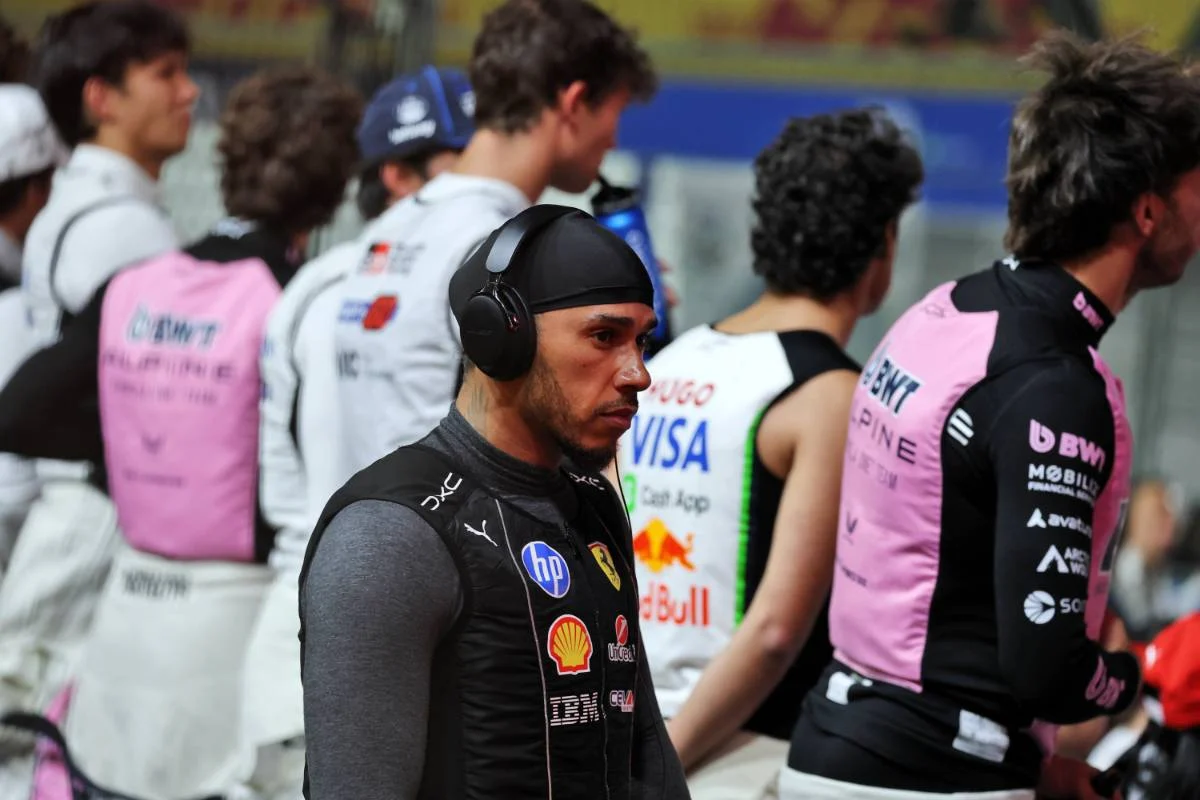
The grueling nature of Formula 1’s most demanding street circuit has once again claimed a victim. Following the conclusion of the 2024 Singapore Grand Prix at the Marina Bay Street Circuit, seven-time World Champion Lewis Hamilton required immediate medical attention from the FIA’s trackside team. The Ferrari driver, who crossed the finish line in a disappointing sixth place, was visibly struggling in the aftermath of the 62-lap marathon, leading the FIA to grant him a rare exemption from his mandatory post-race media obligations.
The Immediate Aftermath: A Rare Absence from the Media Pen
In the high-octane world of Formula 1, the post-race media pen is a non-negotiable stage where drivers dissect their performance, justify tactical gambles, and engage with the global press. When Lewis Hamilton failed to appear in the paddock following the Singapore Grand Prix, it immediately signaled that the situation was more serious than mere post-race fatigue.
Ferrari, in an official statement provided to RacingNews365, confirmed the gravity of the situation. "After the race, Lewis was not feeling well and was examined by the FIA medical team," a team spokesperson stated. The Scuderia emphasized that the Federation had proactively cleared the British driver of his media duties to allow him to receive the necessary care. While Ferrari has remained tight-lipped regarding the specifics of his condition, the medical intervention highlights the extreme physiological toll that the Marina Bay circuit—renowned for its stifling humidity and intense cockpit temperatures—exerts on even the most seasoned athletes.
Chronology of a Grueling Weekend
The physical collapse did not occur in a vacuum; it was the culmination of an arduous weekend that began with tactical friction and ended in a battle against the elements.
The Strategic Gamble
Hamilton’s race was characterized by an aggressive, albeit ultimately flawed, tire strategy. Starting from a promising third position on the grid, the Ferrari team opted to start Hamilton on medium compound tires, diverging from the strategy employed by his immediate rivals, Max Verstappen and Charles Leclerc, who chose the softer compound to gain an initial launch advantage.
The plan was clear: extend the first stint to maintain pace, then switch to hard tires to challenge for the podium. However, the track conditions proved unforgiving. Hamilton pitted on the 18th lap, but the subsequent stint on hard tires became a struggle for survival. As the race progressed, the degradation of his tires accelerated faster than the team had anticipated.
The Fade
By the final quarter of the race, Hamilton was a sitting duck. Struggling with rear-end instability and a lack of grip, he was systematically hunted down by the late-race chargers. He lost positions to Kimi Antonelli, Lando Norris, and Oscar Piastri, ultimately sliding to a sixth-place finish. Over the team radio, a dejected Hamilton took full accountability for the strategic setup, apologizing to the Ferrari pit wall for the lost points. Yet, as he climbed out of the cockpit, it was clear that the disappointment of the result was secondary to a more pressing, physical malaise.
The "Marina Bay Effect": A Recurring Physical Challenge
The Singapore Grand Prix is widely regarded as the most physically taxing event on the F1 calendar. Drivers often lose between two and four kilograms of body weight during the race due to excessive perspiration, with cockpit temperatures frequently exceeding 50 degrees Celsius.
This is not the first time the circuit has pushed Hamilton to his limits. In 2024, the heat and humidity of Singapore proved to be a major hurdle for the entire grid. Notably, Hamilton’s then-teammate at Mercedes, George Russell, also suffered from acute physical exhaustion during the same weekend. The fact that an athlete of Hamilton’s caliber—a man known for his meticulous fitness regime—has now required medical intervention twice at this venue serves as a stark reminder of the limitations of the human body under extreme mechanical and environmental pressure.
Analysis: Why Singapore Remains the Ultimate Test
To understand why a driver would require medical intervention, one must look at the specific environmental constraints of the Singapore street circuit.
Physiological Stressors
- Thermal Load: The ambient temperature in Singapore rarely drops significantly at night, and the humidity acts as an insulator, preventing the body from cooling itself through evaporation.
- G-Force and Duration: Unlike shorter sprints, the Singapore GP often pushes close to the two-hour time limit. The constant turning, braking, and accelerating through 19 corners create a persistent G-force load that taxes the cardiovascular system.
- Dehydration and Cognitive Function: Even a 2% loss in body hydration can lead to a 20% drop in cognitive performance. In a sport where a millisecond of delayed reaction can result in a collision with a wall, the exhaustion experienced by Hamilton is not merely a "bad feeling"—it is a legitimate safety concern.
The FIA’s Role in Driver Safety
The FIA’s decision to allow Hamilton to bypass his media duties is a testament to the federation’s evolving approach to driver welfare. Historically, drivers were expected to fulfill all PR duties regardless of their physical state. However, recent years have seen a shift toward prioritizing the medical recovery of athletes. By providing immediate access to the FIA medical team, the organization ensured that Hamilton was monitored for signs of heatstroke or severe exhaustion, both of which can have long-term impacts if not addressed immediately.
Implications for the Remainder of the Season
As the dust settles on the Marina Bay event, questions remain about the impact of this incident on the remainder of the season.
Ferrari’s Response
Ferrari has been careful to frame the incident as a temporary issue brought on by the specific conditions of the Singapore circuit. There has been no indication that Hamilton will miss any future races, nor has there been any mention of underlying health issues. The team’s priority remains the Constructors’ Championship, and they are likely to conduct a full review of the race data to understand why the car was so punishing to drive, as well as why the tire strategy failed to yield the intended results.
The Human Element
For Lewis Hamilton, this incident is a sobering reminder of the physical cost of his profession. Now in the twilight of his illustrious career, he continues to push himself to the limits that defined his championship-winning years. However, the incident also humanizes the legend; even a seven-time champion is subject to the unforgiving laws of biology.
Looking Ahead
With the next rounds of the championship approaching, the focus will undoubtedly shift back to performance. However, the Singapore incident has sparked a wider conversation about whether the F1 calendar, which continues to expand, is becoming too physically demanding. As the sport pushes into warmer climates and more humid conditions, the safety of the drivers—both in terms of their psychological and physical endurance—must remain at the forefront of the FIA’s regulatory agenda.
Conclusion
The image of Lewis Hamilton leaving the paddock under the guidance of medical staff rather than engaging with the press is a rare one, and it underscores the sheer intensity of modern Formula 1. While the disappointment of a sixth-place finish at the Singapore Grand Prix is significant for his standings, the primary takeaway from the weekend is the resilience of the human element within the machine.
Ferrari has kept the details of his recovery private, and for now, the focus shifts toward the next Grand Prix. Whether this was a temporary case of heat exhaustion or a symptom of the immense pressure the drivers face, it serves as a timely reminder that behind the technology, the aerodynamics, and the multi-million dollar budgets, the sport is still driven by individuals who are pushed to the absolute edge of their endurance every time they strap into the cockpit. For Hamilton, the goal will be to recover, reset, and return to the grid with the intensity that has become the hallmark of his legendary career.