

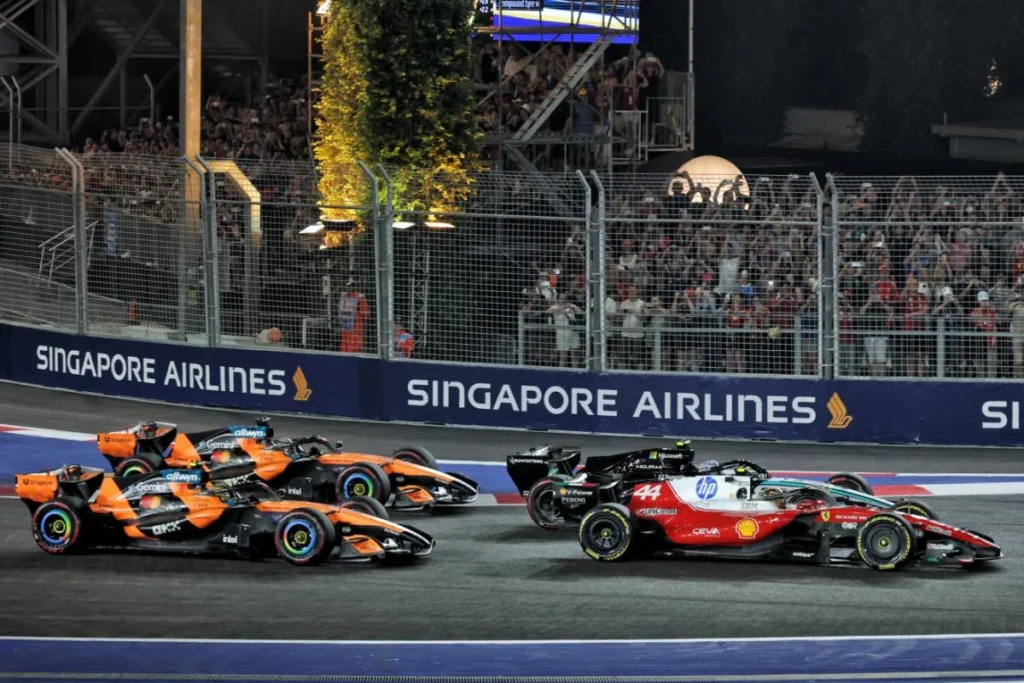
The landscape of Formula 1 is currently witnessing an unexpected technical phenomenon that is forcing teams, drivers, and Pirelli to reconsider the fundamental principles of race strategy. As the sport accelerates toward the radical 2026 technical overhaul, a byproduct of the design philosophy—specifically regarding tire pressures and aerodynamic loads—has rendered the traditional tire hierarchy obsolete. The softest compounds in Pirelli’s arsenal, typically reserved for short, high-grip qualifying bursts, are now demonstrating an endurance that rivals the harder, more durable rubber, effectively neutralizing the strategic variance that makes Grand Prix racing unpredictable.
Main Facts: The Erasure of the Strategic Gap
The core of the issue lies in a fundamental shift in how tires interact with the track surface. In recent races, including the high-stakes Singapore Grand Prix and the demanding street circuit in Baku, the "Soft" tire (C5 compound) has shown remarkable resilience.
Traditionally, a Soft tire is expected to fall off a "performance cliff" after a limited number of laps due to thermal degradation. However, drivers have found themselves capable of pushing these tires for almost the entire race distance. This durability creates a "one-strategy-fits-all" scenario. When the softest tire in the range can perform for 30, 40, or even 50 laps without significant loss of pace, the incentive to use the Medium or Hard compounds vanishes. This shift has not only complicated the jobs of team strategists, who thrive on finding windows of opportunity through varying pit-stop intervals, but it has also arguably reduced the excitement of the race by limiting the "undercut" or "overcut" opportunities that arise from having tires at different stages of their life cycle.
Chronological Context: From Baku to Singapore
The warning signs of this trend were first observed during the Azerbaijan Grand Prix. As the field navigated the tight, technical confines of the Baku City Circuit, it became apparent that the soft tires were not behaving as historical data suggested they should. Drivers were able to manage their pace, keep temperatures stable, and extend their stints far beyond the expected degradation profiles.
This trend reached a critical point at the Singapore Grand Prix. Despite Pirelli opting for the three softest compounds—the C3, C4, and C5—the field largely abandoned the Hard tire. Even with the grueling heat and the high-downforce requirements of the Marina Bay circuit, the Soft tire became the preferred option.
Lewis Hamilton, who started on Mediums, eventually transitioned to the Softs, finding himself in a position where he could push significantly harder than his peers on older, harder compounds. While he did eventually encounter a drop-off after 44 laps of heavy usage, the fact that he was able to maintain competitive pace for that duration on a compound designed for maximum speed is a testament to the current distortion of the tire performance curve.
Supporting Data: The Pressure Dilemma
At the heart of this technical anomaly is the relationship between tire pressure and the upcoming 2026 aerodynamic regulations. Pirelli, acting as the sole tire supplier, has been tasked with developing rubber that can withstand the extreme forces projected for the 2026 cars.
The transition to active aerodynamics, specifically the "straight-line mode" designed to reduce drag, has created a safety-critical environment. In the event of a mechanical failure of these systems, the tires could be subjected to forces exceeding their structural integrity. To mitigate these risks, Pirelli has been forced to mandate higher tire pressures.
While this ensures safety, it creates a secondary effect: the tires, particularly the rears, are operating at a different contact patch geometry and thermal equilibrium. Alex Albon, the Williams Racing driver who has been vocal about these developments, explains: "What we are seeing is that the rear tire pressures have increased massively. Currently, it feels like the softer tires offer more grip, which allows for better control of the surface temperature."
Essentially, the higher pressures prevent the tire from flexing as much as it normally would, which in turn reduces the "scrubbing" effect that leads to rapid degradation. The "Soft" tire, by virtue of its softer construction, is now better able to keep its surface temperature in the optimal window under these high-pressure mandates, effectively turning it into a long-lasting, high-grip hybrid that outperforms the theoretically more durable Hard compounds.
Official Responses and Driver Perspectives: The Albon Critique
Alex Albon has become the primary spokesperson for the drivers’ frustrations regarding these technical constraints. For Albon, the current state of play is a symptom of over-regulation.
"The soft tire was very performant during that race, almost too performant, in reality," Albon noted following the Singapore event. "I don’t think it’s normal that a soft tire can do that many laps while remaining so consistent. It was an excellent tire, but it felt more like a hard tire than a soft tire."
Albon’s criticism extends to the "straight-line mode" itself. He argues that the sport is compromising the quality of the racing to account for potential, yet unlikely, failures of an unproven system. "They did this because of the rules related to the straight-line mode, but I would prefer if we just got rid of it. Because if this system breaks, the race is over anyway—you might as well stop the car."
His perspective reflects a growing sentiment in the paddock that the pursuit of a "perfect" technical regulation for 2026 is currently making the 2024 and 2025 seasons suffer from unintended, and largely unnecessary, side effects.
Implications: The Future of F1 Strategy
The implications of this phenomenon are significant for the remainder of the current regulatory cycle. If Pirelli cannot find a way to re-introduce the performance delta between the compounds, the sport risks a period of "stagnant" racing where strategies are homogenized.
- Strategic Stagnation: If the Soft tire is always the best choice, the variety in pit stops will disappear. This forces teams into a "copy-cat" strategy, where the race is decided by qualifying position and straight-line speed rather than tactical ingenuity.
- The 2026 Uncertainty: The fact that the tires are already behaving according to 2026 predictions suggests that the cars may be faster and more physically demanding than initially anticipated. This forces Pirelli into a delicate balancing act: prioritize safety to accommodate future, more powerful cars, or prioritize the quality of the show by allowing tires to degrade at the rates fans expect.
- The Human Factor: As Albon noted, teams that solve the "secondary" challenges—like cooling—are finding an advantage. While Williams has struggled with car performance this season, Albon praised their work on driver cooling systems, noting that even when the system failed for the first ten laps in Singapore, it eventually provided the best thermal management on the grid. This suggests that while tire strategy may be narrowing, the "hidden" technical battles (cooling, ergonomics, weight management) are becoming more vital than ever.
Conclusion: A Delicate Balance
The situation underscores the difficulty of managing a sport as technically complex as Formula 1. By attempting to future-proof the tires for 2026, the authorities have inadvertently changed the character of the racing in the present.
The "Soft" tire paradox is more than just a technical grievance; it is a reminder that in Formula 1, every regulation has a ripple effect. Pirelli, the FIA, and the teams are now engaged in a quiet, intense dialogue to determine whether these tire pressures can be adjusted to restore the performance gaps between compounds. Until then, the grid remains in a state of flux, where the softest rubber in the shed is arguably the hardest to beat—a reality that neither the fans nor the drivers seem particularly happy about.
As we look ahead, the challenge for the sport will be to ensure that the technical evolution of 2026 does not come at the cost of the unpredictability that defines the pinnacle of motorsport. For now, the "Soft" tire remains the unlikely protagonist of a season defined by unintended consequences.
