

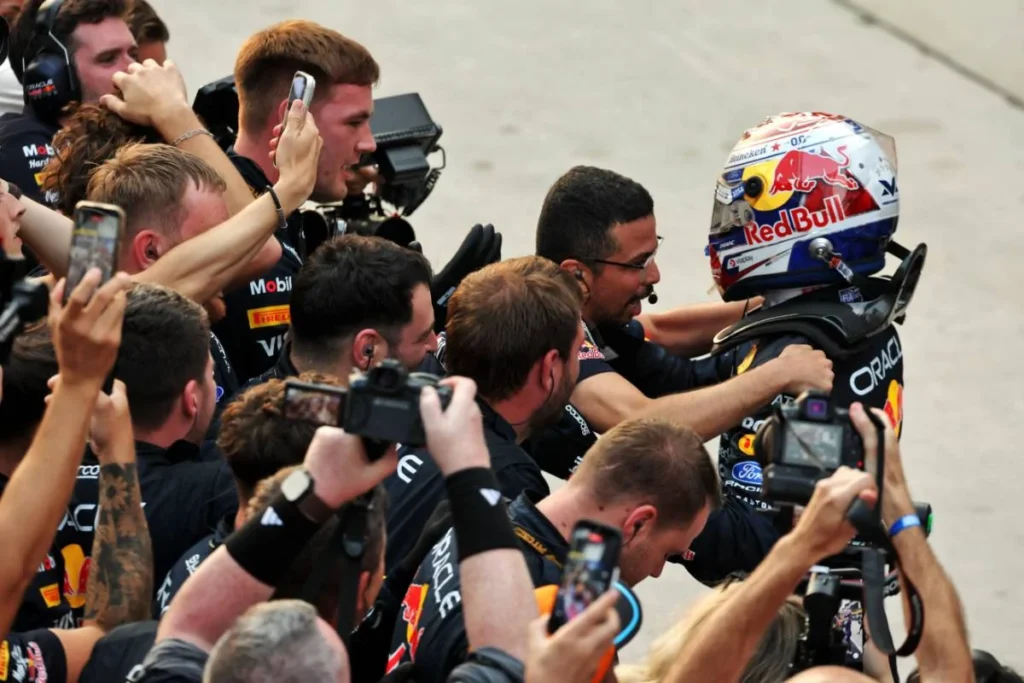
Following a long-awaited return to the top step of the podium in Malaysia, Red Bull Racing finds itself at a critical juncture in the 2026 Formula 1 season. While the victory for Max Verstappen in Sepang has provided a much-needed morale boost for the team, Team Principal Laurent Mekies remains remarkably grounded. Despite the clear upward trajectory of the RB22, Mekies insists that the team must temper its expectations as the circus moves toward the street circuit challenge of Singapore.
The Road to Recovery: A Chronology of Progress
The narrative of Red Bull’s 2026 season has been one of perseverance. After a challenging start that saw the Milton Keynes outfit struggle to find the optimal operating window for their new car, the mid-season period became a testing ground for aggressive development.
The turning point can be traced back to the Azerbaijan Grand Prix, the opening leg of a grueling triple-header. Bringing significant aerodynamic and floor updates to the Baku street circuit, Red Bull saw an immediate return on investment. A double-podium finish in Baku acted as a catalyst, proving that the simulation data and the wind tunnel work were finally aligning with real-world track performance.
This momentum carried through to subsequent rounds. Verstappen’s triumph in Malaysia—the 72nd victory of his storied career—was not a bolt from the blue, but rather the culmination of a systematic effort to rectify the handling balance that plagued the team earlier in the year. However, as Mekies reflects on this progress, he is quick to emphasize that while the RB22 is undoubtedly faster, the specific environment of Sepang may have played a deceptive role in the margin of victory.
Decoding the Performance: Data vs. Circumstance
To understand why Mekies remains cautious, one must look at the technical variables present at the Sepang International Circuit. The Malayan Grand Prix is notorious for being one of the most physically and mechanically demanding races on the calendar.
"On one hand, this confirms the positive trend we observed in Monza, Madrid, Baku, and Bahrain," Mekies noted in a recent briefing. "We seem to be gaining a performance increment at every race, which is obviously very encouraging for the entire factory."
Yet, the technical staff at Red Bull is looking beyond the raw lap times. Mekies raised a compelling point regarding the "operating window." Every F1 car is designed to perform at its peak within a specific range of tire temperatures, downforce levels, and surface grip. Sepang, with its abrasive asphalt and extreme ambient temperatures, is an outlier.
"Is there another factor, or perhaps several, that influenced what we observed in Malaysia? It is highly possible," Mekies admitted. "With the extreme heat, the high surface roughness, and the unique layout, I am convinced that most cars were not operating within their ideal window. When the conditions are this extreme, it acts as a filter. Some teams handle that stress better than others, which can mask the true hierarchy of the grid."
This perspective suggests that the victory in Malaysia may have been a combination of genuine mechanical progress and the ability of the RB22 to cope with extreme environmental stress more effectively than its rivals.
The Strategic Outlook: Preparing for the Marina Bay Challenge
As the team prepares for the Singapore Grand Prix, the focus shifts from high-speed thermal management to low-speed agility. Marina Bay is a stark contrast to Sepang. It is a tight, twisting street circuit where mechanical grip, traction out of slow corners, and car rotation are the primary determinants of speed.
Red Bull had earmarked Singapore as a potential stronghold even before the success in Malaysia. The team believes that the specific aerodynamic characteristics of the RB22—specifically its ability to handle low-speed transitions—should play to their strengths.
"We are going to try to adapt as well as possible for the next race and see what happens," says Mekies. "We still believe that Singapore should, hopefully, suit us better, as we had anticipated, particularly regarding performance in the slow-speed corners."
However, there is an inherent danger in over-confidence. The 2026 grid is notoriously tight, and the "midfield" has frequently become a "front-pack" depending on the circuit characteristics. Mekies is wary of the unpredictability that defines this era of regulations. "It is very difficult to know exactly how competitive we will be against the others. The margins are so thin that one small setup error can drop you from a podium contender to a Q2 elimination."
Implications for the Championship Battle
The return of Red Bull to the winner’s circle has immediate implications for the remainder of the season. After waiting sixteen rounds to secure their first victory of 2026, the psychological pressure on the team has finally been lifted. For a driver of Verstappen’s caliber, the win is a confirmation that the equipment is now capable of delivering on his talent.
However, the team’s long-term strategy remains unchanged: continuous, iterative improvement. The development race in 2026 is arguably as intense as the on-track competition. With the budget cap forcing teams to be surgical with their upgrades, Red Bull cannot afford to rest on the laurels of the Malaysian victory.
The implications for the Constructors’ Championship are equally significant. While catching the current leaders remains a monumental task, the consistency shown by the RB22 over the last four races suggests that Red Bull has established a floor for their performance. If they can continue to unlock the car’s potential in the slow-speed sectors of Singapore and beyond, they could well become the primary agitators for the championship leaders in the final quarter of the season.
Conclusion: A Measured Approach to Excellence
Laurent Mekies’ refusal to get carried away is not a sign of lack of ambition, but rather a reflection of the maturity required to manage a modern F1 team. The victory in Malaysia was a milestone, not the destination.
"We have taken a step forward, but we are not yet where we want to be," Mekies concluded. "The true test will be our consistency across the varied circuits that remain on the calendar."
As the F1 world turns its eyes to Singapore, the spotlight will be firmly on the Milton Keynes squad. Can they replicate the dominance of Sepang on the streets of Marina Bay? Or will the volatile nature of the 2026 season swing the pendulum back toward their rivals? For Red Bull, the answer lies in the data they gather during the upcoming free practice sessions, where the "operating window" will once again be the primary variable in their quest to prove that their resurgence is no fluke, but a new standard of performance.
The 2026 season, which began with frustration and uncertainty for Red Bull, has transformed into a fascinating development story. Whether this trajectory leads to a late-season title surge or simply a stronger foundation for the following year, one thing is certain: Max Verstappen and his team are no longer just participating—they are once again dictating the pace.
