

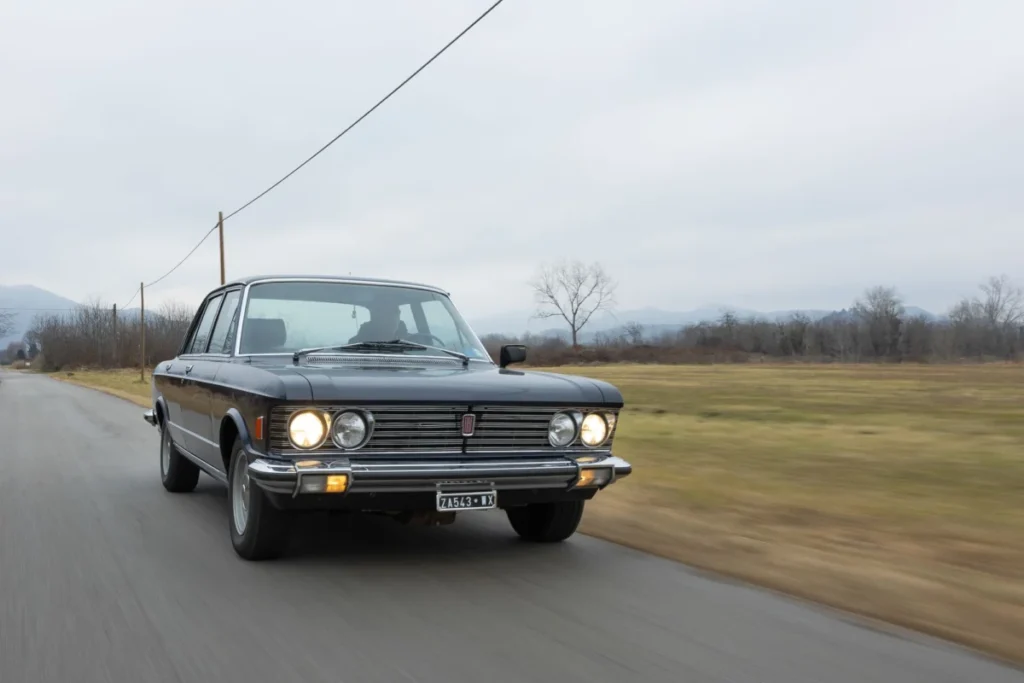
By Marco Visani — Photography by Domenico Fuggiano
Main Facts: A Flagship Born of Pride and Politics
At the twilight of the 1960s, Fiat—the undisputed industrial titan of Italy—embarked on a high-stakes gamble. The objective: challenge the formidable dominance of Mercedes-Benz in the executive luxury segment. For years, Fiat’s flagship offerings, the 1800 B and the larger 2300 Lusso, had served as reliable, dignified transport for industrialists and high-ranking state officials. However, with their aging styling, conservative inline-six engines, and old-fashioned tailfins, they were rapidly becoming relics of a bygone era.
Simultaneously, a vacuum was forming at the apex of the Italian automotive industry. Domestic rivals Lancia and Alfa Romeo were preparing to phase out their respective luxury stalwarts, the Flaminia and the 2600, leaving the market for official state vehicles wide open. Recognizing an opportunity to capture both market prestige and government contracts, Fiat’s leadership authorized project X1/3—the development of what would become the Fiat 130.
Conceived as a bold technological statement, the Fiat 130 was larger, more powerful, and vastly more ambitious than anything Turin had produced in the post-war era. Yet, despite its sophisticated independent suspension, four-wheel disc brakes, and refined V6 powerplant, the vehicle was fated to navigate a storm of economic turmoil, changing political tides, and, most hauntingly, a dark chapter of domestic terrorism that would permanently etch its name into the history books of modern Europe.

Chronology: From Drawing Board to the Streets of Rome
1965–1966: The Genesis of Project X1/3
The technical directorate at Fiat’s Mirafiori plant begins debating the replacement for the aging 2300 Lusso. Initially, veteran engineer Dante Giacosa is skeptical about investing heavily in a new six-cylinder luxury model, foreseeing limited commercial viability due to Italy’s punitive vehicle taxation laws that heavily penalized large displacements and multi-cylinder engines.
However, the automotive landscape shifts dramatically in April 1966 when Gianni Agnelli succeeds Professor Vittorio Valletta as the president of Fiat. Agnelli champions a more aggressive, internationally minded vision for the company. He greenlights the X1/3 project, calculating that Fiat’s booming economic momentum can absorb the risk of challenging Mercedes-Benz on its home turf, while effortlessly stepping into the void left by Lancia and Alfa Romeo in the state vehicle fleet.
1969: The Public Debut
The Fiat 130 Berline makes its official debut at the Geneva Motor Show. Sporting sharp, geometric styling penned under the watchful eye of Centro Stile Fiat, the car introduces a completely new 2,866 cc V6 engine designed by Aurelio Lampredi, the legendary former Ferrari engine builder. While praised for its exceptional ride quality, spacious interior, and advanced road-holding capabilities, critics immediately target its conservative styling and underwhelming initial power output (140 horsepower) relative to its hefty curb weight.
1971: The Evolution and the Coupe
Responding to criticisms regarding sluggish performance, Fiat introduces the second series alongside a stunning companion: the Fiat 130 Coupé, styled by Pininfarina (specifically by master designer Paolo Martin). The engine displacement is bored out to 3,235 cc, boosting power to 165 horsepower. The Coupé, in particular, receives critical acclaim for its breathtaking, angular aesthetic and luxurious interior appointments, becoming a favorite among Italy’s elite.

1973: The Oil Crisis and Market Stagnation
The global economic shockwaves of the 1973 oil crisis deal a catastrophic blow to large-displacement luxury cars worldwide. In Italy, soaring fuel prices and strict austerity measures decimate the private market for vehicles exceeding three liters. Production numbers plummet, turning the Fiat 130 into a rare sight on public roads, though its adoption by the Italian state as an official ministerial transport remains steady.
March 16, 1978: The Darkest Day in Modern Italian History
At 8:45 a.m. on a Thursday morning in Rome, a routine that has played out hundreds of times turns into a national tragedy. A non-armored 1973 Fiat 130 Berline (registered as Roma L59812) carrying Aldo Moro—president of Christian Democracy and the architect of the historic political compromise with the Italian Communist Party—leaves his home on Via del Fronte Trionfale.
At the intersection of Via Fani and Via Stresa, a meticulously coordinated ambush orchestrated by the militant terrorist group Red Brigades (Brigate Rosse) is sprung. A decoy white station wagon cuts off the convoy, causing a multi-vehicle collision. The terrorists slaughter Moro’s five police escorts within seconds and abduct the statesman. Fifty-five days later, Moro’s lifeless body is discovered in the trunk of a Renault 4 in central Rome. The Fiat 130 is forever bound to this grim historical milestone, cementing its tragic legacy in the collective Italian consciousness.
Supporting Data: Specifications and Production Realities
To understand the engineering ambition behind the Fiat 130, one must examine the figures that defined its construction and commercial performance.

- Engine Architecture: 60-degree V6, designed by Aurelio Lampredi. Featuring an aluminum cylinder head and a cast-iron block, it utilized a single overhead camshaft per bank driven by a toothed rubber belt.
- Displacement & Power:
- First Series (1969–1971): 2,866 cc, developing 140 hp at 5,600 rpm.
- Second Series (1971–1977): 3,235 cc, developing 165 hp at 5,600 rpm, paired with a standard Borg-Warner 3-speed automatic transmission or a 5-speed manual ZF gearbox.
- Suspension & Handling: Independent suspension all around—a sophisticated setup featuring MacPherson struts, torsion bars at the front, and semi-trailing arms with coil springs at the rear. This gave the heavy sedan remarkably agile handling characteristics that frequently outperformed its German rivals on winding Italian tarmac.
- Production Volumes: Commercial success eluded the project. Between 1969 and 1977, approximately 15,093 units of the Berline were manufactured, alongside just 4,493 units of the exquisite Pininfarina-styled Coupé. Total production across both body styles barely crossed the 19,500 threshold—a fraction of Mercedes-Benz’s output during the same era.
Official Responses: Corporate Ambition Meets Economic Reality
When Fiat first conceptualized the 130, official corporate communications from Turin framed the vehicle as a testament to Italian industrial resurgence. President Gianni Agnelli frequently emphasized that Italy deserved a domestic flagship capable of projecting national prestige on the international stage. In internal memos leaked decades later, Fiat’s board acknowledged that the 130 was unlikely to generate massive direct profit; rather, its primary ROI was intended to be "halo prestige"—lifting the perceived value and technological credibility of smaller models like the Fiat 124 and 128.
However, as the macroeconomic climate deteriorated following the 1973 oil crisis, the tone from Mirafiori shifted. Publicly, Fiat downplayed production slowdowns, attributing them to bespoke, hand-finished assembly processes at the factory. Privately, executives realized the platform was trapped in a no-man’s-land: too expensive and fuel-thirsty for private buyers during a recession, yet lacking the sprawling dealer and service network abroad to successfully poach executive buyers from BMW and Mercedes-Benz in export markets like Germany and the United States.
Government ministries, conversely, offered glowing endorsements of the car’s utility. For Italian high-ranking officials, magistrates, and cabinet ministers, riding in a Fiat 130 was an act of patriotic solidarity. State agencies remained the primary purchasers of the Berline variant throughout its lifecycle, ensuring that the assembly lines trickled along until production officially ceased in 1977.
Implications: A Monument to a Bygone Era
The story of the Fiat 130 extends far beyond pistons, sheet metal, and sales charts. It serves as a microscopic lens through which the complex socio-political landscape of 1970s Italy can be observed.

1. The End of the Domestic Luxury Dream
The commercial failure of the Fiat 130 signaled the end of an era in which mass-market volume manufacturers could successfully compete in the ultra-luxury executive segment. Following the 130’s quiet retirement, Fiat wisely chose to leave the top-tier luxury sedan market to its upscale subsidiary, Lancia (with cars like the Thema and Thesis), and ultimately focused its core brand energies on compact and mid-size vehicles. No mass-market Italian automaker has attempted to build a direct V6-powered flagship saloon to rival German luxury brands since.
2. A Symbol of State Trauma
In the cultural memory of the Italian Republic, the Fiat 130 Berline occupies a haunting psychological space. Much like the dark blue Lincoln Continental associated with the Kennedy assassination in the United States, the image of the black Fiat 130 riddled with bullets on Via Fani remains one of the most potent visual symbols of the Anni di Piombo (Years of Lead)—a turbulent decade marked by political extremism, violence, and institutional crisis.
3. Collector Status and Modern Reappraisal
Decades after its demise, the Fiat 130 has undergone a remarkable renaissance among classic car enthusiasts. While the Berline remains a rare and polarizing sight, praised for its clean architectural lines and lamented for its tragic history, the Pininfarina Coupé is now recognized as a masterclass of 1970s automotive design. Collectors actively seek out well-preserved 3200 models, drawn by their rarity, advanced engineering, and the unmistakable pedigree of a Lampredi-designed V6 engine.
Ultimately, the Fiat 130 remains a monument to Italian ambition: a brilliant, deeply flawed, and profoundly unlucky machine that swung for the fences, only to be caught in the crosshairs of history.
