

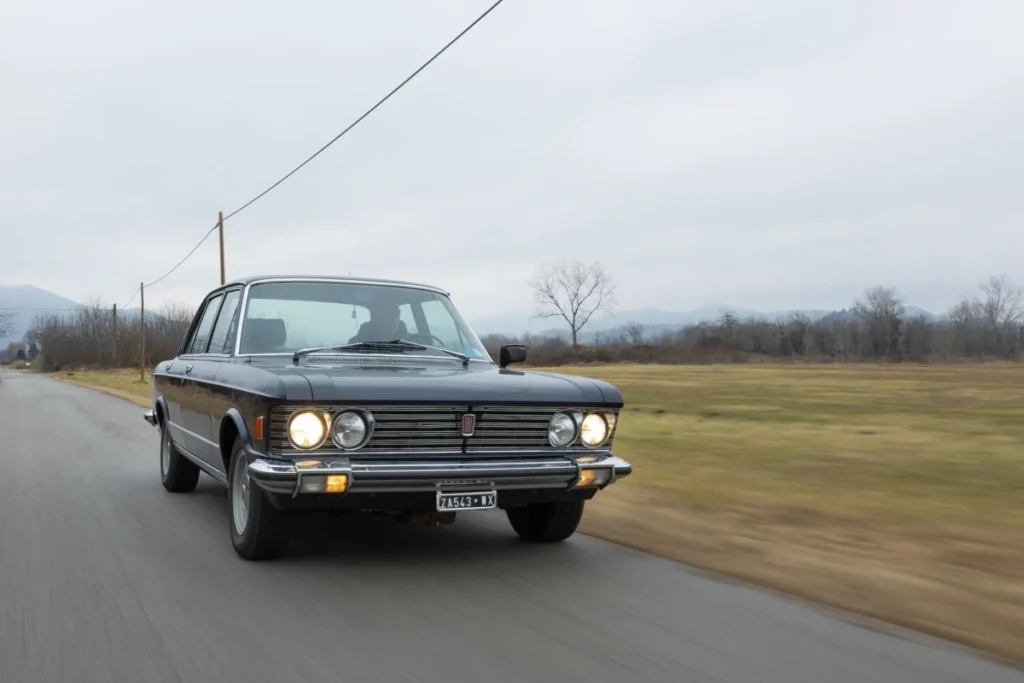
By Marco Visani | Photographs by Domenico Fuggiano
Main Facts: Ambition, Bureaucracy, and the Shadow of History
At the twilight of the 1960s, Fiat embarked on a daring and prestigious mission: to challenge Mercedes-Benz on its own turf. For years, the Italian automotive giant had relied on aging inline-six models—such as the 1800 B and the 2300 Lusso—to represent its upper echelons. While charming, these vehicles were fundamentally conservative, burdened by dated styling cues and rigid taxation structures that penalized both large engine displacements and high cylinder counts.
Enter the Fiat 130, codenamed project "X1/3." Conceived as a technological tour de force and a regal flagship, the car was designed not only to capture the imagination of private luxury buyers but also to fill a looming void. With traditional domestic competitors like Lancia and Alfa Romeo preparing to vacate the high-ranking government sedan market (as their aging flagships, the Flaminia and the 2600, approached the ends of their lifecycles), Fiat saw an opening to become the premier official transporter for Italy’s civil servants and state officials.

Yet, despite its lofty engineering credentials and grand political ambitions, the Fiat 130 ultimately became a tale of unfulfilled potential. Caught in the crosshairs of the devastating 1973 oil crisis and destined to be forever shadowed by one of the darkest days in modern Italian political history, the 130 remains a fascinating study in corporate ambition meeting unforeseen tragedy.
Chronology of a Flagship: From Drawing Board to National Tragedy
1965–1966: The Genesis at Mirafiori
- Late 1965: The Technical Direction at Mirafiori begins deliberating on a successor to the aging 1800/2300 lineage. Chief engineer Dante Giacosa remains skeptical, doubting the economic viability of investing heavy resources into a new six-cylinder model whose market was constrained by Italy’s punitive taxation system.
- April 1966: Gianni Agnelli assumes the presidency of Fiat, succeeding Professor Vittorio Valletta. Agnelli immediately accelerates the X1/3 project. He reasons that Fiat’s soaring industrial momentum makes challenging Mercedes-Benz an achievable goal, while supplying the Italian state with a new official vehicle will help offset development costs through invaluable prestige.
March 16, 1978: The Darkest Day
- 8:45 AM: Parliament in Montecitorio prepares for a crucial vote of confidence concerning the fourth government led by Giulio Andreotti—notable for securing the first direct support from the Italian Communist Party.
- 9:00 AM: Christian Democracy president Aldo Moro steps out of his residence at 79 Via del Fronte Trionfale. He enters his unarmored Fiat 130 sedan (Registration: Roma L59812, a 3200 model registered in April 1973).
- The Ambush: At the intersection of Via Fani and Via Stresa, a white 128 Familiare with diplomatic plates reverses and suddenly brakes. Moro’s Fiat 130 rear-ends it, while an escort vehicle (a white Alfetta carrying three guards) crashes into the back of the 130.
- The Aftermath: Members of the Red Brigades emerge from the chaos, brutally executing all five police officers and kidnapping Aldo Moro. This commences a tragic 55-day captivity that ends in Moro’s assassination—forever entangling the history of the Fiat 130 with a national trauma.
Supporting Data: Evolution, Engineering, and Market Realities
The Fiat 130 was built in two distinct series, evolving to meet market demands before being crippled by external economic forces.
Technical Evolution
- First Series (1969–1971): Launched with a 2,866 cc V6 engine, the car featured advanced independent suspension all around (utilizing torsion bars up front and coil springs at the rear) and four-wheel disc brakes. However, critics noted that the engine felt underpowered relative to the car’s substantial weight.
- Second Series (1971–1977): In response to performance criticisms, Fiat enlarged the engine displacement to 3,235 cc (the "3200"), boosting power and torque. This version offered improved drivability, refined interior ergonomics, and greater authority on the autostrada.
- The Coupe Variant: Designed in parallel by Pininfarina (with Paolo Martin leading the pen), the Fiat 130 Coupe debuted in 1971 and was widely lauded as an aesthetic masterpiece, praised for its sharp, geometric lines and luxurious cabin appointments.
Production and Market Metrics
- Total Production: Despite its ambition, the Fiat 130 was a low-volume vehicle. Between the sedan and the stunning coupe, fewer than 15,000 units were produced over its lifecycle.
- Taxation Penalties: Italian fiscal policy heavily penalized engines exceeding two liters, relegating the 130 mostly to state ministries, corporate fleets, and wealthy industrialists rather than private buyers.
- Fuel Economy: The introduction of the 3.2-liter engine coincided disastrously with the 1973 oil shock, rendering large-displacement petrol engines politically and economically unviable for broad consumer adoption.
Official Responses and Corporate Strategy
When Fiat introduced the 130, the corporate narrative was one of national industrial pride. Gianni Agnelli framed the project not merely as a commercial venture, but as a statement of capability. By building a true executive sedan, Fiat aimed to prove that Italian engineering could match—and even surpass—German refinement in ride comfort, build quality, and styling.

However, the reality within Fiat’s boardroom was far more pragmatic. Recognizing that private sales would inevitably be stifled by domestic tax laws, the manufacturer heavily courted public administration contracts. By positioning the Fiat 130 as the definitive state vehicle for ministers, magistrates, and high-ranking officials, Turin secured a captive market that ensured continuous, albeit modest, production runs.
Publicly, the automotive press praised the 130 for its exceptional highway stability, superb braking systems, and the sublime comfort of its Pininfarina-inspired interior environments. Privately, however, executives acknowledged that the car was fighting a losing battle against rising fuel costs, aggressive German competition (such as the Mercedes-Benz W108/W116 series), and shifting socio-political climates in Italy during the turbulent "Years of Lead."
Implications: The Legacy of a Misunderstood Machine
The story of the Fiat 130 reaches far beyond sheet metal and horsepower figures; it serves as a microcosm of Italy’s socio-economic trajectory during the late 20th century.

- The End of an Era for Italian Luxury: With the eventual discontinuation of the 130 in 1977 (and the Coupe following shortly after), Fiat effectively abandoned the large executive sedan segment. For decades, mass-market manufacturers retreated to smaller, more economical segments, leaving the upper-luxury tier entirely uncontested by domestic brands.
- A Political Symbol: The tragic kidnapping of Aldo Moro transformed the Fiat 130 from a symbol of industrial aspiration into an icon of a nation in crisis. To this day, archival footage of the Via Fani massacre permanently links the 130 sedan to the darkest chapters of Italy’s republican history.
- Collector Status Today: Decades after rolling off the production lines, the Fiat 130 has experienced a remarkable renaissance among classic car enthusiasts. Admired for its bold, boxy 1970s aesthetic, advanced independent suspension, and silky-smooth V6 powerplant, surviving examples—particularly the rare Pininfarina coupes—are now celebrated as design masterpieces and sought-after collectors’ items.
The Fiat 130 may have been pretentious, ill-fated, and shadowed by tragedy, but it remains an unforgettable testament to a time when Italian design dared to dream at the highest level.
For the complete, unabridged feature, discover Gazoline issue #351, available now on the official Gazoline store.
