

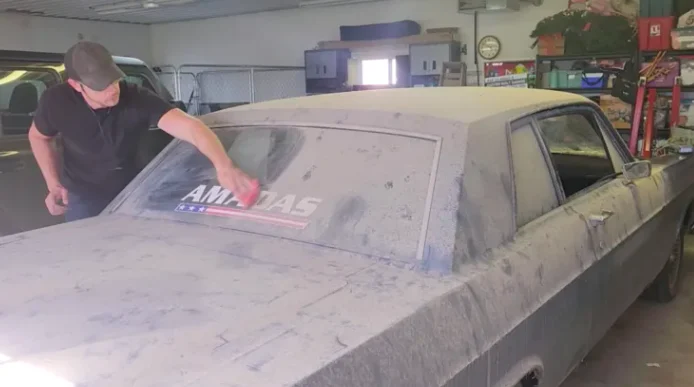
For many automotive enthusiasts, the sight of a project car gathering dust in a garage is a familiar, if somewhat melancholic, reality. It often starts with grand ambitions—a vision of a tire-shredding hot rod or a concourse-quality restoration—only to be sidelined by the creeping encroachment of life’s responsibilities. For one Ford Fairlane owner, that dream remained dormant for a full decade, trapped behind a shroud of cobwebs and broken resolve.
However, in a feat of mechanical ingenuity that borders on the absurd, the vehicle has finally roared back to life. The catalyst for this resurrection wasn’t an expensive performance carburetor or a complex fuel-injection conversion; it was a simple, humble component sourced from a garden lawnmower. This unconventional experiment, documented by the YouTube personality known as "ThunderHead289," offers a fascinating glimpse into the resilience of American muscle and the creative problem-solving that defines the hot-rodding subculture.
The Decade of Silence: Anatomy of a Stalled Project
The vehicle in question is a Ford Fairlane—a nameplate synonymous with the golden era of American automotive power. Under the hood lies a Ford "small-block" V8, a legendary powerplant known for its versatility and massive aftermarket support. To add to its potential, the engine is equipped with a supercharger, a piece of forced-induction hardware designed to cram dense air into the combustion chambers, thereby generating immense horsepower.
For ten years, this machine remained an immobile statue. The factors that contribute to such long-term abandonment are rarely singular. Often, it is a "death by a thousand cuts": a missing gasket, a persistent electrical gremlin, or a faulty fuel pump that seems too daunting to address on a busy weekend. Over time, the car shifts from being a "project" to being an architectural fixture in the garage—a space-consuming memento of an intention that never quite materialized.
When the YouTube creator Luke, the mind behind the channel ThunderHead289, approached the project, the primary concern was not performance, but survival. After a decade of sitting, the engine’s internal health was a complete mystery. Would the rings be seized? Would the seals have perished? Before investing in a high-end fuel system, a diagnostic tool was needed to verify that the heart of the beast was still beating.
The Engineering Improbability: A Lawnmower’s Contribution
The decision to utilize a lawnmower carburetor was born from a mix of necessity and "garage-science" curiosity. In the world of high-performance V8s, a standard four-barrel carburetor is designed to handle massive volumes of fuel and air. A lawnmower carburetor, by contrast, is designed for small, single-cylinder engines that operate at a fraction of the power output.
To bridge this gap, the setup required a radical, albeit temporary, reconfiguration. Because lawnmower carburetors are typically gravity-fed—meaning the fuel tank sits above the engine to allow gravity to pull the fuel into the float bowl—Luke had to fabricate a makeshift fuel system. A small auxiliary tank was placed in the passenger footwell, and a fuel pressure regulator was dialed down to a minuscule 0.1 bar to prevent the carburetor from being overwhelmed by the fuel pump’s output.
Even the battery was relocated to the cabin, creating a precarious environment where volatile fuel and electrical connections sat in close proximity to the operator. As a standard safety precaution in such extreme DIY scenarios, a fire extinguisher was kept at the ready, serving as a silent reminder of the potential for a catastrophic error.
Chronology of the Start-Up
The start-up process was a study in patience and precision. Once the fuel lines were plumbed and the spark was verified, the ignition was turned. To the surprise of many, the V8 didn’t just turn over; it fired almost immediately.
- Preparation Phase: Luke spent hours ensuring the basic timing and ignition systems were functional before attempting to introduce the lawnmower carb.
- The Hook-up: The integration of the gravity-fed system allowed for a steady, if low-pressure, fuel supply that wouldn’t blow out the tiny internal gaskets of the garden equipment part.
- The Ignition: Using an app called "Carb Cheater" to monitor the air-fuel mixture via real-time sensors, the engine was brought to life.
- Steady State: The engine achieved an idling speed that was remarkably smooth, given the disparity between the hardware and the displacement.
- The Load Test: As the car was put into gear and the revs increased, the limitations of the lawnmower part became apparent. The tiny venturi of the carburetor acted as a mechanical choke, restricting the airflow required by the supercharger to generate actual boost.
Supporting Data and Technical Reality
It is essential to clarify that this was never intended to be a long-term performance solution. A V8 engine requires a specific stoichiometric ratio—roughly 14.7 parts of air to one part of fuel. The lawnmower carburetor simply cannot flow enough air to satisfy the demands of a supercharged V8 under load.
When the car moved under its own power, the supercharger actually created a parasitic drag. Because the engine couldn’t pull enough air through the tiny carburetor to overcome the mechanical resistance of the blower, the setup functioned more as an "engine-running test" than a driveable configuration. However, the data gathered during these short bursts proved that the engine block, heads, and internal rotating assembly were in excellent working order. The "Carb Cheater" app confirmed that the fuel-to-air ratio, while lean at high RPMs, was sufficient to keep the engine from suffering catastrophic detonation during the test.
Precedent: The Ford Maverick Experiment
This is not the first time the automotive community has seen such "Frankenstein" engineering from ThunderHead289. In a previous project involving a Ford Maverick powered by a 302 cubic-inch V8, Luke pushed the lawnmower-carb concept to its logical extreme.
In that iteration, he utilized a 3D-printed adapter plate, an Arduino microcontroller, and a custom mobile application to manage supplemental air intake. That setup was significantly more advanced; it allowed the Maverick to reach speeds of up to 70 mph (approximately 113 km/h). While the car was clearly not winning any drag races, it demonstrated that with enough electronic intervention, a V8 could be operated at highway speeds on a lawnmower’s fuel-delivery system. The result was a surprisingly fuel-efficient V8 cruiser, proving that "oversized" engines are often wasting fuel simply because their carburetors are tuned for maximum power rather than efficiency.
Implications for the Project Car Community
The implications of this experiment go beyond the novelty of a lawnmower-powered hot rod. For the owner of the Ford Fairlane, the psychological barrier of the "dead project" has been shattered. The greatest hurdle in any restoration is the feeling that the goal is unattainable. By hearing the V8 roar to life after a decade, the owner has regained the motivation necessary to finish the build.
Furthermore, this serves as a testament to the durability of older American iron. Despite a ten-year slumber in a garage environment, the fundamental mechanics remained robust enough to function once basic fuel and spark were introduced. It highlights a recurring theme in car culture: the best way to move forward is often to ignore the "correct" way of doing things and focus on the most immediate, accessible way to make progress.
As the industry moves toward electrification and complex computer-controlled systems, there is a certain romanticism in the ability to fix a classic muscle car with parts found in a garden shed. It reminds the enthusiast that mechanical systems, regardless of their age, are inherently logical. If you can provide them with the basic necessities—air, fuel, and spark—they will, more often than not, respond with the mechanical symphony that originally inspired the purchase.
The Ford Fairlane is no longer a static piece of furniture. It is, once again, a machine, and its path back to the open road is now clearly defined. Through the lens of this unorthodox experiment, we see that the line between a scrap-heap relic and a functional masterpiece is often drawn by the willingness to try something that everyone else says shouldn’t work.
