

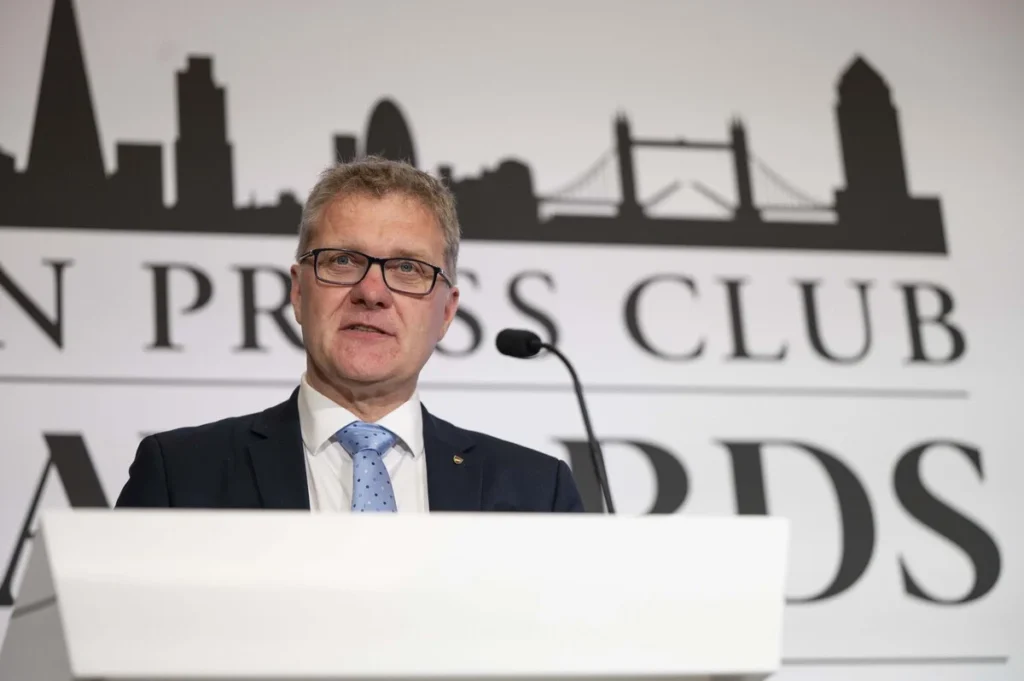
LONDON — In an era marked by aggressive climate targets, rapid urbanization, and sweeping regulatory shifts, the automotive sector often finds itself on the frontline of cultural and economic friction. Nowhere is this tension more palpable today than in the United Kingdom, where the leadership of one of the country’s largest dealership networks has launched a blistering critique against national and local governance, accusing authorities of spearheading a coordinated assault on car ownership.
Robert Forrester, Chief Executive Officer of Vertu Motors, took the stage at the prestigious London Press Club Awards, hosted at Stationers’ Hall near St Paul’s Cathedral. Before an audience of more than 150 editors, senior journalists, and broadcasters, Forrester delivered a pre-budget address that departed sharply from diplomatic convention. Denouncing what he described as an "accumulation of restrictive policies," the CEO culminated his speech with a stark, resonant warning: the United Kingdom is currently fighting a "secret war against motorists."
Forrester’s remarks have reignited a fierce national debate concerning the balance between ecological imperatives and the socio-economic realities of everyday mobility. As the automotive industry navigates its most profound structural transformation since the invention of the assembly line, the friction between policy ideals and consumer realities has reached a critical tipping point.
1. Main Facts and the Core Controversy
The central thesis of Forrester’s address is that while individual regulatory measures may be defended under the guise of public health, road safety, or environmental stewardship, their cumulative effect is deeply damaging. Together, they form an economic and logistical matrix that makes driving significantly more expensive, heavily restricted, and increasingly impractical for the average British citizen.
The Vertu Motors chief executive specifically targeted four pillars of modern British transport policy:
- The Zero Emission Vehicle (ZEV) Mandate: Government-imposed quotas forcing manufacturers to sell escalating percentages of electric vehicles (EVs), backed by punitive fines of up to £12,000 for every traditional petrol or diesel vehicle sold over the threshold.
- Urban Traffic Restrictions: The proliferation of camera-monitored low-traffic neighborhoods (LTNs), most recently highlighted by contentious new traffic filters introduced in Oxford.
- Speed Limits: The widespread, blanket implementation of 20 mph zones across urban and residential areas.
- Pay-Per-Mile Road Pricing: Speculative government proposals aimed at replacing fuel duty with a distance-based taxation scheme, which Forrester dismissed as unnecessarily complex, expensive, and administratively intrusive.
Rather than dismissing these policies as isolated annoyances, Forrester argued that they represent an overarching philosophy that views the private automobile not as a vital utility, but as a public nuisance to be systematically discouraged.
2. Chronology of Events Leading to the Clash
The escalation of tensions between the UK automotive sector and regulatory bodies did not happen overnight. It is the result of a multi-year trajectory driven by net-zero commitments and municipal experimentation.
- 2020–2021 (The Pandemic Shift): During and immediately following the COVID-19 lockdowns, numerous local councils across the UK leveraged emergency powers to rapidly expand cycling lanes, pedestrianized zones, and LTNs. While initially framed as public health measures to aid social distancing, many of these schemes were made permanent, drawing early ire from local businesses and motorists.
- 2022–2023 (The Expansion of 20 mph Limits): Welsh authorities instituted a default 20 mph speed limit across residential roads, setting a precedent that prompted various English local authorities to follow suit, leading to widespread motorist frustration over extended journey times and mechanical inefficiency.
- January 2024 (The ZEV Mandate Takes Effect): The UK government officially launched its ZEV mandate, requiring 22% of new cars and 10% of new vans sold by manufacturers to be zero-emission. This marked the legal transition from consumer-incentive approaches to manufacturer-penalization frameworks.
- August 2024 (Oxford Traffic Filters): Controversial new traffic filters went live in Oxford, restricting private vehicles from passing through specific city center points during peak hours, further stoking anxieties over urban mobility access.
- Late 2024 / Pre-Budget Season (The Pushback): As the Treasury began drafting upcoming fiscal policies and weighing potential pay-per-mile road pricing models to offset declining fuel duty revenues, industry leaders like Robert Forrester mobilized public resistance. His address at the London Press Club Awards marked the crystallization of this industry-wide pushback.
3. Supporting Data and Economic Realities
To understand the weight of Forrester’s warnings, one must examine the sheer scale of the UK automotive sector and the delicate economics underpinning it.
The Scale of the Industry
The British automotive industry remains a cornerstone of the national economy, supporting approximately one million jobs across manufacturing, supply chains, logistics, and retail. Vertu Motors itself is a massive corporate entity within this ecosystem, operating 196 sales and aftersales outlets across the UK and representing over 30 major global brands, ranging from volume manufacturers like Ford and Toyota to premium marques such as BMW, Audi, Land Rover, and Volvo.
The ZEV Mandate Pressure Points
At the heart of the manufacturing dispute is the ZEV mandate’s enforcement mechanism. Under current rules, manufacturers face penalties of up to £12,000 per non-compliant internal combustion engine (ICE) vehicle sold if they fail to meet the mandated electric vehicle sales ratio.
However, consumer adoption rates for electric vehicles have hit speed bumps. High upfront purchase costs, lingering consumer anxiety regarding charging infrastructure availability, and the withdrawal of various government purchase grants have left showrooms overstocked with petrol and diesel models that consumers still overwhelmingly demand.
Furthermore, Forrester highlighted that regulations governing light commercial vehicles (vans) are even more stringent and commercially detached from reality than those for passenger cars. This has severely impacted the domestic light commercial market, threatening small businesses, tradespeople, and delivery networks that rely heavily on affordable utility vehicles.
An Alternative Fiscal Proposal
Addressing the looming prospect of a pay-per-mile taxation system—designed to recoup billions in lost fuel duty as electrification erodes traditional tax revenues—Forrester offered a pragmatic alternative. Rather than tracking motorist mileage via complex, privacy-invasive digital monitoring systems, he advocated for a weight-based vehicle taxation model. Under this approach, annual vehicle taxes would scale directly with the physical mass of the automobile. Forrester argued this system would be vastly simpler to administer, significantly cheaper to implement, and entirely predictable for the consumer.
4. Official Responses and Industry Reactions
The reception to Forrester’s speech has laid bare deep ideological divides within British politics and business.
The Government and Municipal Perspective
Proponents of the current regulatory trajectory—including various urban planners, environmental NGOs, and municipal leaders—maintain that these policies are not "anti-car," but rather "pro-future." Supporters argue that aggressive measures are non-negotiable if the UK is to meet its legally binding carbon reduction targets, combat urban air pollution, and reduce traffic congestion.
Regarding the ZEV mandate, government officials have defended the framework as an essential catalyst to force legacy manufacturers to accelerate innovation, secure green jobs, and establish the UK as a leader in clean mobility technology. Transport departments have consistently emphasized that transitioning away from fossil-fuel reliance is vital for long-term national health and climate resilience.
The Push for Policy Review
Importantly, Forrester acknowledged a small victory: the government has already initiated a formal review of the ZEV mandate. This concession suggests that policymakers are beginning to recognize the commercial squeeze experienced by dealerships and manufacturers. However, industry insiders maintain that superficial tweaks will not suffice; structural reforms are required to align regulatory timelines with genuine market demand.
5. Broader Implications: Freedom, Equity, and the Future of Mobility
Beyond balance sheets and regulatory compliance, Forrester’s speech touched upon a profound philosophical truth regarding the role of the automobile in modern society.
The Automobile as Social Infrastructure
For millions of citizens, particularly those residing outside major metropolitan centers like London, the private car is not a luxury good; it is an indispensable lifeline. In rural and semi-rural areas lacking robust public transport infrastructure, the car guarantees:
- Economic Opportunity: Access to employment centers, industrial parks, and commercial hubs.
- Family Logistics: The ability to transport children to schools, nurseries, and extracurricular activities.
- Healthcare Access: Timely visits to hospitals, general practitioners, and emergency services.
- Social Inclusion: Connection to community networks that would otherwise remain isolated.
By imposing restrictive urban policies, blanket speed reductions, and escalating motoring taxes, critics argue that authorities are inadvertently penalizing working-class and rural communities who have no viable alternatives to private transport. This creates a deeply regressive dynamic where mobility becomes an increasingly expensive privilege rather than a fundamental utility.
The Role of the Fourth Estate
In his closing remarks at Stationers’ Hall, Forrester issued a direct challenge to the gathered journalists. He urged the media to exercise rigorous oversight regarding government transport policies, cutting through bureaucratic rhetoric to expose the tangible, day-to-day consequences imposed on British households. By framing the press as a necessary check on overreaching mobility regulations, he elevated the debate from an industry grievance to a broader democratic concern.
Conclusion: The Road Ahead
The friction articulated by Vertu Motors’ CEO encapsulates the turbulent crosscurrents of 21st-century policymaking. The transition toward sustainable, low-emission transportation is an undeniable global necessity. However, as Robert Forrester’s impassoned address demonstrates, top-down regulatory coercion that ignores commercial realities and grassroots socio-economic dependencies risks alienating the very population it seeks to transform.
Whether policymakers choose to heed these warnings and recalibrate their approach to the ZEV mandate, urban access, and taxation will determine not only the health of the UK’s £1-million-job automotive sector, but also the preservation of affordable, practical mobility for millions of British citizens.
