

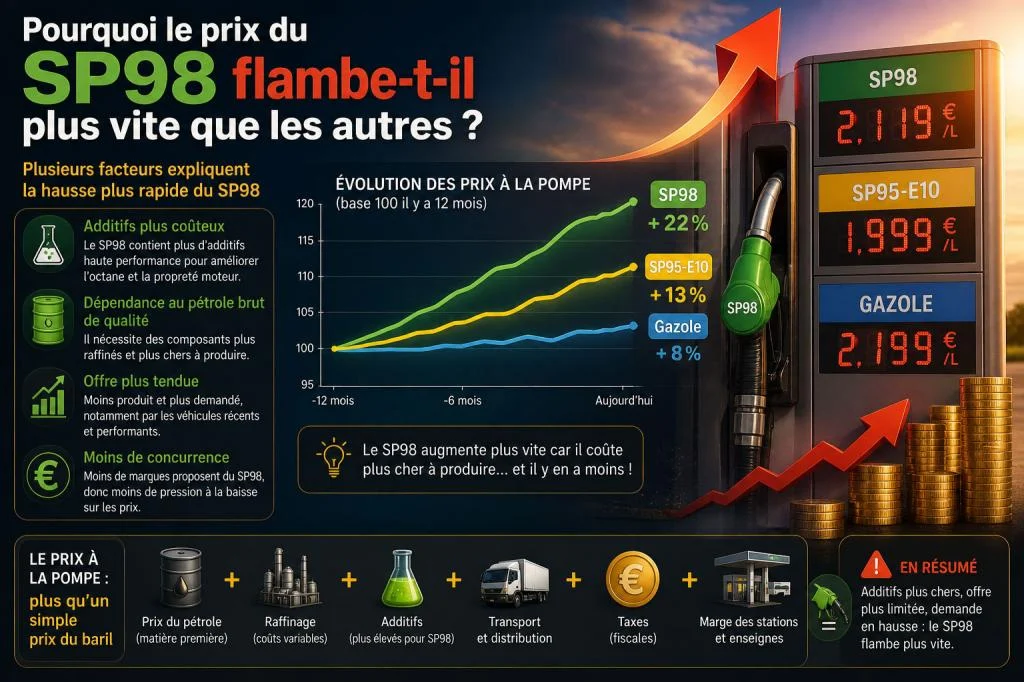
By May 2026, motorists across France have been confronted with a jarring reality at the pump: a widening, seemingly insurmountable price gap between the standard SP95-E10 and the premium SP98. While the E10 attempts to weather the inflationary storm, SP98 has surged well beyond the €2-per-liter psychological threshold. This divergence is not a mere market fluctuation; it is the culmination of a "perfect storm" of refined chemistry, complex logistics, and a shifting fiscal landscape that favors renewable integration over pure fossil fuel performance.
The Core Facts: A Market in Disarray
The primary driver of this price disparity lies in the fundamental composition of the two fuels. Despite the branding, the SP98 is, in essence, the "most petroleum-reliant" fuel available at the average service station.
Chemical Dependency
SP98 contains significantly less biofuel than its counterparts. Even the key additive used in E5 (the precursor to 98)—Ethyl Tert-Butyl Ether (ETBE)—is composed of approximately 53% direct petroleum derivatives. Consequently, when the global price of crude oil rises, the SP98 is exposed to the volatility of that increase across more than 95% of its total volume. In contrast, the SP95-E10, which utilizes a higher percentage of bioethanol, maintains an exposure rate of roughly 90%. In a global market where crude oil prices remain sensitive to geopolitical tensions, this 5% difference in composition acts as a price multiplier for the premium fuel.
Chronology: The Road to the 2026 Price Gap
To understand how we reached this point, we must look at the structural changes implemented over the last several years.
- 2022: The Fiscal Pivot: The replacement of the TICPE (Domestic Consumption Tax on Energy Products) with the new "Accise" system set the stage for a more granular approach to fuel taxation.
- 2023–2024: Industrial Inflation: As energy costs for European refineries skyrocketed due to regional instability and gas price volatility, the costs of the energy-intensive "reformage" and "alkylation" processes used to create high-octane SP98 began to bite into the bottom line.
- Early 2026: The Bio-Fuel Squeeze: As the European Union tightened its requirements for the TIRUERT (Taxe Incitative Relative à l’Utilisation d’Énergie Renouvelable dans les Transports), the fiscal penalty for fuels with lower renewable content became more pronounced.
- May 2026: The Breaking Point: A combination of a sharp rise in crude oil prices and increased refinery maintenance costs caused the SP98 price to decouple from the SP95-E10, resulting in the current record-high spread.
Supporting Data: Why "Premium" Costs More
The production of SP98 is not simply a matter of adding more additives; it is an industrial feat of "haute gastronomie" engineering.
The Energy Cost of Refining
To achieve an octane rating of 98, refineries must employ sophisticated unit processes. Unlike the SP95-E10, which relies on the relatively straightforward blending of ethanol into a base gasoline, the production of SP98 requires extensive "reformage" and "alkylation." These processes are notoriously energy-hungry, requiring massive inputs of electricity and industrial gas.
When energy costs are high, the cost to "cook" a liter of SP98 increases significantly. Because the ETBE used in 98 requires an additional chemical reaction in the factory, the industry faces higher overheads that are passed directly to the consumer at the pump.
The Fiscal Lever: Accise and the "Tax on Tax"
The tax structure in France is designed to favor renewables. The Accise on energy products is compounded by a Value Added Tax (VAT) that is calculated on the total price of the fuel—including the Accise itself. This creates a "tax on tax" effect that disproportionately affects higher-priced products. Because SP98 has a higher base price due to its industrial processing costs, it absorbs a higher absolute amount of VAT, further widening the gap between it and the more "green" fuels.
The "Niche" Effect and Distribution Economics
Beyond the refinery gate, the economics of the service station itself contribute to the price hike.
The Volume Paradox
SP95-E10 has become the undisputed fuel of the masses, representing the vast majority of consumption. SP98, conversely, has shifted into a "niche" category. Transporting and storing a fuel that accounts for less than 20% of sales is logistically inefficient.
Strategic Pricing by Distributors
To remain competitive in a price-sensitive market, fuel retailers often use a "loss-leader" strategy. They intentionally keep the margins on SP95-E10 razor-thin to attract customers to their stations. To compensate for these thin margins, they apply a higher markup on "Premium" fuels like SP98. Furthermore, these margins must cover the weight of mounting regulatory obligations, including:
- CEE (Certificats d’Économie d’Énergie): Obligations to fund energy-saving projects.
- TIRUERT Obligations: Mandatory renewable energy integration quotas.
- Strategic Stockpiling: The costs associated with maintaining national petroleum reserves.
Official Responses and Regulatory Context
Government bodies and regulatory agencies have largely remained silent on the specific price gap, framing it as a natural result of the "polluter-pays" principle. By incentivizing fuels with higher bioethanol content, the state is effectively discouraging the use of high-fossil-content fuels like SP98 through fiscal pressure.
Industry experts point out that the TIRUERT system is functioning exactly as intended:
- The Green Incentive: A fuel is taxed less if it contains more "green" energy.
- The 98 Penalty: Because SP98 contains only about 5% renewable content (via the ethanol in the ETBE), it receives fewer tax breaks than the E10, which boasts a 10% bioethanol content. This difference is not an accident; it is a deliberate policy choice designed to steer the automotive fleet toward fuels that align with European carbon reduction targets.
Implications: What Does This Mean for the Motorist?
For the average driver, the shift in May 2026 provides a sobering lesson in the cost of engine performance.
- Budget Impact: If you drive a vehicle that requires SP98 for optimal engine health or performance, you are no longer just paying for gasoline; you are paying for an industrial, low-renewable, energy-intensive luxury. The price is structure-linked, meaning that if oil or gas prices rise, SP98 will almost always be the first to spike and the last to stabilize.
- Technological Obsolescence: As the price gap widens, manufacturers may face pressure to optimize engines to run on lower-octane fuels, potentially phasing out the need for high-performance, high-cost gasoline in standard commuter vehicles.
- The "Premium" Trap: Owners of sports cars or older vehicles requiring high octane must reconcile the fact that their fuel of choice is now subject to the full brunt of fiscal penalties aimed at fossil fuel reliance.
Summary for the Budget-Conscious
The "E10" is the subsidized, mass-market standard, supported by policy and volume economics. The SP98 is the "refined" choice, burdened by its chemical reliance on oil, the high energy cost of its production, and its status as a niche product in a market pivoting toward greener alternatives. When evaluating your monthly fuel budget, recognize that SP98 is a commodity whose price is math-locked to the highest-cost inputs in the energy chain.
For those who continue to require SP98 for their specific engine requirements, the message from the market is clear: the era of "affordable" high-octane motoring is effectively over. Motorists must now factor the "fiscal and chemical premium" into their ownership costs, acknowledging that the price at the pump is no longer just a reflection of the oil market, but a reflection of the transition away from it.
