

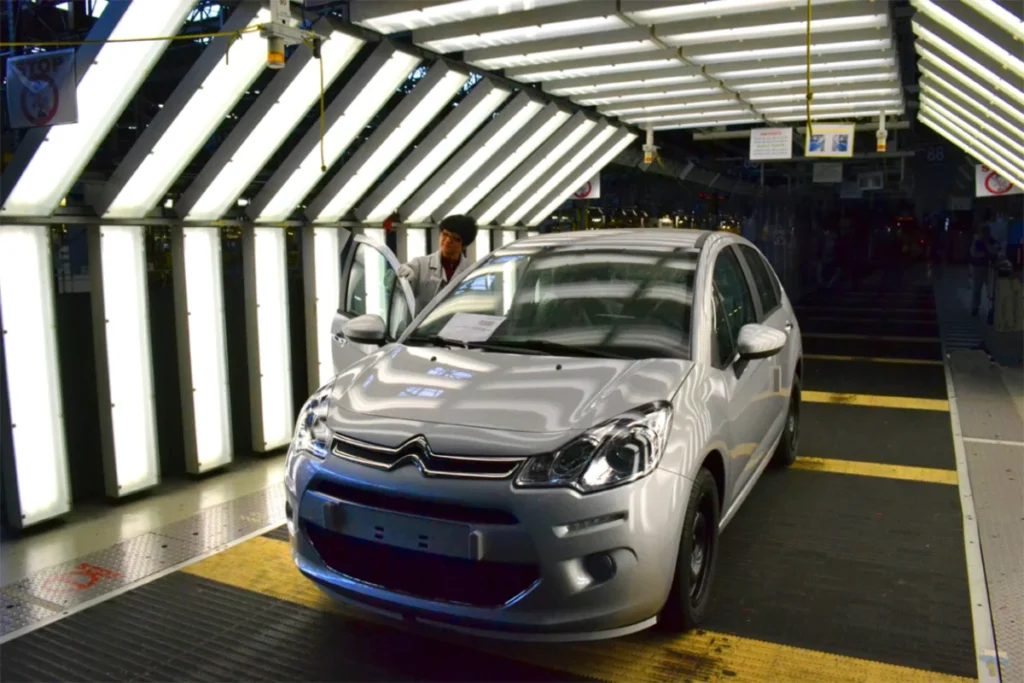
It was 7:00 AM on Friday, October 25, 2013, when the silence finally descended upon the assembly lines of Aulnay-sous-Bois—a silence that felt more like a requiem than a shift change. There were no fanfare-filled ceremonies, no high-ranking executives from the Paris headquarters, and no media cameras capturing the moment. In a stark, industrial departure from tradition, the last vehicle to roll off the line was not met with applause but with the quiet dignity of the men and women who had spent decades keeping the heart of the Seine-Saint-Denis manufacturing hub beating.
The final product was a modest, gray, five-door Citroën C3, equipped with a standard gasoline engine. The workers, marking the end of an era, had simply used a strip of masking tape to scrawl "C3 Héritage" on its flanks. This was the 8,568,391st vehicle to emerge from the facility. With its completion, the assembly line’s counter froze for the final time. In just two minutes, forty years of industrial history were effectively folded away, and the last of the assembly workers turned in their security badges, marking the end of a legacy that had once defined the social and economic landscape of the northern Parisian suburbs.
A Chronology of Industrial Might and Decline
The Genesis: 1973–1980s
Opened in 1973, the Aulnay-sous-Bois plant was designed as a modern solution to the constraints of Citroën’s historic Javel factory, which was cramped along the banks of the Seine and incapable of keeping pace with rising demand. The site was built for scale, and it immediately proved its worth by overseeing the final production stages of the iconic Citroën DS. The last of the 23 Pallas models, featuring electronic fuel injection, were assembled here until the spring of 1975. As the 1970s progressed, the 160-hectare site became a sprawling theater of mass production, eventually dominating the landscape with the assembly of the CX model.
The Peugeot Integration: 1980s–2000s
The absorption of Citroën by the PSA Group (Peugeot-Citroën) fundamentally recalibrated the facility. PSA, seeking to optimize its stamping and assembly processes, pivoted Aulnay toward becoming the primary hub for small, high-volume models. Beginning in 1986, the factory saw the light-gauge steel bodies of the AX roll off the lines, followed by the Saxo and the Peugeot 106. By the early 2000s, the plant was operating at peak capacity, churning out thousands of the first-generation C3 models. At its zenith, the "three-eight" shift system kept the factory alive 24 hours a day, with over 5,000 workers fueling the most significant private employer in the department.
The Death Knell: 2012–2013
The decision to close the plant was handed down in July 2012 by then-CEO Philippe Varin. At the time, PSA was bleeding €200 million in liquidity per month, strangled by the collapse of the automotive markets in Spain and Italy. The group’s calculus was brutal: it possessed too many factories in France relative to its diminishing sales. Furthermore, the cost of producing a B-segment city car in the Parisian suburbs was roughly 25% higher than assembling the same platform in Trnava, Slovakia, or Madrid. The accounting logic left no room for sentimentality, and the closure was scheduled for 2014.
Supporting Data: The Economic Anatomy of a Closure
The closure of Aulnay was not merely a local tragedy; it was a symptom of a broader structural crisis within the European automotive industry. During the height of its operation, Aulnay was a microcosm of the French labor market, acting as a melting pot for generations of suburban workers.
Key metrics of the decline included:
- Production Capacity: At its peak, the factory produced over 1,000 cars daily.
- The Cost Differential: Production in Aulnay was 25% more expensive than Eastern European or Iberian alternatives.
- The Financial Drain: In 2012, the PSA Group was losing €200 million per month, a figure that made the "high-cost" French sites primary targets for consolidation.
- The Final Tally: The cumulative production of 8,568,391 vehicles stands as a testament to the factory’s historical significance to the Citroën brand.
Official Responses and the Failure of Mediation
The announcement in 2012 ignited a firestorm of labor unrest. Beginning in early 2013, the Sud trade union led a fierce, prolonged strike. For four months, the factory became a site of occupation. Production halted, parts piled up, and the French government attempted various mediations to save the site or soften the blow for the workforce.
However, the political and corporate willpower to keep Aulnay open was nonexistent. When work resumed in the spring of 2013, the rhythm of the plant was irrevocably altered. It was no longer a functioning industrial powerhouse, but rather a slow-motion dismantling. The lines moved only to exhaust the remaining inventory—the bins of screws, the wiring harnesses, and the door panels that had languished in the logistics aisles. The government’s attempts to facilitate a "re-industrialization" of the site largely failed to replicate the scale or the nature of the jobs lost, leading to a profound sense of abandonment among the local workforce.
Implications: A Landscape Transformed
The final "C3 Héritage" did not travel to a showroom, nor did it require a car carrier. After undergoing basic quality checks, a technician drove the vehicle a few hundred meters across the internal factory grounds to the Citroën Conservatory, situated on the same plot. It was parked alongside pre-war utility vehicles and failed design studies—a museum piece before it had even left the factory gate.
The implications of this closure were twofold:
1. The Death of Local Industrial Identity
For the surrounding communes in Seine-Saint-Denis, the closure of Aulnay represented the end of a social contract. The factory had provided not just a salary, but a sense of communal identity for thousands of families. Its conversion into urban logistics warehouses—a trend across the Paris region—signified a shift from "making things" to "moving things," fundamentally altering the region’s economic DNA.
2. Corporate Strategy vs. Social Responsibility
The case of Aulnay-sous-Bois remains a landmark study in the friction between globalized capital and domestic labor. The PSA Group’s decision prioritized the survival of the corporation over the continuity of the local community. While the company argued that the move was necessary to prevent total bankruptcy, the human cost was immense. It served as a stark warning to other industrial regions in France that no site, regardless of its history or scale, was immune to the dictates of global market fluctuations.
The Aftermath: The Sursis of the Stamping Workshops
While the final assembly of passenger cars ceased on October 25, 2013, the site did not vanish overnight. In a final, lingering act of utility, the welding and stamping workshops remained operational until mid-2014. These departments continued to produce body components—doors, hoods, and fenders—destined for the PSA spare parts network.
It was only when these stockpiles were deemed sufficient to support the fleet of older C3 models on the road that the heavy machinery was dismantled. The giant presses, which had once formed the shape of millions of French vehicles, were shipped off to other production sites across the PSA network, effectively gutting the factory of its remaining soul. Today, the space serves as a hub for light logistics and urban distribution, a quiet echo of the roar that once defined the northern suburbs of Paris. The "C3 Héritage" remains in the museum, a polished reminder of a time when Aulnay was the heartbeat of the French automotive industry.
