

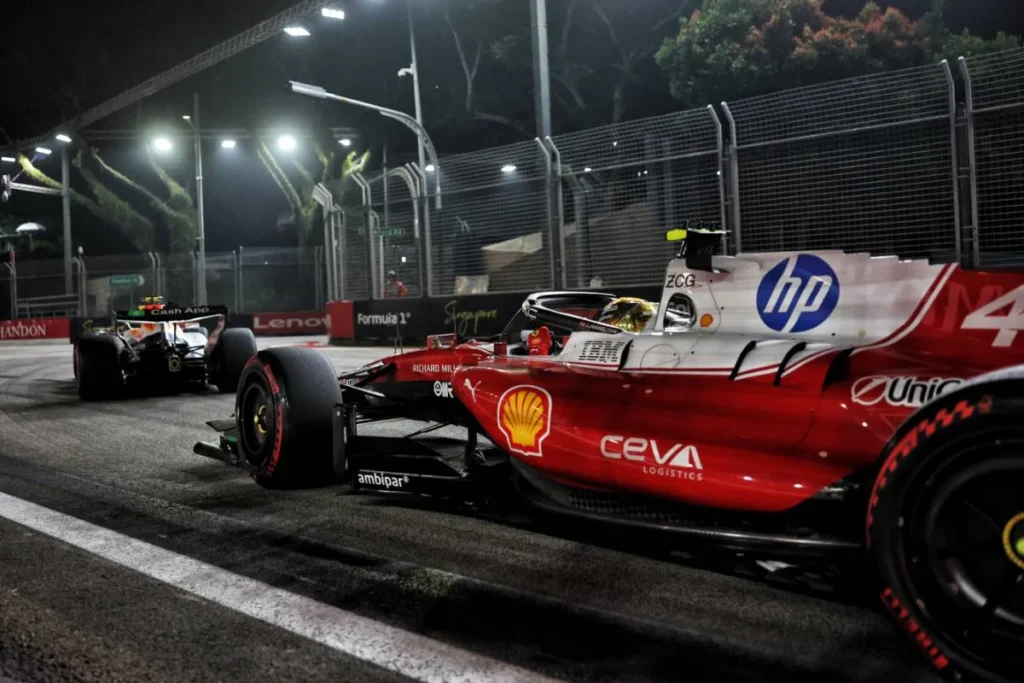
The Formula 1 paddock is often described as a game of high-speed chess, where milliseconds and split-second decisions determine the difference between champagne on the podium and the cold reality of the midfield. At the recent Singapore Grand Prix, the Scuderia Ferrari team found itself staring at the perfect strategic opportunity to solidify a dominant weekend. However, as team principal Frédéric Vasseur later lamented, the best-laid plans of the Maranello engineers were undone not by mechanical failure, but by a critical misjudgment—and a missed pit entry—by Lewis Hamilton.
What could have been a historic double-podium finish for Ferrari behind the indomitable Max Verstappen ultimately dissolved into a sixth-place result for the seven-time world champion. As the dust settles on the Marina Bay Street Circuit, the post-race analysis reveals a complex narrative of weather-affected preparations, tire degradation, and the unforgiving nature of strategic communication in Formula 1.
The Turning Point: The Stroll Incident and the VSC
The central pivot of the Singapore Grand Prix occurred on the 39th lap. Lance Stroll, struggling with a persistent clutch issue in his Aston Martin, was forced to retire his car, leaving it stranded in a precarious position. The race stewards immediately deployed a Virtual Safety Car (VSC) to allow marshals to recover the stricken vehicle.
For the pit wall, a VSC is the "holy grail" of tactical opportunities. It mandates a reduction in speed across the field, effectively slashing the "time cost" of a pit stop by nearly half compared to a green-flag stop. Ferrari had been monitoring the telemetry and the race flow with surgical precision, anticipating such a window. The directive was clear: both Charles Leclerc and Lewis Hamilton were to dive into the pits for a fresh set of tires.
Leclerc, demonstrating the sharpness that has become his trademark, reacted instantly, pulling his Ferrari into the pit lane to switch to fresh rubber. However, trailing his teammate by roughly three seconds, Hamilton failed to mirror the maneuver. He remained on track, soldiering on with tires that had already been pushed to their absolute limit. In that momentary lapse of communication or awareness, the podium finish slipped through his fingers.
Official Perspectives: The Vasseur Critique
Speaking to Sky Sports F1, Frédéric Vasseur was uncharacteristically candid about the missed opportunity. While he acknowledged the brilliance of the team’s overall weekend, he did not shy away from the frustration of seeing a guaranteed result evaporate.
"We had kept both options open depending on a potential Virtual Safety Car. It’s exactly what happened," Vasseur explained. "We asked both of them to come in. We would have finished second and third, but Lewis missed the pit entry. It’s a bit of a shame because that cost him a podium."
The disappointment was palpable. For a team of Ferrari’s stature, the ability to execute dual-stack pit stops is a prerequisite for championship contention. When the driver fails to commit to the lane, the strategic advantage is neutralized. Hamilton, realizing the gravity of the error, reportedly apologized to the team over the radio, acknowledging that his decision to stay out—or his inability to react in time—had effectively ended his pursuit of the top three.
Strategic Uncertainty: The "Tire Lottery"
To understand why Hamilton stayed out, one must look at the chaotic nature of the weekend’s preparation. The Singapore Grand Prix is notoriously difficult to set up for, and this year, the variables were magnified.
Vasseur revealed that the entire grid was operating in the dark regarding tire degradation. "The main problem, and this concerned everyone, was that we were 50-50 on the choice of tires at the start," Vasseur noted. "We had done very few laps during free practice, and we had used the hard tires, which we didn’t end up using in the race."
The situation was exacerbated by the weather during the Sprint race. A heavy downpour forced the field to utilize intermediate tires, stripping the teams of the long-run data they so desperately needed to understand how the medium and soft compounds would behave over a full-length Grand Prix.
"We thought we were going to do a long stint on mediums during the Sprint, but the race took place on intermediates. We all went into the Grand Prix without a real reference on the tires," Vasseur added. This lack of empirical data led Ferrari to put Hamilton on the medium compound to start, a move designed to facilitate a "shifted" strategy—a way to pressure the Red Bull of Max Verstappen later in the race. In hindsight, the soft compound proved to be significantly more resilient and faster, leaving those on the mediums, including Hamilton, at a distinct disadvantage once the rubber began to wear thin.
Chronology of a Fading Podium
The consequences of the strategy gap became evident in the final 15 laps. As Leclerc bolted on his fresh set of tires, he was able to maintain his pace and secure a solid second-place finish. Conversely, Hamilton, left to manage tires that had been in use for 44 laps, found himself in a defensive nightmare.
- The VSC Phase (Lap 39): The gap between the cars is neutralized. Leclerc pits; Hamilton stays out.
- The "Ghost" Second Place: Hamilton momentarily moves into second position as others cycle through stops, giving the illusion of a successful gamble.
- The Degradation Cliff (Laps 45-50): The physical limit of the medium tires is reached. Grip levels drop precipitously, causing the car to slide through the technical corners of the Marina Bay circuit.
- The Final Collapse: Within the closing laps, the lack of traction becomes untenable. Hamilton is systematically hunted down by Charles Leclerc, Kimi Antonelli, and the two McLaren challengers, Lando Norris and Oscar Piastri.
- The Final Tally: Hamilton crosses the line in sixth, a finish that belies the pace he showed during the earlier stages of the weekend.
Implications: A Positive Foundation or a Missed Chance?
Despite the sting of the sixth-place finish, Vasseur is adamant that the overall trajectory of the Scuderia remains upward. The team had been remarkably competitive throughout the entire event, securing second and third positions in the Sprint, the qualifying sessions, and finally with Leclerc’s second-place race result.
"It’s a good weekend," Vasseur insisted. "We finished second and third in the Sprint, second and third in qualifying, then second in the race, without being very far from the third place."
The Ferrari boss recognizes that while they are closing the gap, Max Verstappen remains the benchmark. The challenge for the remainder of the season is to translate this competitive raw pace into error-free execution. The Singapore weekend served as a microcosm of the 2024 season: the speed is there, the car is capable, but the margins for error are razor-thin.
The Road Ahead
The implications for Ferrari are clear. They possess a package capable of challenging for the win, but they must refine their communication and driver-team synergy during high-pressure scenarios like the VSC. Hamilton, for his part, will be looking to bounce back, knowing that a podium was well within his reach had he followed the script written on the pit wall.
As the F1 circus moves to the next venue, the lessons of Singapore will undoubtedly be integrated into the team’s briefing protocols. In a sport where the smallest details are scrutinized under a microscope, Ferrari has learned a hard lesson: in the battle against giants like Red Bull and the surging McLarens, there is no room for hesitation. The "what ifs" of Singapore will haunt the team for a few days, but the evidence of their regained performance remains the most significant takeaway for the tifosi worldwide. Ferrari is back in the fight; they just need to ensure that when the next opportunity arrives, every driver is ready to pull the trigger.
