

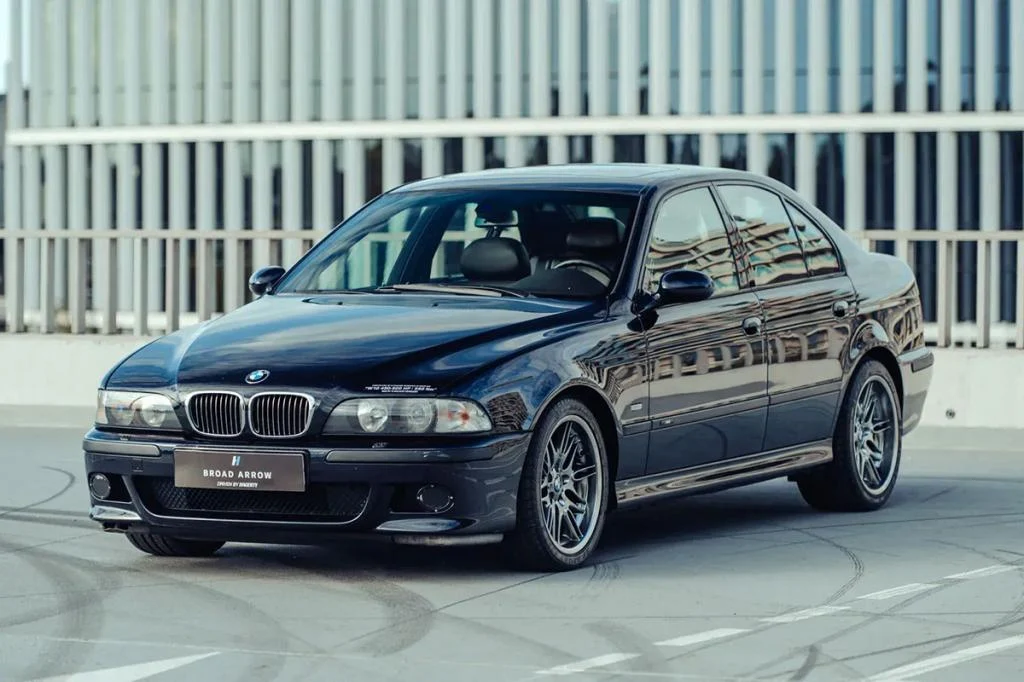
At first glance, the BMW M5 E39 parked quietly under the exhibition lights looks entirely unremarkable. To the untrained eye, it is just another exceptionally well-preserved example of Munich’s legendary late-90s super sedan. Purists glancing beneath its aluminum hood would naturally expect to find the roaring, throttle-responsive 4.9-liter S62 naturally aspirated V8—a powerplant universally celebrated as one of the finest internal combustion engines ever bolted into a passenger car.
Yet, lifting the hood reveals a mechanical plot twist that sounds like internet fiction: nestled snugly inside the engine bay is not a Bavarian V8, but a monstrous, bespoke 5.0-liter W10 engine developed entirely in secret by Volkswagen at the turn of the millennium.
Long before Volkswagen Group would shake the automotive landscape with its quad-turbo W16 Bugatti hypercars and twin-turbo W12 Bentley grand tourers, Wolfsburg was experimenting with modular engine layouts. This unique, road-legal BMW M5 E39 serves as the ultimate automotive crossover episode—a clandestine engineering prototype that bridges two bitter German rivals in the name of avant-garde powertrain development.
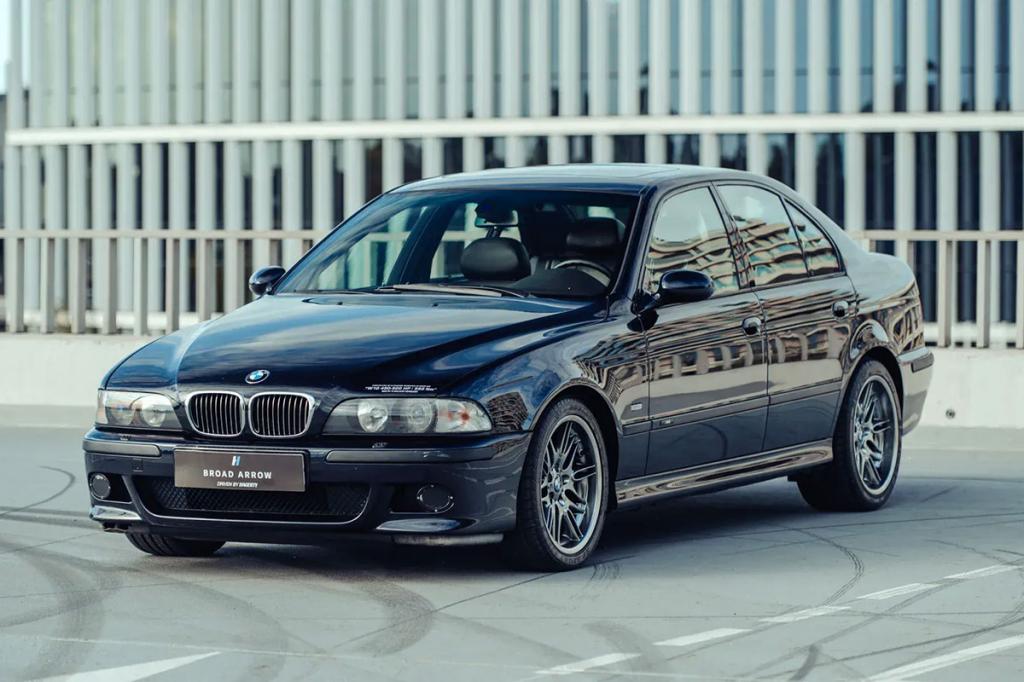
Set to cross the auction block via Broad Arrow Auctions on October 9, 2026, with an estimated hammer price ranging from €250,000 to €350,000, this one-off machine is far more than a quirky tuner special. It is a holy grail of modern automotive archaeology, representing a missing evolutionary link in engine design.
Main Facts: Anatomy of a Wolfsburg Wolf in Bavarian Sheep’s Clothing
To understand the sheer audacity of this project, one must examine the hardware. Volkswagen’s secretive W10 engine was not merely dropped into an M5 chassis as a stunt; it was an exercise in aggressive space-saving and modular engineering.
The Engine Architecture
- Layout: Naturally aspirated W10 (formed by mating two 2.5-liter VR5 engines).
- Displacement: 5.0 liters (4,996 cc).
- Power Output: 480 horsepower.
- Torque: 592 Nm (437 lb-ft).
- Block Philosophy: Derived from the narrow-angle VR architecture (famously utilized in the Golf 4 GTI’s VR6 and VR5 units), the W configuration allowed Volkswagen to cram ten cylinders into the physical footprint typically reserved for a V6 or compact V8.
The Drivetrain and Chassis
Despite housing a Wolfsburg heart, the car remains mechanically faithful to its BMW roots where it counts most for driving enthusiasts. Power is sent exclusively to the rear wheels via a traditional Getrag six-speed manual transmission, retaining the pure, unadulterated rear-wheel-drive dynamics that made the E39 M5 an industry benchmark.

However, its life as a development mule has left a distinct patina. Unlike preserved museum pieces, this M5 shows clear signs of hard engineering use. The front end bears the minor battle scars of high-speed testing, and the interior cabin diverges from standard factory specifications, featuring custom instrumentation and a modified odometer designed to monitor the experimental W10’s vitals during rigorous dyno and track sessions.
Chronology: How a BMW M5 Became Volkswagen’s Secret Testbed
The genesis of this bizarre union dates back to late 1999. Under the ambitious and uncompromising leadership of Ferdinand Piëch, the Volkswagen Group was undergoing a massive, high-end transformation. Piëch was determined to elevate VW and its sister brands into territory traditionally dominated by Mercedes-Benz and BMW.
1999: The Acquisition and the Brief
Volkswagen’s engineering division acquired a stock BMW M5 E39. At the time, the E39 M5 was universally recognized as the undisputed king of performance sedans. Rather than benchmarking it, Piëch wanted to out-engineer it. While an obvious route would have been dropping a modified Audi V8 under the hood and slapping on a turbocharger, Piëch found such conventional solutions pedestrian.

Instead, Volkswagen’s powertrain masterminds were tasked with exploring modular multi-cylinder architectures. The goal was to prove the scalability of the VR engine family—narrow-angle engines that staggered cylinders in a single zigzag cylinder head.
2000–2002: Development and Prototyping
Volkswagen reportedly poured an estimated €2 million into the clandestine W10 project. Engineers took two 2.5-liter VR5 blocks (the 5-cylinder variants of the iconic VR6 found in models like the Golf 4 GTI) and mated them at a precise angle on a common crankshaft.
Out of this intensive R&D phase, only three W10 engines were ever physically manufactured. Of those three, only one single prototype was successfully installed, integrated, and homologated into a road-going vehicle: the silver BMW M5 E39 in question.

Testing and Personal Use
Once the conversion was finalized, the car was subjected to intensive testing regimens at Volkswagen’s private facilities. Its performance envelope was thoroughly evaluated, pushing the limits of the chassis and cooling systems. So attached was the leadership to the project that Ferdinand Piëch reportedly commandeered the car for personal use, driving the wolf-in-sheep’s-clothing M5 as his daily driver for a period.
Supporting Data & Technical Specifications
| Category | Specification Details |
|---|---|
| Make / Model | BMW M5 E39 (Volkswagen W10 Prototype) |
| Engine Type | Naturally aspirated W10 (Dual VR5 configuration) |
| Engine Displacement | 5.0 Liters |
| Peak Power | 480 hp |
| Max Torque | 592 Nm |
| Transmission | 6-speed manual |
| Drivetrain | Front-engine, rear-wheel drive (FR layout) |
| Total W10 Engines Built | 3 units globally |
| Road-Going Prototypes | 1 unit |
| Estimated Development Cost | ~€2,000,000 |
| Auction House | Broad Arrow Auctions |
| Auction Date | October 9, 2026 |
| Pre-Sale Estimate | €250,000 – €350,000 |
Official Responses and Industry Implications
While Volkswagen never publicly marketed a W10 engine for its mainstream passenger cars, the legacy of this M5 prototype reverberates deeply across automotive history.
Internal engineering debriefs from the era highlight that the W10 project was never truly intended for serial production in a BMW chassis. Rather, it was a technological proving ground—a proof-of-concept stepping stone designed to validate the modular "W" engine architecture before investing astronomical sums into more ambitious commercial ventures.
The data gathered from squeezing a W10 into the confines of an E39 engine bay directly paved the way for Volkswagen’s most legendary modern powerplants:
- The W12: Developed by fusing two VR6 blocks, this engine became the beating heart of the Bentley Continental GT, Flying Spur, and various high-end Audi flagships.
- The W16: By scaling up the modular philosophy, Volkswagen created the quad-turbocharged W16 engine that powered the hypercar dynasty, starting with the Bugatti Veyron and culminating in the Chiron.
In this light, the BMW M5 W10 is the literal genetic ancestor of some of the fastest production cars ever built. Without this secretive Bavarian sedan acting as a guinea pig in Wolfsburg’s labs, the Bugatti Veyron might never have achieved its groundbreaking 1,001-horsepower milestone in the exact mechanical package it did.
Conclusion: A Priceless Relic of Corporate Espionage and Engineering Hubris
As the automotive world pivots rapidly toward electrification, internal combustion oddities like the Volkswagen-powered BMW M5 E39 capture a bygone era of fearless corporate engineering. It represents a time when billionaire executives could authorize multi-million-euro skunkworks projects simply to test the limits of what was mechanically possible.
For collectors, the October 9, 2026 auction by Broad Arrow Auctions presents a once-in-a-lifetime opportunity. Valued conservatively between €250,000 and €350,000, the car commands a premium not for its pristine cosmetic condition, but for its unmatched historical narrative. It is a Frankenstein’s monster built by automotive giants—a German executive sedan that marries Munich handling with Wolfsburg witchcraft.
Whether it ends up in a private collection or a manufacturer’s heritage museum, this singular M5 will forever stand as a testament to engineering curiosity, proving that sometimes the most fascinating chapters in car history are written in secret.
