

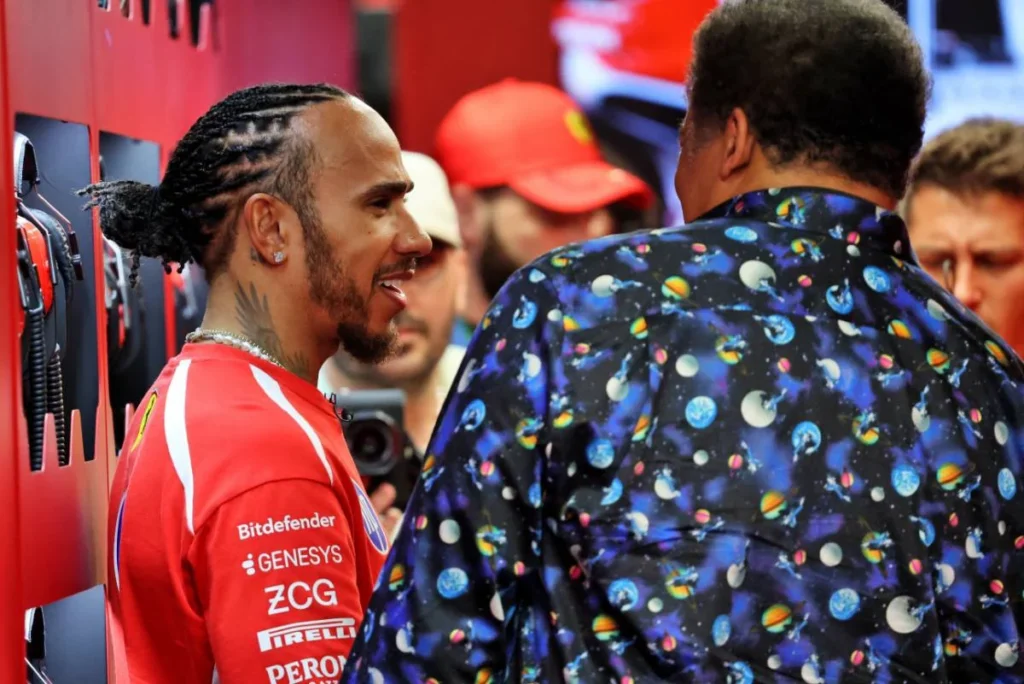
In the high-stakes theater of Formula 1, longevity is often a double-edged sword. For seven-time world champion Lewis Hamilton, the 2026 season represents a critical juncture in a career that has already rewritten the history books. After a challenging introductory campaign with Ferrari, the British legend has shown signs of a renaissance this year, appearing more harmonious with the latest iteration of Maranello’s engineering. Yet, despite a podium finish in Shanghai and a marked improvement in his race pace, the murmurs of doubt from the paddock are growing louder—and more authoritative.
Leading the charge of skeptics is former F1 driver Ralf Schumacher, whose recent assessment of Hamilton’s long-term viability has sent shockwaves through the sport. Schumacher’s critique is not merely a passing comment; it is a fundamental challenge to the belief that Hamilton can sustain a championship-level performance against his teammate, Charles Leclerc, over the grueling duration of a full season.
The Evolution of the 2026 Campaign: A Closer Look
To understand the current tension, one must look at the trajectory of Hamilton’s performance. Following a 2025 season marred by integration struggles and a lack of familiarity with the Scuderia’s specific operational philosophy, the 2026 season began with a more promising narrative. The cars are faster, more agile, and, according to team telemetry, better suited to Hamilton’s late-braking driving style.
The Shanghai podium was a significant milestone, serving as a reminder that the "Sir Lewis" magic has not entirely evaporated. He has shown a superior ability to manage the delicate Pirelli rubber under the new aerodynamic regulations, a skill that previously defined his dominance during his Mercedes tenure. However, while these flashes of brilliance satisfy the casual observer, they do not necessarily equate to the sustained consistency required to dethrone a driver of Charles Leclerc’s caliber.
The Schumacher Verdict: A Harsh Reality Check
Speaking on the Backstage Boxengasse podcast for Sky Sports Germany, Ralf Schumacher offered a candid, albeit brutal, analysis of the situation. Schumacher, known for his no-nonsense approach to driver management, argues that the gap between Hamilton’s peak and his current baseline is becoming increasingly difficult to bridge.
"I have to be honest: Hamilton is clearly in better form this year, there is no doubt about that," Schumacher noted. "But on the scale of an entire season and in the long term, he has no chance against Leclerc. It is simply the reality."
Schumacher’s argument hinges on the intersection of age and natural decline. At 41, Hamilton is competing against a grid that is getting younger, faster, and more aggressive. While experience is an asset in tactical race management, the raw, instinctive speed required to beat a teammate like Leclerc—who is currently in the absolute prime of his career—is often the first casualty of the aging process.
Beyond Hamilton: The Call for a Generational Shift
The criticism leveled at Hamilton was not an isolated incident; it was part of a broader manifesto from Schumacher regarding the state of the F1 grid. Fernando Alonso, another veteran who has defied the odds for two decades, was also in the crosshairs.
Schumacher’s sentiment is clear: the sport is reaching a saturation point where the presence of legendary figures may be hindering the ascent of the next generation. "It’s time. Even if they surely don’t want to hear it," Schumacher stated. "Hamilton and Alonso have had magnificent careers in Formula 1, but I think it is time to free up the cockpits for the young drivers."
This perspective touches on a recurring theme in F1: the tension between honoring the past and investing in the future. With talents like Oliver Bearman waiting in the wings, the question arises whether Ferrari—and by extension, the sport—is prioritizing commercial marketability and heritage over the pure, unbridled potential of rising stars.
The Bearman Factor: A Succession Plan in Motion?
The name Oliver Bearman has become synonymous with the "next big thing" at Ferrari. Having impressed in every category he has touched, the young Briton is already being touted as the natural successor to the seat currently occupied by Hamilton.
Schumacher, for one, is a vocal proponent of this transition. "Oliver Bearman really deserves his chance at Ferrari," he argued. He further posited that introducing a talent like Bearman wouldn’t just be a symbolic changing of the guard; it would provide a genuine, high-octane challenge to Leclerc that could force the Monegasque driver to reach new heights. The dynamic between a seasoned veteran and a hungry rookie is a classic F1 trope, but in the case of Bearman and Leclerc, it could be the catalyst that finally brings the Constructors’ Championship back to Maranello.
Implications for Ferrari’s Strategic Direction
For the leadership at Maranello, this presents a delicate balancing act. Ferrari has historically favored the weight of experience, yet their recent history of near-misses in the championship hunt suggests that perhaps a different approach is needed.
If Hamilton fails to maintain his momentum or if the gap to Leclerc widens as the season progresses, Ferrari will face an agonizing decision. Do they honor the contract of a seven-time champion, or do they acknowledge the inevitable and accelerate their transition to the future? The commercial fallout of replacing a driver of Hamilton’s stature would be immense, yet the sporting cost of stagnating is arguably higher.
The Burden of History
Hamilton’s position is unique. He is not just a driver; he is an institution. Every race he runs is a test of his legacy. As he enters the mid-point of the 2026 season, the pressure is not just to win races, but to prove that he remains the definitive benchmark for the sport.
The critics, like Schumacher, are essentially asking if the hunger remains. In Formula 1, the difference between a podium and a win is often found in the mental fatigue that sets in after 15 or 20 years of relentless competition. Hamilton has successfully reinvented himself before, but this time, he is not just fighting the regulations or his rivals—he is fighting the clock.
Conclusion: A Season of Reckoning
The remainder of the 2026 season will serve as the final verdict on this debate. If Hamilton can find the consistency to consistently out-pace or equal Leclerc, he will silence the skeptics and justify his seat at the top table. If he falters, the narrative of "time to step aside" will likely become an deafening chorus that even the most resilient champion will find impossible to ignore.
As the circus moves from Shanghai to the classic European circuits, the eyes of the world remain fixed on the Ferrari garage. It is here that the future of Formula 1 is being negotiated, one lap at a time. Whether Hamilton leaves on his own terms or is pushed by the sheer force of youth, one thing is certain: the era of the titans is sunsetting, and the next chapter of F1 is being written in the high-speed corners of a changing grid. The question is not whether the young will eventually take over, but whether the legends have enough left to ensure they go out on their own terms.
