

By Hugues Chaussin
Main Facts: The Diamond in the Rough of French Sports Car History
In the pantheon of storied French automotive marques, few evoke as much passionate romanticism—or remain as delightfully obscure—as Chappe et Gessalin (CG). Recognized by their proud Gallic rooster emblem, this boutique family-run enterprise captured the essence of light-footed, rear-engined French sports car engineering during an era when giants roamed the earth. This year marks the diamond jubilee of the brand: six decades since the Chappe brothers and their partner Amédée Gessalin cemented their legacy.
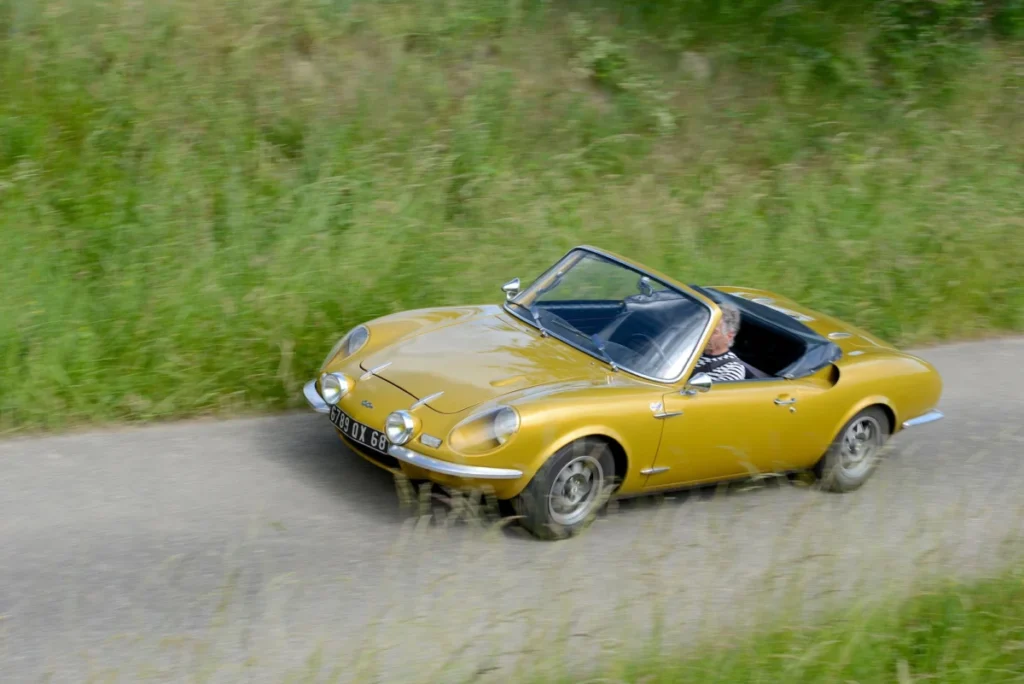
To honor this milestone, we turned our photographic lenses and historical archives toward one of the rarest gems of the marque’s production run: a breathtaking CG 1200 S Spider finished in a mesmerizing "Old Gold" (vieil or) hue.
The story of CG is not merely one of horsepower and torque figures; it is a testament to artisanal perseverance. Born out of the coachbuilding mastery of the Chappe family—who had previously sculpted fiberglass bodies for pioneers like Deutsch & Bonnet (D.B) and Alpine—CG was supposed to be their definitive step into independent manufacturing. Instead, it became a turbulent, highly creative high-wire act. The brand’s trajectory shifted from a timid, underpowered initial offering to a fierce competitor on rally stages across France, backed by an unlikely corporate partnership with Simca and immortalized by an official logo designed by none other than Asterix creator Albert Uderzo.
Chronology: From Humble Beginnings to the High-Flying 1200 S
1965–1966: The Genesis and the Paris Salon Miscalculation
The first conceptual sketches of what would become a CG automobile were drawn in mid-1965. Fueled by ambition and decades of composite-material expertise, the team moved at a blistering pace. Just fifteen months later, in October 1966, the wraps came off the brand’s maiden creation at the Paris Motor Show.

Unfortunately, reality dealt the founders a harsh blow. The public reception was lukewarm at best. Both the styling and the modest 40 horsepower pulsing from its entry-level mechanicals felt far too timid for a populace increasingly hungry for visceral thrills. The car simply lacked the aggressive DNA expected of a dedicated sports machine. Realizing they had misjudged the market, the team quickly pivoted: if they wanted to survive alongside heavyweights like Alpine and René Bonnet, they had to build genuine sports cars.
1967–1968: The Pivot to Performance
The first step in this frantic evolution was the creation of a hard-top to transform the soft cabriolet into a streamlined coupe. Unveiled in October 1967 as the Sport 1000, this iteration was drastically lightened through extreme interior simplification. Yet, retaining the stock engine meant it still failed to spark the hearts—and wallets—of prospective buyers.
The breakthrough arrived when a formal partnership with Simca was secured in 1968. This alliance proved to be an absolute windfall, granting CG access to the mechanical arsenal of the Simca 1200 S coupe.
To remain competitive, CG needed a machine capable of dominating light sports categories. Fitted with the new Simca powerplant, the resulting CG 1200 S (Type B1200) unleashed 80 horsepower. Weighing a featherlight 660 kilograms—just 20 kg more than the A1000—the car transformed dynamically. It blasted from a standstill to 1,000 meters in a staggering 31.5 seconds, topping out at 185 km/h.
Esthetically, the 1200 S distanced itself from the earlier 1000 model with a commanding four-headlamp setup, a distinctive "mouth" integrated into the front valance to feed a newly front-mounted radiator, and the elimination of the awkward rear-engine hood bulge required by the A1000’s induction setup. Handling was similarly upgraded, with the rear suspension revised to incorporate four dedicated shock absorbers.

1968–1974: Golden Years, Rally Glory, and the Twilight of Production
When the high-performance CG debuted at the 1968 Paris Motor Show, the public reaction was instantaneous and euphoric. The aggressive front fascia and a vertical rear window flanked by fastback-style body contours gave the car an unmistakable road presence.
Late in 1968, distribution received a monumental boost. An agreement was struck with Simca’s corporate leadership, allowing CG cars to be sold directly through Simca’s extensive network of subsidiaries and dealerships across France, backed by an official two-year factory warranty.
Competition success swiftly followed. Driver Michel Liochon piloted a Brie-built CG to a sensational fourth-place finish at the demanding Rallye des Routes du Nord. Soon after, thanks to the intervention of Chrysler France Marketing Director William Reiber, CG cars were officially integrated into the prestigious Challenge Simca motorsport program. This elevated their visibility on the tarmac and firmly stamped Simca’s marketing image with a youthful, high-performance GT veneer.
Production numbers, though artisanal, surged compared to earlier efforts. While the initial A1000 trickled out at roughly 20 units per year, the 1200 S more than quadrupled output, averaging 70 units annually. Out of approximately 280 B1200 models to roll out of the Seine-et-Marne workshop, a mere thirty were spiders—twenty featuring fold-down canvas soft-tops and the remainder utilizing removable hard-tops.
Supporting Data: The Numbers Behind the Legend
To truly understand the engineering achievement of Chappe et Gessalin, one must examine the metrics that defined their machines on both road and track:

- Development Timeline: 15 months from initial sketch to the October 1966 Paris Salon debut.
- CG A1000 Production Volume: ~20 units per year.
- CG 1200 S (B1200) Production Volume: ~70 units per year, totaling roughly 280 units produced during its lifecycle.
- CG 1200 S Spider Rarity: Only ~30 spiders built out of the 280 total B1200 production (20 soft-tops, 10 hard-tops).
- Curb Weight: 660 kg (B1200), offering an exceptional power-to-weight ratio for its era.
- Engine & Performance Evolution:
- Early A1000: 40 hp.
- 1968 B1200: 80 hp, 185 km/h top speed, 0–1,000m in 31.5 seconds.
- Later 1200 S (1969–onward): 85 hp, 188 km/h top speed, 0–1,000m in 31.3 seconds.
- Motorsport Milestones: First major competition finish achieved by driver Michel Liochon at the Rallye des Routes du Nord (4th place), leading to factory backing in the Challenge Simca.
Official Responses and Corporate Synergy
The survival and relative prosperity of Chappe et Gessalin in the late 1960s were inextricably linked to institutional backing from industrial heavyweights. The partnership forged with Simca—and subsequently overseen by Chrysler France—transformed CG from a backyard coachbuilder into a semi-official manufacturer with elite motorsport credentials.
William Reiber, then Marketing Director of Chrysler France, recognized the cultural cachet that a boutique sports car brand could bring to Simca’s broader commercial portfolio. In contemporaneous corporate statements, Chrysler executives emphasized that supporting niche manufacturers like CG injected an aura of youthful dynamism and sporting pedigree into mass-market showrooms.
Furthermore, the decision by Simca to extend its own rigorous two-year factory warranty to the CG 1200 S served as an unprecedented vote of confidence. It signaled to consumers that these lightweight fiberglass specials were not fragile kit cars, but thoroughly engineered, reliable GT machines capable of standing shoulder-to-shoulder with established French sporting icons.
Implications: The Enduring Legacy of an Artisanal Vision
Though Chappe et Gessalin ceased automobile production in 1974 due to the shifting economic realities of the 1973 oil crisis and tightening regulations, their footprint on automotive history remains indelible.
Today, surviving examples of the CG 1200 S—especially ultra-rare coachbuilt variants like the "Old Gold" Spider photographed by Hugues Chaussin—are treated as holy grails by collectors of French automotive heritage. They represent a vanishing epoch of automotive passion: an era when a tight-knit family, a handful of clever engineers, and a generous supply of fiberglass could partner with a major industrial player to punch well above their weight class.

As we celebrate the 60th anniversary of the founding of Chappe et Gessalin, the rooster still crows proudly. The legacy of the Chappe brothers and Amédée Gessalin lives on through every restored chassis, echoing the spirited exhaust note of a golden era when French lightweight sports car design was second to none.
For the complete, unabridged feature story, photography gallery, and archival deep-dive, refer to issue no. 350 of Gazoline magazine, available via their official online store.
