

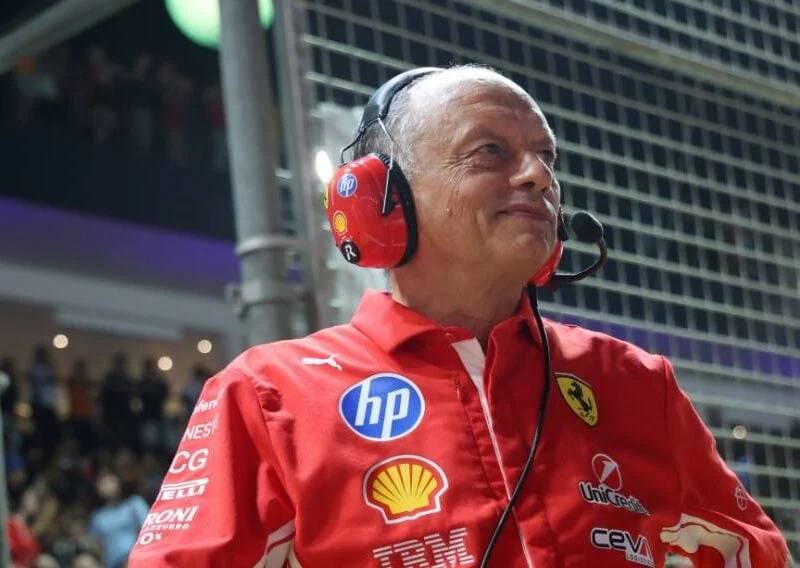
The dust has barely settled on the Marina Bay Street Circuit, but the fallout from the Singapore Grand Prix continues to dominate the Formula 1 paddock conversations. While the race results saw a familiar name atop the podium, the narrative surrounding the Scuderia Ferrari camp has shifted toward internal accountability and the high-stakes friction between the pit wall and the cockpit.
At the heart of the storm is Lewis Hamilton’s sixth-place finish—a result that many observers believe robbed the team of a double-podium celebration. Under immense pressure from the media, Ferrari team principal Frédéric Vasseur has mounted a robust defense of his squad’s operational choices, explicitly refuting claims that the team mismanaged the seven-time world champion’s race.
The Anatomy of a Strategic Miscalculation
The race weekend in Singapore was defined by ambiguity. Due to a chaotic Sprint format and fluctuating weather conditions, teams arrived at the main event with a significant data deficit. The traditional long-run simulations, usually conducted during Free Practice 2, were compromised, leaving engineers to navigate the complexities of tire degradation on a "blind" basis.
Ferrari entered the race with a dual-pronged approach. Max Verstappen and Charles Leclerc were equipped with soft-compound tires, while Lewis Hamilton was sent out on mediums. The logic was clear: in a race where track position is paramount and overtaking is notoriously difficult, splitting the strategies allowed Ferrari to cover all tactical bases against the dominant Red Bull pace.
However, the medium tires failed to provide the expected performance window. By the 18th lap, it became evident that the degradation was higher than initial models predicted. Ferrari, sensing the shift, prepared to pivot. But the race took a decisive turn when an incident involving Lance Stroll triggered a Virtual Safety Car (VSC). This was the golden window—the "free pit stop" that every strategist dreams of.
A Critical Communication Breakdown
The crux of the controversy lies in the moments during the VSC. According to Vasseur, the Ferrari pit wall issued a clear instruction to both drivers: enter the pits. While the team successfully managed the transition for the rest of the garage, the directive to Hamilton went unheeded.
"We were running second and third on the track," Vasseur explained during a heated post-race media session. "We asked both drivers to pit under the Virtual Safety Car. One of them replied that he preferred to stay out, and he subsequently missed the entry to the pits. Do not put the blame on the team."
This revelation serves as a stark reminder of the split-second decision-making required in modern F1. When a driver is in the "flow state" of a race, balancing the sensory input of the car with the strategic mandates from the engineer, the margin for error is non-existent. Hamilton’s decision to override the call, while ultimately detrimental to his final position, highlights the autonomous pressure placed on drivers when they feel the car’s feedback contradicts the telemetry on the pit wall.
The Media Scrutiny: Vasseur Loses Patience
The atmosphere in the media pen was palpably tense. Journalists, sensing a potential rift between the team and their star driver, pressed Vasseur on whether the team had issued a follow-up order to mitigate the damage once it became clear the medium tires were failing.
Vasseur, known for his pragmatic and often blunt management style, did not suffer the interrogation gladly. In a sharp retort, he challenged the consistency of the press: "Did you ask as many questions to McLaren yesterday?" he quipped, referencing the earlier on-track collision between Lando Norris and Oscar Piastri.
When asked specifically if Ferrari had forced a second, mandatory call for a pit stop as Hamilton’s tires began to fall off a cliff, Vasseur was categorical in his denial. "No, no, no. We were simply monitoring the situation," he stated. The team found themselves in a state of strategic purgatory: they were unsure if the tires could endure the remainder of the race, but they were also hesitant to force a stop that would drop Hamilton into the heart of the midfield traffic, effectively ending his chances of a competitive recovery.
The Reality of the Result
As the laps dwindled, the lack of grip became insurmountable. Hamilton’s defense faltered, and he was systematically picked off by Kimi Antonelli, Lando Norris, and Oscar Piastri. The once-promising race ended with the Briton crossing the line in sixth, a result that leaves a bitter taste given the pace Ferrari demonstrated earlier in the weekend.
The lack of hard data regarding tire degradation proved to be the team’s undoing. Vasseur admitted that the team was forced into an improvised tactical plan. "The choice of tires was difficult," he noted. "Like everyone else, we had run on the hards during the first free practice, and we were effectively flying blind concerning the mediums and softs."
By splitting the strategies, Ferrari was attempting a bold maneuver to challenge the status quo. While it backfired for Hamilton, the team remains confident that the decision to diversify was mathematically sound given the information available at the time.
Acknowledgment and Accountability
Perhaps the most significant aspect of the aftermath was the internal reconciliation between the driver and the team. In the world of high-stakes racing, radio transcripts are often scrutinized for signs of dissent. However, Vasseur was quick to neutralize any rumors of a fractured relationship.
"The driver himself apologized," Vasseur revealed. "At the radio, he clearly said: ‘I’m sorry, I let you down, it was my decision.’ The message was clear, and the driver apologized for having let the team down."
This admission from Hamilton is crucial. It effectively closes the chapter on the external narrative of "team error." In the high-pressure environment of a Grand Prix, the driver has the final say on the physical act of entering the pit lane. By taking ownership, Hamilton has allowed the team to move past the finger-pointing phase and focus on the technical analysis of why the medium tires performed so poorly—a critical piece of data for the remainder of the season.
Implications for the Future
The Singapore Grand Prix serves as a case study in the complexities of team-driver dynamics. For Ferrari, the priority now shifts toward refining their communication protocols during neutralizations. While the pace of the SF-24 has been promising, the ability to execute perfect pit stops under the unpredictable conditions of a VSC remains a differentiator between podium contenders and race winners.
As the circus moves to the next destination, the focus for the Scuderia will be on optimizing their tire management models. The technical team will undoubtedly pore over the telemetry from the medium tires to understand the heat-soak and degradation curves that forced such a volatile strategic situation.
For Lewis Hamilton, the focus is on bouncing back. His candid admission of responsibility speaks to his maturity as a driver—a rare trait in an era where excuses are the default. As the team looks to close the gap on their rivals, the synergy between the pit wall and the cockpit will be tested time and again. If there is one takeaway from the Singapore weekend, it is that while the strategy may be formulated in the garage, it is won and lost in the split second the driver decides whether or not to turn into the pit lane.
Ferrari leaves Singapore with a solid second-place finish for Charles Leclerc, but they depart with the lingering question of what could have been. For Frédéric Vasseur, the mandate is clear: defend the team, trust the drivers, and ensure that when the next VSC appears, there is no ambiguity left in the comms.
