

By The Editorial Team | June 30, 2026
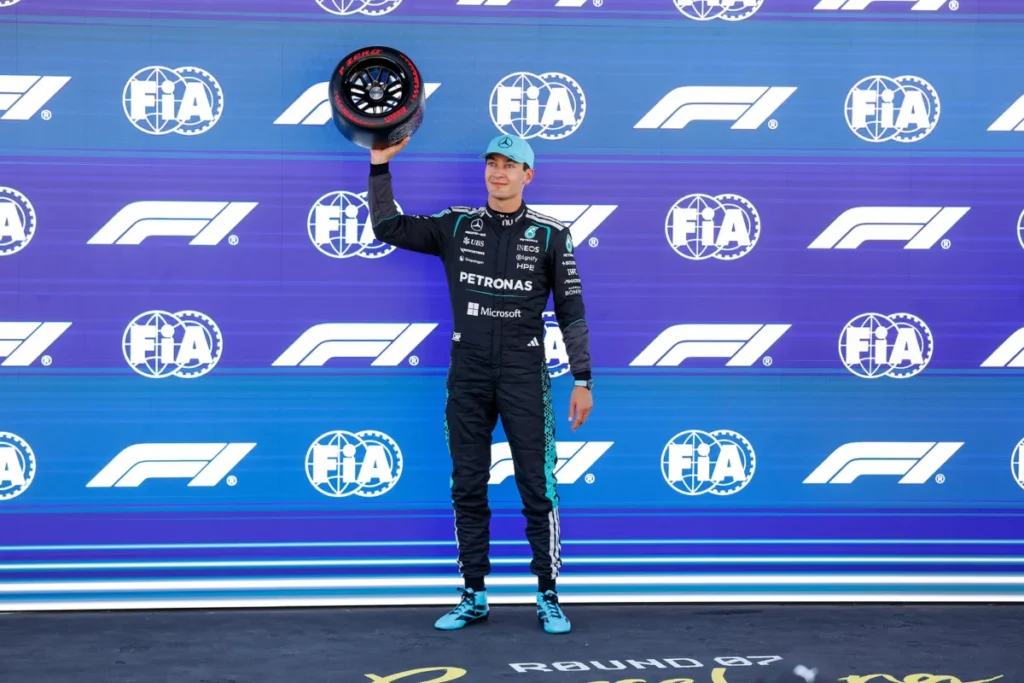
The Circuit de Barcelona-Catalunya served as the stage for one of the most intense qualifying sessions of the 2026 Formula 1 season this Saturday. In a display of precision and composure, George Russell snatched pole position for the Spanish Grand Prix, halting a wave of momentum from his rivals and asserting his dominance on a track where technical perfection is non-negotiable.
Following a challenging weekend in the streets of Monaco, the Mercedes driver arrived in Spain with a point to prove. His performance was not merely a result of the final Q3 push, but a masterclass in consistency, having topped the timesheets in both FP1 and FP3. As the sun set over the Catalan landscape, the margins between the front-runners were razor-thin, setting the scene for a Sunday showdown that promises to be a defining moment in the championship narrative.
The Chronology of a High-Stakes Saturday
Q1: Chaos and the Fall of a Local Hero
The opening segment of qualifying began under a scorching Mediterranean sun. With high track temperatures, the asphalt offered little grip, leading to significant thermal degradation of the Pirelli tires. Drivers struggled to keep their machines within the white lines, turning the session into a test of patience and car balance.
Lewis Hamilton, looking resurgent in his Ferrari, set the pace early, signaling that the Scuderia had found the sweet spot for a single-lap burst. However, the session proved disastrous for Aston Martin. In a shocking turn of events, Fernando Alonso—the local hero—was eliminated in the first segment. It marked a historic low for the Spaniard, who was out-qualified by his teammate Lance Stroll for the first time in 42 consecutive race weekends. The home crowd’s silence spoke volumes as the Aston Martin garage struggled to explain the lack of pace.
Elsewhere, Esteban Ocon’s struggles with the Haas continued, failing to progress beyond 17th. Williams’ Alex Albon also faced an early exit, while the Cadillac pair of Sergio Pérez and Valtteri Bottas found themselves at the very bottom of the timing screens, highlighting the ongoing technical hurdles for the American-backed team.
Q2: The Fine Margins of Progress
As the field narrowed, the competitive nature of the 2026 grid came to the fore. At the midpoint of Q2, just 0.067 seconds separated George Russell, Charles Leclerc, and Kimi Antonelli. It was a three-way tug-of-war that showcased the parity between the Mercedes and Ferrari power units.
McLaren initially appeared vulnerable. Lando Norris, battling an unstable rear end, described his car’s handling as "horrible" over the team radio. However, a strategic switch to a fresh set of rubber allowed both Norris and Oscar Piastri to salvage their sessions, comfortably clearing the Q2 hurdle.
The standout performance in the midfield came from Nico Hülkenberg, who piloted his Audi into the top 10. His success came at the expense of Arvid Lindblad, the young Racing Bulls prodigy, who missed the cut by less than a tenth of a second. Lindblad cited a critical energy deployment failure in Turn 1, a frustrating technical snag that ended his hopes of a Q3 appearance.
Q3: Tragedy and Triumph
The final shootout was destined to be a classic, but it was interrupted prematurely. Charles Leclerc, who had looked like a serious contender for pole, pushed his Ferrari beyond the limit at Turn 4. The car snapped, skated through the gravel trap, and made heavy contact with the tire barrier. While the Monegasque driver emerged unscathed, his car was immobilized, forcing him to settle for 10th place without a competitive time.
Following a brief red-flag period to clear the debris, the track turned into a sprint. Oscar Piastri momentarily set the benchmark with a 1:15.176, but the heavy hitters soon responded. Kimi Antonelli briefly eclipsed his teammate, but George Russell produced a blistering 1:14.679 to reclaim the top spot.

Lewis Hamilton, sensing the pole was within reach, threw everything into his final flying lap. He pushed his Ferrari to the absolute limit, but the clock stopped at 0.064 seconds shy of Russell’s time. It was a heartbreak for the seven-time champion, but a testament to the sheer competitiveness of the 2026 season.
Supporting Data: A Grid Defined by Milliseconds
The qualifying results provide a sobering look at how tight the 2026 field has become. With the top four drivers separated by less than four-hundredths of a second, the race is essentially a blank canvas.
| Pos. | Driver | Team | Q3 Time |
|---|---|---|---|
| 1 | George Russell | Mercedes | 1:14.679 |
| 2 | Lewis Hamilton | Ferrari | 1:14.743 |
| 3 | Kimi Antonelli | Mercedes | 1:14.998 |
| 4 | Lando Norris | McLaren | 1:15.001 |
| 5 | Max Verstappen | Red Bull Racing | 1:15.021 |
The data confirms a shift in the hierarchy. While Mercedes has regained the lead in one-lap pace, the Ferrari and McLaren packages are fundamentally equal in race trim. Notably, Max Verstappen, sitting in 5th, remains a massive threat; his Q3 time was just 0.342 seconds off the pole, suggesting that Red Bull may have prioritized race setup over single-lap qualifying speed.
Official Responses and Driver Reflections
In the post-qualifying press conference, the mood was one of cautious optimism. George Russell was visibly relieved to return to the front. "After the disappointment of Monaco, this feels like a return to form," Russell remarked. "The car felt alive today. The team did a fantastic job with the setup, but I know tomorrow will be a different animal. The degradation here is severe, and keeping the tires alive will be the priority."
Lewis Hamilton, meanwhile, focused on the positives of his front-row start. "It’s great to be back on the front row with Ferrari. We’ve made huge strides in our understanding of the car over the last few races. Of course, you want the pole, but starting P2 gives us a strategic advantage. It’s going to be a long race, and we’re right in the fight."
Kimi Antonelli, currently leading the championship, remained pragmatic about his third-place start. "It’s not my best qualifying of the year, but in this field, starting in the top three is always a win. The car is fast, but I have to manage the race from a slightly different perspective tomorrow."
Strategic Implications for Sunday’s Race
The Barcelona-Catalunya circuit is notorious for its difficulty in overtaking, which places a premium on the start and tire management. With Russell on pole, Mercedes holds the tactical advantage, but the long run down to Turn 1 will provide Lewis Hamilton with a perfect slipstream opportunity.
The Tire Factor
Thermal degradation is expected to be the primary narrative of the race. Teams are anticipating a two-stop strategy, but the temperatures at the track could force a move to a three-stop race if drivers push too hard, too early. The ability of the Mercedes W17 to manage its rear tires compared to the Ferrari SF-26 will likely determine the winner.
The Midfield Scramble
Further down the grid, the battle between Liam Lawson, Nico Hülkenberg, and the recovering Charles Leclerc will be fascinating. Leclerc, starting 10th, has the pace to carve through the field, but he will need to be clinical to avoid getting stuck in the "DRS train" that often plagues the mid-pack at this venue.
The Championship Outlook
Kimi Antonelli enters Sunday’s race as the points leader, but his lead is precarious. With his closest rivals starting ahead of him and the likes of Verstappen and Norris lurking just behind, the Italian teenager will need to display the maturity of a veteran to maintain his championship buffer.
As the lights go out on Sunday, the eyes of the sporting world will be fixed on the first corner. Barcelona has historically been a track that rewards the bold, and with the field as tightly packed as it is, the 2026 Spanish Grand Prix promises to be an unmissable tactical chess match played at 200 miles per hour. George Russell has the advantage of the front row, but in this era of Formula 1, nothing is decided until the final lap.
