

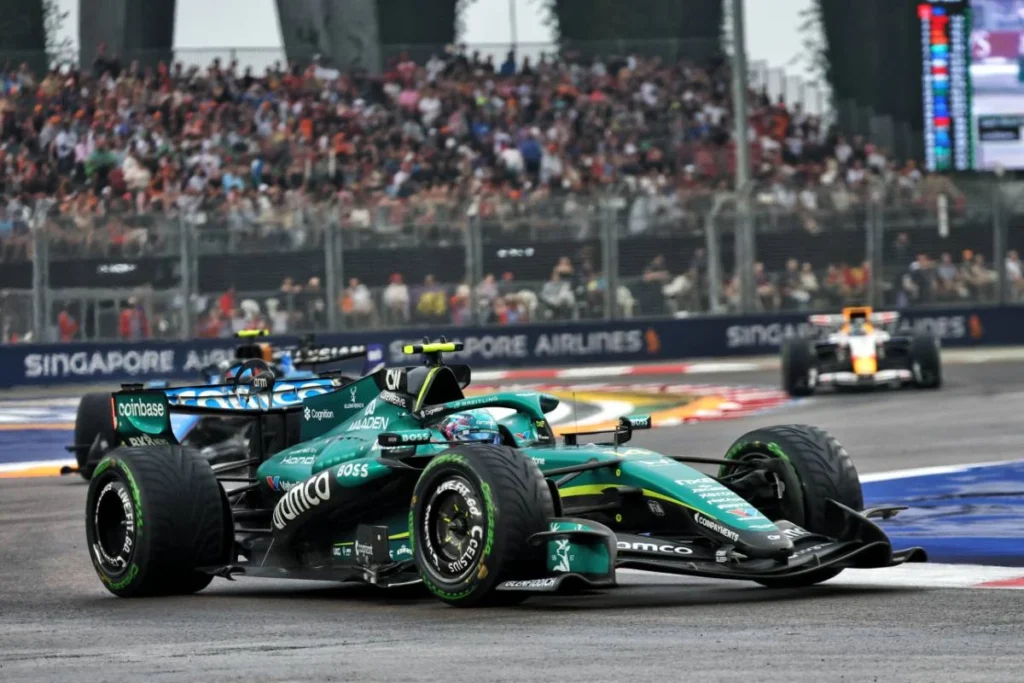
The Formula 1 paddock is a place where history often repeats itself, but rarely with such poetic, albeit painful, irony. For Fernando Alonso, the 2024 Singapore Grand Prix was not merely a race to forget—it was a visceral flashback to the darkest chapters of his career. As the double world champion languished in 16th place, finishing a lap down at the Marina Bay Street Circuit, the frustration echoing over his team radio served as a stark reminder that the marriage between Aston Martin and Honda is facing a turbulent, high-stakes honeymoon period.
The Chronology of a Sporting Disaster
The weekend in Singapore was intended to be a reset for the Silverstone-based outfit. After a promising eighth-place finish in Malaysia, the team arrived in Singapore hoping that the technical, twisty nature of the Marina Bay circuit—where raw horsepower is often secondary to chassis balance and mechanical grip—would mask the underlying deficiencies of their current package.
However, the reality proved far more harrowing. From the moment the cars hit the track, it was clear that the AMR-series challengers were struggling. Technical gremlins, particularly regarding the suspension geometry and the complex hybrid powertrain, forced both Fernando Alonso and his teammate Lance Stroll to start the Grand Prix from the pit lane.
The race itself was a microcosm of the team’s current despair. While Stroll eventually retired the car, citing compounding mechanical failures, Alonso soldiered on to a demoralizing 16th position. The optics were damaging: at one point, the two-time world champion was seen struggling to defend his position against a Cadillac—a vehicle not even participating in the FIA Formula 1 World Championship—before being effortlessly dispatched by a Red Bull. It was a moment of profound humiliation for a driver of Alonso’s caliber, leading to a radio outburst that caught the ears of those monitoring the team’s private frequencies: "The energy is not deploying… this engine is just so ridiculous."
Technical Analysis: When the Hybrid Heart Fails
At the core of the team’s struggles is an increasingly unstable relationship with the Honda power unit. While Honda’s return to the top tier of motorsport has been largely successful with other partners, the integration with Aston Martin appears plagued by software and hardware synchronization issues.
Alonso, never one to mince words when performance is on the line, provided a forensic breakdown of the failures. The primary grievance concerns the deployment of electrical energy (ERS). According to the Spaniard, the car’s electronic brain seemed to lose track of its position on the circuit during a Virtual Safety Car (VSC) period.
"There were significant issues with energy deployment," Alonso explained in the aftermath. "Specifically after the Virtual Safety Car, the system seemed to lose its orientation. It was deploying energy in sectors where I didn’t need it and failing to provide that crucial boost on the straights. It’s as if the car didn’t know where I was on the track."
Furthermore, the mechanical lag of the turbocharger has become a point of critical contention. In the tight, stop-and-start nature of Singapore, the delay between the driver’s throttle input and the engine’s response was, by all accounts, unacceptable. Alonso noted that the team had discovered these issues "at our own expense" over the course of the weekend.
When asked if the team could blame fatigue or hardware age, Alonso was dismissive. He confirmed that a turbocharger failure on Saturday had forced an emergency replacement, meaning the unit in his car for the race was brand new. "There are no excuses on that side," he stated firmly. "We have to fix these driveability issues and the turbo response time. We are losing far too much time."
A Haunting Echo: The "GP2 Engine" Legacy
For long-time observers of the sport, the scene was chillingly familiar. In 2015, during the nascent stages of the McLaren-Honda partnership, a beleaguered Alonso famously branded his engine a "GP2 engine" over the radio at Suzuka. The resulting scandal and public relations fallout defined an entire era for the driver and the manufacturer.
Now, years later, the irony is palpable. Honda, having found redemption with Red Bull, is now the primary partner for Aston Martin. Yet, the same feelings of helplessness and technological inferiority have resurfaced. For Alonso, who is now 45, the patience he once possessed in abundance has worn thin. He is not in Formula 1 to build a project for the next decade; he is here to win now. The sight of him wrestling with a car that lacks both power and reliable energy management is a stark warning to the team management.
The Internal Fallout: Lawrence Stroll’s Intervention
The repercussions of this weekend are already beginning to ripple through the upper echelons of the Aston Martin hierarchy. Lawrence Stroll, the team’s billionaire owner, is not known for his tolerance of underperformance. The sight of his cars trailing behind the midfield pack—and even struggling against non-F1 machinery—has reportedly pushed him to the limit.
Sources within the paddock suggest that Stroll is actively planning a trip to Tokyo to confront Honda’s senior management. The message is expected to be blunt: the current level of technical support and reliability is untenable. For a team that has invested hundreds of millions into a state-of-the-art factory at Silverstone, the "Honda problem" is the final barrier to entering the championship conversation.
Stroll’s potential intervention is significant. It signals a shift from a "wait-and-see" approach to a more aggressive, hands-on management style. If the engine issues are not resolved by the time the circus hits the high-altitude challenges of Mexico or the high-speed streets of Las Vegas, the pressure on the Japanese manufacturer will be unprecedented.
Strategic Implications and Future Outlook
The technical failures in Singapore have wider implications for the remainder of the 2024 season. With the championship entering its final, grueling stretch, there is little time for the intensive R&D required to rewrite the engine’s energy deployment maps.
If the current problems persist, Aston Martin risks being overtaken by competitors like Haas or Williams, who have found significant gains in recent races. The loss of points in Singapore is not just a statistical setback; it is a morale blow for the entire engineering department.
For Alonso, the path forward is clear: the team must prioritize the fundamental integration of the power unit over any aerodynamic upgrades. "We have several difficult races coming up," Alonso warned. "If we do not understand why the engine is behaving this way, we are going to face a very long and very painful end to the year."
Conclusion: A Turning Point for the Silverstone Team
The Singapore Grand Prix will likely be remembered as the moment the veneer of optimism at Aston Martin cracked. While the team remains committed to the Honda partnership, the reality of the 2024 season has proven that hardware alone is not enough to secure success. It requires a seamless, sophisticated marriage of software, mechanical engineering, and driver confidence—all of which were missing in Singapore.
As the team prepares for the next leg of the season, all eyes will be on the boardroom. Will a trip to Tokyo by Lawrence Stroll be enough to force a breakthrough, or are we witnessing the beginning of a long, acrimonious divorce? For Fernando Alonso, the veteran who has seen it all, the answer is simple: he wants a car that functions. Until then, the ghost of the "GP2 engine" will continue to haunt the halls of Silverstone, serving as a reminder that in Formula 1, there is no substitute for power and reliability.
