

By The Editorial Staff | June 30, 2026
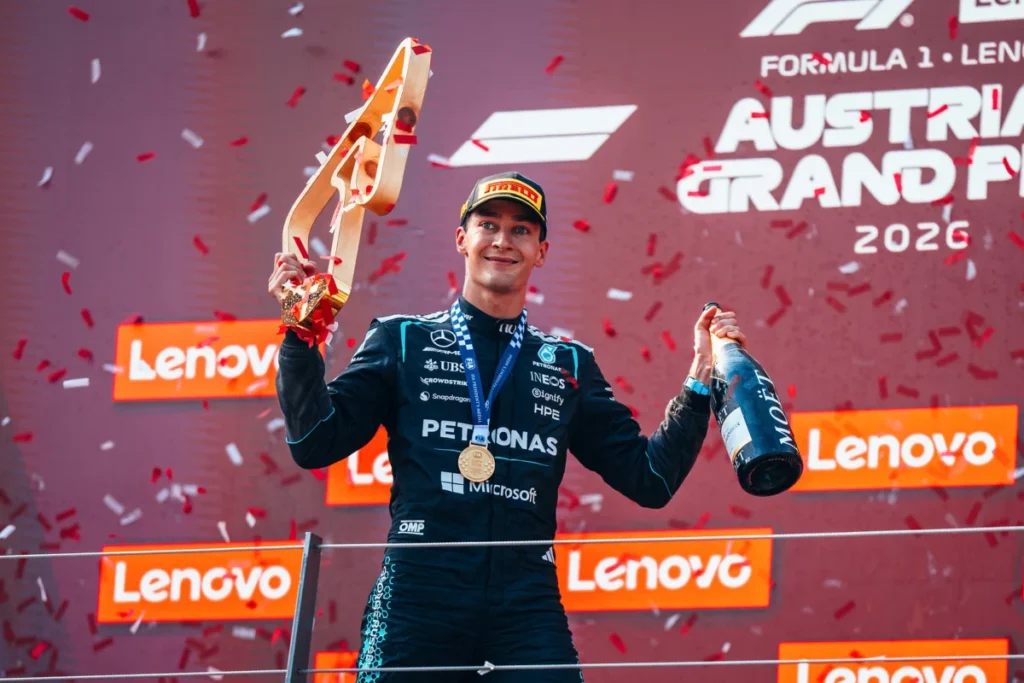
The 2026 Formula 1 season has long been framed as a coronation for the sport’s newest sensation, Kimi Antonelli. However, the Red Bull Ring provided a stark reminder this Sunday that the championship hierarchy remains a contested battleground. In a race defined by blistering heat, high-stakes tactical gambles, and a late-race surge from Max Verstappen, George Russell delivered a performance of immense composure to secure his seventh career victory and reassert his status as a legitimate title contender.
A Tactical Chess Match in the Styrian Mountains
From the moment the lights went out, the 2026 Austrian Grand Prix became a race of attrition and management. George Russell, starting from pole position, executed a flawless launch to maintain his lead, immediately setting a blistering pace that allowed him to pull a five-second cushion over the field within the first 15 laps.
Yet, the circuit—known for its unforgiving kerbs and reliance on thermal management—began to dictate the rhythm. As track temperatures climbed, the radio chatter turned from tactical planning to urgent pleas for tire preservation. Russell’s own voice crackled over the airwaves: "I think it’s just surface overheating," a remark that underscored the fine line between maintaining a winning pace and pushing the Pirelli compounds beyond their structural integrity.
The race was punctuated by several interruptions, including a Virtual Safety Car (VSC) triggered by a heartbreaking mechanical failure for Carlos Sainz, whose Williams ground to a halt on the main straight. These moments of caution proved decisive. While the field shuffled through varying strategies—some opting for a bold two-stop approach, others clinging to a singular, agonizing stint—the timing of the VSC proved a double-edged sword. Championship leader Kimi Antonelli, in particular, was caught on the wrong side of the window, pitting just moments before the neutralization, which effectively stripped him of a "free" pit stop opportunity that might have allowed him to challenge for the win.
Chronology of a Tense Sunday
The early stages of the race were chaotic. While Russell controlled the front, his teammate Kimi Antonelli struggled with the physical demands of the Red Bull Ring. The Italian prodigy was noted by race control for several track-limit infringements as he battled an inconsistent car balance. Though no penalties were ultimately applied, it signaled a rare moment of vulnerability for the championship leader.
The middle phase of the race belonged to the midfield movers and the aggressive recovery of Max Verstappen. Having started fifth following a bruising qualifying session, the Dutchman clawed his way through the pack, engaging in a fierce, wheel-to-wheel duel with Lewis Hamilton. The former titans of the sport traded lines through the tight Turn 3 and the high-speed sweepers of the middle sector, with Verstappen eventually forcing his way past the Ferrari to begin his hunt for the leaders.
By the 50-lap mark, the tension was palpable. Verstappen had whittled Russell’s lead down to less than two seconds, while a charging Antonelli began to recover from his earlier frustrations, putting immense pressure on the Red Bull. As the final ten laps approached, the gap between the top three—Russell, Verstappen, and Antonelli—hovered at a razor-thin margin.
In the final three laps, the intensity reached a fever pitch. Verstappen, pushing his Red Bull to the absolute limit, found the final 0.5 seconds of pace required to enter the DRS detection zone of the Mercedes. As they crossed the line for the penultimate time, the gap was a mere 0.375 seconds. Russell, however, held his nerve, managing his deployment and positioning perfectly to negate the Red Bull’s power advantage, ultimately crossing the line 1.611 seconds ahead to secure a hard-fought victory.

Supporting Data: The Cost of Performance
The 2026 Austrian Grand Prix served as a brutal reminder of the reliability challenges inherent in the current technical regulations. The casualty list was extensive and expensive:
- Cadillac’s Nightmare: Valtteri Bottas and Sergio Perez were the first to retire, both sidelined by catastrophic brake overheating—a direct result of the high-energy braking zones at the Red Bull Ring.
- Williams and Aston Martin Woes: Carlos Sainz’s retirement served as the catalyst for the race’s primary tactical disruption. Later, Lance Stroll was forced to retire his Aston Martin due to an ERS (Energy Recovery System) malfunction, capping a miserable day for the Silverstone-based team.
- Ferrari’s Fading Hopes: Despite high expectations, the Scuderia struggled significantly with tire degradation. Charles Leclerc, visibly frustrated, was heard venting on the radio, "These tires are ****," as he plummeted to eighth place. Lewis Hamilton managed a more respectable fifth, but the lack of race-winning pace will be a point of concern for Maranello.
Final Classification (Top 10):
- George Russell (Mercedes) – 1:26:37.979
- Max Verstappen (Red Bull) +1.611s
- Kimi Antonelli (Mercedes) +1.986s
- Oscar Piastri (McLaren) +21.809s
- Lewis Hamilton (Ferrari) +26.393s
- Isack Hadjar (Red Bull) +29.399s
- Lando Norris (McLaren) +31.505s
- Charles Leclerc (Ferrari) +45.659s
- Liam Lawson (Racing Bulls) +1 lap
- Arvid Lindblad (Racing Bulls) +1 lap
Official Responses and Post-Race Sentiment
In the cool-down room, the contrast in body language was telling. A relieved George Russell took a long moment to collect his thoughts, fully aware of the bullet he had dodged in the final laps. "That was one of the toughest races I’ve had to manage," Russell stated in the post-race press conference. "When you see Max closing in that quickly, you start to doubt the tire life, but the team gave me the exact data I needed to keep the car on the edge without falling over it."
Max Verstappen, while clearly disappointed to miss out on the top step, was pragmatic about the result. "We recovered well from the accident in qualifying," he noted. "We had the pace at the end, but getting past George is never easy. We lacked just a bit of energy recovery in the final sector to make the move stick."
Kimi Antonelli, despite his frustration with the timing of the VSC, remained focused on the long-term goal. "The car felt like a handful today, and I struggled with the brake balance for most of the second stint," the young leader admitted. "Still, third place is vital points for the championship. We learn, we analyze, and we move to the next one."
Implications for the 2026 Title Fight
The victory in Spielberg has significant ramifications for the Drivers’ Championship. George Russell has vaulted into second place, narrowing the gap to his teammate, Antonelli, who still leads by a comfortable, yet shrinking, 40-point margin.
More importantly, the result proves that Mercedes has two viable weapons in their arsenal. The psychological pressure of having two drivers capable of winning races will complicate strategic decisions for the Silver Arrows in the coming rounds. For Red Bull, Verstappen remains the sole beacon of consistency, as the team struggles to find a reliable second driver capable of supporting the Dutchman’s charge.
As the circus heads to the next round, the narrative has shifted. The "Antonelli Era" is not a foregone conclusion. George Russell has reminded the paddock that experience, combined with a cool head under immense pressure, remains the most potent tool in Formula 1. With the championship gap closing, the mid-season push promises to be the most intense period of the year. The Austrian Grand Prix was not just a race; it was a warning shot that the fight for the 2026 crown is only just beginning.
