By Hugues Chaussin (Adapted for international publication)
Main Facts
In the annals of automotive history, few vehicles bridge the gap between human-powered whimsy and motorized pragmatism quite as charmingly as the Bellier Véloto. Propelled jointly by the sweat of the rider’s brow and the unmistakable hum of a legendary two-stroke French moped engine—famously known as the Mobylette "bleue"—this quirky plastic quadricycle served as an eccentric precursor to the modern voiture sans permis (license-free car) boom of the 1980s.
Conceived in the mid-1970s by industrialist Jean Bellier in Les Sables-d’Olonne, France, the Véloto was an exercise in extreme minimalist transport. It was slow, dangerously exposed to the elements, and deeply unconventional. Yet, it captured a distinct cultural moment when shifting economic realities, urban congestion, and regulatory loopholes created a sudden appetite for alternative personal mobility. Today, looking back at the Véloto offers a tender, nostalgic lens into an era when getting from point A to point B without a driver’s license meant trusting your life to a fiberglass shell, bicycle pedals, and a 49.99cc Motobécane motor.
Chronology: From Playground Toys to Road-Legal Microcars
To understand the genesis of the Véloto, one must trace Jean Bellier’s unlikely trajectory through the French manufacturing landscape.
1968–1972: The Genesis in Mini-Buggies
At the dawn of the 1970s, the French automotive market saw a proliferation of boutique manufacturers specializing in lightweight "voiturettes." While earlier iterations—such as Poirier vehicles—were historically designed to assist war veterans and individuals with physical disabilities, this new wave of microcars targeted a broader demographic: those lacking the age, means, or legal privilege to hold a standard driver’s license.

Jean Bellier, initially an entrepreneur specializing in the manufacture of electrical accumulators based on Rue de la Petite-Garlière in Les Sables-d’Olonne, decided to diversify his business in 1968. Eschewing full-sized automobiles entirely, Bellier entered the market by producing miniature buggies for children. Originally commissioned for road safety educational operations (Prévention Routière), these pint-sized vehicles featured a rudimentary steel-tube chassis mated to a molded polyester body that integrated the driver’s seat. A refined version of these children’s buggies made a splash at the 1972 Toy Fair, proving that Bellier had a knack for compact, lightweight design.
1974: The Human-Powered Quadricycle
Not one to rest on his laurels, Bellier looked to the parents of his young clientele for his next venture. In 1974, he introduced a larger, side-by-side human-powered quadricycle. Essentially a commercialized rosalie powered by dual pedal systems—similar to the leisure quadricycles still found today in public parks like Lyon’s Parc de la Tête d’Or—it was marketed heavily as a "sporty apparatus recommended by the medical profession." While this unvarnished pedal-car lacked a weather-proof body, it laid the direct technical and conceptual groundwork for the breakthrough vehicle that would follow two years later.
1976: The Birth of the Véloto
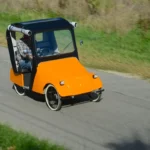
The turning point arrived in 1976 with the debut of the Bellier Véloto. Unveiled at the 63rd Paris Motor Show in the autumn of that year, the Véloto was heralded as the least expensive vehicle on display.
In a market where competing microcars commanded steep prices—such as the rudimentary KVS (derived from New-Map) selling for just under 10,000 francs, and the Motobécane-powered Mini-Comtesse priced at 7,560 francs—the Véloto initially shocked showgoers with an eye-popping introductory price tag of just 5,950 francs. Unsurprisingly, this promotional price proved unsustainable; market demand and rising production costs quickly pushed the price to 6,470 francs, and shortly thereafter to 6,850 francs.
Supporting Data and Technical Specifications
Classified administratively not as an automobile, but as a "quadricycle with an auxiliary motor," the Véloto ingeniously navigated French traffic laws to fit the legal definition of a moped (cyclomoteur). This classification was its ultimate superpower: it allowed young drivers and license-less adults to operate it legally on public roads without formal testing.

The Powerplant: From Vélosolex to Mobylette
The development of the Véloto’s propulsion system was not without hurdles. The very first prototypes were fitted with Vélosolex engines, but these failed to secure road homologation. It took several weeks of engineering adaptation before Bellier successfully integrated a single-cylinder engine borrowed directly from the iconic Motobécane 50V—better known as the Mobylette bleue.
- Engine Type: Two-stroke, air-cooled single-cylinder.
- Displacement: 49.993 cc.
- Variants: Initially the AV 7, followed quickly by the AV 10 from the Motobécane 50V.
- Transmission: Combined with a Mobymatic automatic variator system.
- Chassis: Mechanically welded square steel tubing, with all auxiliary running gear sourced directly from Motobécane moped parts bin.
Bodywork and Interior Appointments
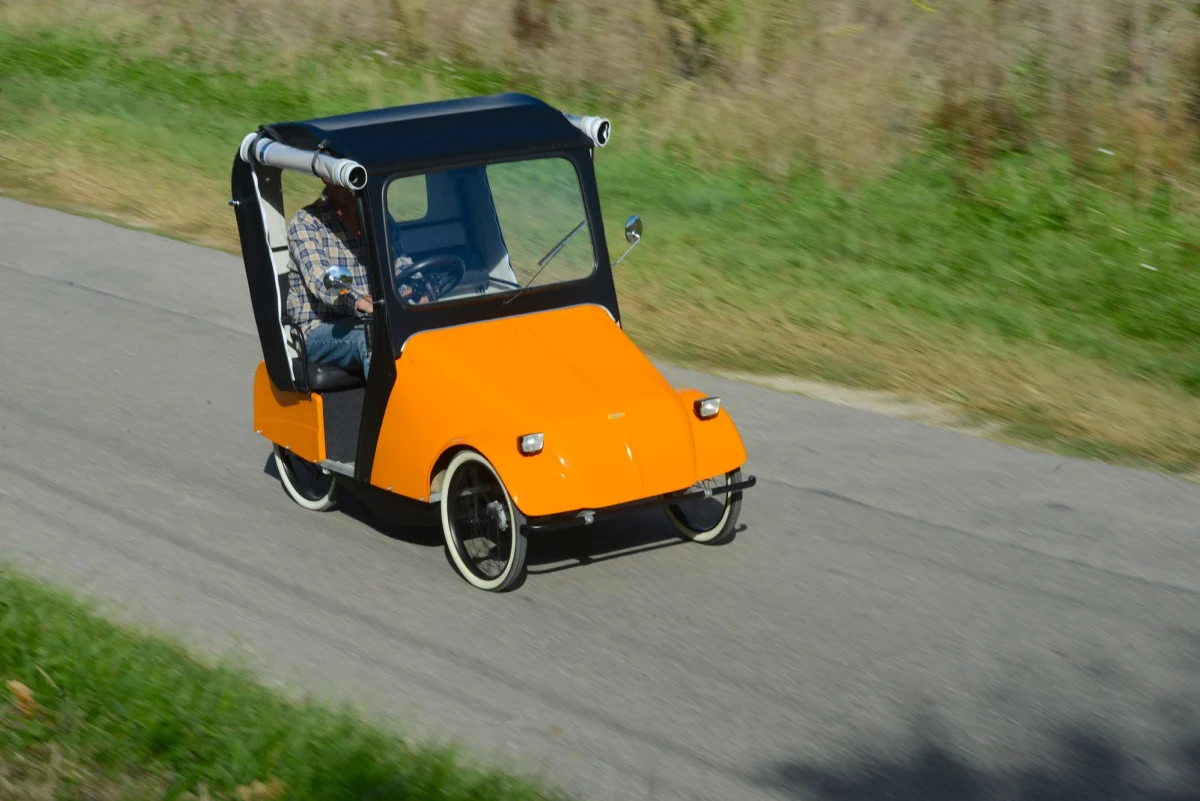
Unlike its pedal-powered predecessor, the Véloto featured a full resin body made of layered polyester, mass-pigmented and available in four distinct factory colors. The body comprised three primary sections:
- A rear engine cover.
- A forward nose cowling.
- A lower "tub" (bassine) serving as a floor pan beneath the occupants’ feet.
Accommodation was snug, designed for one adult and potentially a child under the age of fourteen. Passengers sat behind a tall windshield secured within a delicate, satin-black-painted sheet metal frame.
Weather protection was decidedly rudimentary: a black faux-leather top covered the rear and roof sections, flanked by flexible side doors secured with twin zipper closures. When the weather cleared, these fabric doors could be rolled upward and strapped into place. Rear visibility was managed via a mica rear window paired with a small interior rearview mirror, supplemented by a single exterior mirror mounted on the driver’s side.
Inside, the amenities reflected its utilitarian roots. The tubular bench seat resembled outdoor park furniture far more than automotive upholstery. However, a singular touch of sporting luxury disrupted the cabin’s austere ambiance: a thick-rimmed, small-diameter leather-wrapped steering wheel lifted straight from a sports accessory catalog for mainstream touring cars.

Official Responses and Regulatory Context
The introduction of the Véloto sparked varied reactions across French society, dividing traffic regulators, medical professionals, and traditional motorists.
Regulatory Approval and Bureaucracy
The French Ministry of Transport and the Service des Mines (the government vehicle inspection and approval body) scrutinized the Véloto closely. Because its displacement sat strictly under 50cc and its maximum design speed hovered within legal moped thresholds, it slipped through a regulatory loophole. Officials conceded that as long as the vehicle retained its auxiliary pedal capability and moped-derived powerplant, it could not be subjected to the rigorous crash-testing and homologation standards reserved for full automobiles.
However, this lack of formal automotive oversight drew quiet concern from traffic safety advocates. The absence of mandatory steel crash structures, seatbelts, or shatterproof glass meant that Véloto occupants were exceptionally vulnerable in urban collisions.
Public and Commercial Reception
Consumer response at the 1976 Paris Motor Show was sharply polarized. Traditional motorists scoffed at the vehicle’s lawnmower-like soundtrack and fragile plastic construction, frequently comparing it to the cyclecars (Vélocars) of the 1940s austerity era.
Conversely, urban commuters, teenagers on the cusp of adulthood, and elderly citizens who had never obtained a driver’s license embraced the Véloto as a liberating, highly economical alternative to walking or relying on sporadic public transit. Jean Bellier’s marketing apparatus capitalized on this by pitching the vehicle not as a compromise, but as a clever, health-conscious, and ultra-affordable mode of modern transit.

Implications for Modern Mobility and Microcar History
The legacy of the Bellier Véloto extends far beyond its modest sales figures or its quirky aesthetic. It proved that a market existed for ultra-lightweight, fossil-fuel-sipping quadricycles designed specifically for congested cities and rural mobility gaps.
The Evolution of License-Free Motoring
The commercial path blazed by the Véloto directly inspired the 1980s explosion of dedicated voitures sans permis companies in France—including Aixam, Ligier, and Bellier’s own subsequent, more sophisticated microcar models. Over the decades, these vehicles evolved from glorified moped-boxes into fully enclosed, fiberglass- and plastic-bodied quadricycles equipped with small diesel or electric motors, rudimentary heating systems, and modern interior comforts.
Echoes in Contemporary Urban Planning
Today, as major European cities grapple with traffic congestion, low-emission zones, and the urgent need for sustainable urban transport, the core philosophy of the Véloto feels remarkably prescient. The modern quadricycle market—exemplified by vehicles like the Citroën Ami—mirrors Bellier’s founding vision: lightweight, slow-speed, highly efficient personal transport that rejects excess in favor of pragmatic urban agility.
Though we may look back at the orange-and-blue plastic bubble of the Véloto with a mixture of amusement and disbelief, Jean Bellier’s creation remains a fascinating milestone. It stands as a testament to French industrial ingenuity, proving that sometimes, all it takes to move a nation forward is a Mobylette engine, a fiberglass shell, and a heavy dose of optimism.